
Semisonic | Closing Time
Last Call for Meaning
Everyone knows “Closing Time” as the universal bar-closing anthem, but its songwriter hid a second meaning so personal that his own bandmates didn’t know for 15 years.
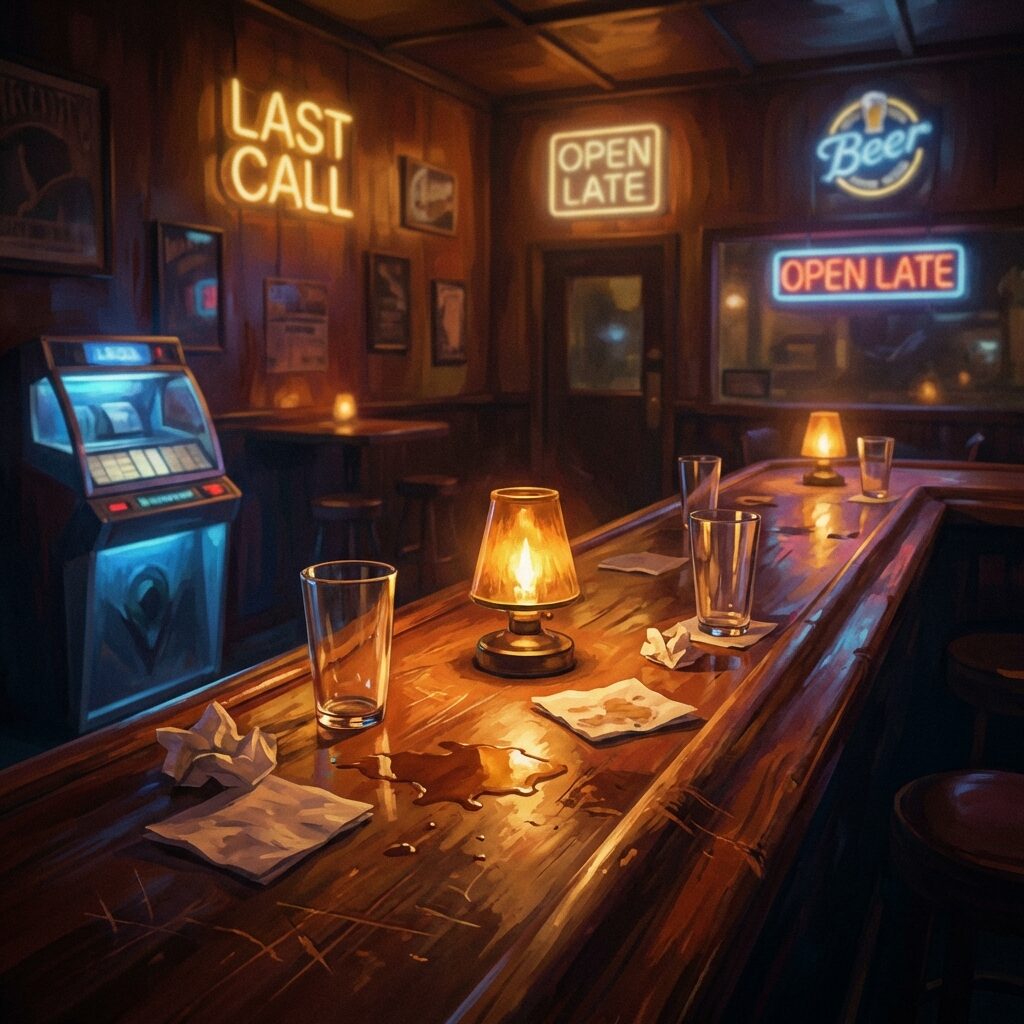
You know the moment. It’s 2 AM. The house lights snap on, ugly and fluorescent, and suddenly everyone in the bar looks ten years older. The bartender’s already wiping down the rail. And from the speakers comes that opening piano riff, those four notes you could recognize from a hundred feet away, muffled through a closed door. Closing time.
For going on thirty years now, “Closing Time” has been the song that ends the night. It plays in college bars in Iowa City and dive bars in Brooklyn. Airport lounges. Wedding receptions that have gone on too long. It’s so tied to last call that bartenders literally use it as a tool, hit play, and people start reaching for their jackets without being told. The song does the bouncer’s job.
But here’s the thing. What if the song isn’t about a bar at all?
What if “closing time” doesn’t mean last call, what if it means the moment a body exits the only room it’s ever known, pushed out, blinking, into the shock of the world?
What if you’ve been singing a lullaby this whole time?
Dan Wilson, the songwriter and frontman of Semisonic, wrote “Closing Time” in about twenty minutes in 1996. He thought the double meaning was obvious, a bar anthem that was secretly about being born. He assumed everyone would get the joke. Nobody did. Not his fans, not his label, not even John Munson and Jacob Slichter, the two guys who played the song with him night after night for years. Wilson kept the secret for a decade and a half before casually dropping it at his Harvard reunion.
And the real meaning runs deeper than a clever pun. Because while Wilson was recording the song, his daughter Coco was fighting for her life in a neonatal intensive care unit, born three months early at just eleven ounces. The song about being born was written and recorded while Wilson was watching his own child struggle to survive the act of arriving in the world.
The world has been getting this song wrong for twenty-seven years. Stubbornly, obliviously wrong. And they’re still at it.
Minneapolis Power Pop Trio
Semisonic grew out of the ashes of Trip Shakespeare into a late-’90s alt-rock scene hungry for hooks. They had the talent and the songs, but they needed one track to break through, and they needed it to close the show.

Before there was Semisonic, there was Trip Shakespeare, an adventurous, slightly weird Minneapolis indie rock band that Dan Wilson and John Munson rode through the late ’80s and early ’90s until it dissolved in 1992. Wilson and Munson regrouped, recruited drummer Jacob Slichter, and initially performed under the name Pleasure before settling on Semisonic in 1995.
The Minneapolis they came out of was a city with serious musical credibility. Prince had already put it on the map. The Replacements and Hüsker Dü had given it punk and post-punk bona fides. Semisonic weren’t trying to be any of those things. They were a power pop trio, tight, melodic, three guys who could actually play, showing up in a late-’90s alt-rock scene that was post-grunge but pre-whatever came next. This was the era of Matchbox Twenty, Third Eye Blind, Fastball, the Goo Goo Dolls. Bands that wrote big hooks and hoped radio would notice.
Their debut album, Great Divide, came out in 1996 on MCA Records. It was fine. It was more than fine, actually, solid record, good songs. But no breakout hit. No song that crossed over from the alternative stations to the mainstream, no track that made casual music fans sit up and say who is this?
And the band had a practical problem. They’d been closing every live show with “If I Run,” a track from Great Divide, and they were sick of it. Munson and Slichter told Wilson what every band eventually tells their songwriter: we need a new closer. Write us something we can end the night with.
Wilson, Harvard-educated, summa cum laude, a guy who could have done any number of things with his life but chose to chase songs, picked up his Guild F-30 acoustic guitar and started writing. He had no idea he was about to write the most misunderstood hit of the decade.
Twenty Minutes and a Double Meaning
Wilson wrote the whole song in twenty minutes as a simple bar anthem, then noticed halfway through that every line doubled as a joke about being born. He assumed the pun was obvious. Nobody got it for fifteen years.

Twenty minutes. That’s all it took.
Wilson sat down with the Guild F-30, the acoustic guitar he used for almost every Semisonic song, and started writing what he thought was a straightforward bar-closing anthem. Bouncers yelling, lights coming on, everybody out. The imagery was literal, obvious, the kind of thing you’d scribble on a cocktail napkin.
Then, halfway through, the other meaning showed up. His wife was pregnant with their first child, and he started noticing that every line he’d already written worked both ways. Closing time, open all the doors and let you out into the world. That’s not just a bouncer clearing the room. That’s a baby being born.
“That’s how the song started,” Wilson told Billboard in 2018, “and then when I was halfway done, I started realizing the whole thing was a pun about being born, so I just made sure that the rest of the thing could ride with that double meaning, but nobody got the joke and I didn’t bother to explain. I thought everyone would get it.”
He thought everyone would get it. Wilson wrote a song with a meaning he considered obvious, and then watched an entire planet miss it for fifteen years. That has to mess with your head a little.
The song almost had a different shape. Hans Haedelt, the band’s A&R representative at MCA, listened to an early version and told Wilson it was “too simple”, that he needed to “break up the rhythm of the verses.” That note led directly to one of the song’s most distinctive moments: “Gather up your jackets, move it to the exits, I hope you have found a friend.” It’s the first time the vocal rhythm breaks from the pattern it’s been running, and it hits like a friend putting a hand on your shoulder. Wilson later called it “a great moment in the song.” He was right. Sometimes the best parts come from someone telling you what’s wrong.
Wilson first played the demo for Munson and Slichter in John Kuker’s basement, part of a monster batch of over sixty new songs the band was considering for their second album. Sixty songs. They’d eventually whittle that down to twelve for the finished record. “Closing Time” survived the cut, obviously, but at that point it was just another contender, a song they could close live shows with that happened to contain a private joke its author figured was transparent.
It wasn’t. Not to his bandmates, not to his label, not to anyone. The joke worked too well in the wrong direction. Wilson had written a song where every line made perfect sense as a bar anthem, and the birth meaning sat right there on the surface, but nobody saw it, because why would you look for a second reading when the first one already feels complete?
Analog Tape and an Untuned Piano
Recorded live on analog tape in a Minneapolis studio next to a bicycle shop, the track’s warm, slightly rickety sound came from vintage gear, an untuned piano dragged in from an antique shop next door, and one of the first Fuzz Factory pedals ever built, handed over at a house party.

The recording sessions for Feeling Strangely Fine ran from April through August of 1997, and they happened in the kind of place where interesting records tend to come from: a not-quite-finished studio owned by a friend who knew what he was doing.
Seedy Underbelly Studio in Minneapolis belonged to John Kuker, who the band described as having “golden ears for what sounded right in a guitar or a compressor or a keyboard.” The studio wasn’t entirely ready when sessions began, so the band initially worked in the adjacent storefront. Additional tracking happened in a nearby shuttered bicycle shop. If you’re picturing a pristine, purpose-built facility with perfect acoustics, adjust your expectations. This was scrappier than that, and honestly the record sounds like it benefited from the roughness.
Nick Launay, the English-born, Sydney-based producer known for his work with Nick Cave and Public Image Ltd, was brought in after MCA rejected the band’s initial demos. Launay came from an engineering background and wanted a live, organic feel. That meant tracking on analog tape, specifically Ampex 499 stock running through a Studer A827 tape machine. No digital audio workstation. No safety net of infinite takes you can comp together on a screen. They recorded full-band takes, including vocals, and edited the strongest sections together.
“We tried to keep everything to 24-track,” Launay said, “so sometimes some tracks had two or three different instruments on them.” When you can’t just add another track, you have to commit. You have to make choices. Limitations like that tend to produce more interesting work than having unlimited options.
The piano on the record, the one you hear on that opening riff, has a story worth telling. Bassist John Munson played an electric grand piano part, but the recording also features an untuned upright grand from the 1900s that was sitting forgotten in an antique shop next door to the studio. They dragged it in and just started playing it. “We didn’t even tune it, great sound, though,” Launay said. “Just the right amount of rickety. It was miked with one Neumann tube 67 through UREI 1176 compressors through the API.” That slightly out-of-tune character is part of why the song feels warm instead of sterile. If they’d tuned it properly, I think it would have lost something.
The textures on the recording go deeper than most people realize. Real strings, four violins, a viola, and a cello, are layered with a string patch from a Kurzweil 2000 synthesizer and untuned Mellotron samples that Launay had recorded in Australia from Midnight Oil guitarist Jim Moginie’s real Mellotron. Real, fake, and somewhere in between, all stacked on top of each other. The result sounds lush without sounding expensive, which fits a song that’s pretending to be simpler than it actually is.
And then there’s the guitar solo. That buzzy, aggressive, slightly unhinged sound? That’s a Z.Vex Fuzz Factory pedal, labeled #5, meaning it was roughly the fifth unit ever built. Zach Vex, the pedal maker, was based in Minneapolis and brought it to a party at Dan Wilson’s house. “It was that buzzy sound struck me as so insane,” Wilson said. “I loved it. And that’s the sound of that solo in ‘Closing Time.'” Wilson has used the Fuzz Factory on everything since. A party, a handmade pedal, and a guitarist who heard something unhinged and thought yes, that’s the one. Most good gear stories come down to somebody being in the right room at the right time.
Two more production details worth knowing. First: the entire song was recorded to a click track at roughly 92 BPM, but for the final chorus, the click was deliberately bumped up by 1 BPM. Just one beat per minute faster. You probably can’t consciously detect it, but your body can. It’s why the last chorus feels like it lifts, like the song is pulling you forward rather than winding down. Second: there’s a brief pause before the third chorus, the kind of dramatic breath that mixer Bob Clearmountain was famous for, sometimes called a “Clearmountain Pause.” Wilson had independently conceived of putting a pause at that exact spot before anyone suggested it. His friend Karen Glauber, a music industry veteran, told him to mention it to Clearmountain during mixing. They’d arrived at the same silence separately.
One wrinkle on the mixing credits: Jack Joseph Puig mixed the “Closing Time” single at Ocean Way Recording, while Clearmountain handled the rest of the album at Mix This in Pacific Palisades. So the version of the song you know, the radio version, the bar version, the one lodged in your brain, has Puig’s fingerprints on it, not Clearmountain’s. Bob Ludwig mastered the whole thing at Gateway Mastering.
Four Chords and a Trick
“Closing Time” runs on four dead-simple chords, G, D, Am, C, repeated identically in the verse and chorus. The chorus feels bigger not because the harmony changes, but because the band pushes the dynamics forward and Wilson’s melody climbs. One borrowed B-flat in the bridge is the song’s only harmonic surprise, and it lands because it’s the only one.

The chord progression is almost embarrassingly simple.
“Closing Time” runs on four chords: G – D – Am – C. In music theory terms, that’s I – V – ii – IV in the key of G major. If you’ve ever picked up a guitar and learned four chords, you can play this song start to finish. It’s a variant of the ubiquitous I – V – vi – IV progression, the one behind roughly forty percent of all pop hits, except Wilson swaps the vi chord (Em) for the ii (Am). The Cure’s “Just Like Heaven” does the same thing. So does Smash Mouth’s “All Star.” It’s a common substitution, and it shifts the emotional weight slightly, the Am has a touch more melancholy than the Em, a little more pull toward something unresolved.
But here’s the part that gets me: Wilson uses the same progression for both the verse and the chorus. Same four chords, same order. G – D – Am – C whether he’s singing “closing time” or “I know who I want to take me home.” On paper, that should make the song monotonous. Harmonically, nothing changes. So why does the chorus feel like a completely different song?
Dynamics. That’s it. That’s the whole move.
The verses sit back, relaxed, slightly behind the beat. Wilson’s vocal is conversational, almost lazy. The band leaves space. Then the chorus hits and everyone leans forward. The drums open up, the guitars get thicker, and Wilson’s melody climbs. Listen to the way “I know who I want to take me home” lifts upward, each phrase rising higher than the last. That ascending motion does all the emotional heavy lifting. It turns what could be a song about getting kicked out of a bar into something that feels like hope. You’re not being shown the door. You’re being pulled toward something.
The one harmonic surprise in the entire song is a B-flat that shows up in the bridge. After four minutes of living inside G major, that B-flat is like opening a door you didn’t know existed. It’s a flat-III chord, borrowed from G minor, and it creates a brief flash of tension and darkness before the song settles back into familiar territory. It works precisely because it’s the only time Wilson steps outside the four-chord box. Restraint makes the one deviation land harder.
Something else worth noticing about the arrangement: Semisonic was a trio. Three guys. No rhythm guitarist. When Wilson plays the solo, that buzzy Fuzz Factory line, he has to abandon chord-playing entirely because there’s nobody to hold down the harmony behind him. The bass and drums carry the progression alone while the guitar goes off on its own melodic adventure. It’s a constraint that shapes the whole sound. A four- or five-piece band would fill that gap. With a trio, the solo literally strips the song to its skeleton, and that rawness is part of why it hits.
Bounced from the Womb
A line-by-line walk through the lyrics reveals a birth song hiding inside a bar anthem, but the real weight comes from Wilson’s daughter Coco, born three months early at eleven ounces, and the absurd coincidence that she came home from the hospital the same day the single dropped.

Let’s walk through the lyrics the way Wilson intended them. Not as a bar song, as a birth song.
Closing time, open all the doors and let you out into the world. On the surface: the bouncer’s opening the doors, clearing the bar. But read it as birth: a body being pushed through the doors of the womb into the world. Jacob Slichter nailed it: “Being sent forth from the womb as if by a bouncer clearing out a bar.”
This room won’t be open ’til your brothers or your sisters come. The bar’s closing for the night, won’t reopen until the next crowd. Or: the womb is done for now, but it’ll open again when the next sibling arrives. Sit with that line for a second. It’s clever. It’s a little bit funny. And it works in both readings without any strain at all.
Time for you to go out to the places you will be from. This might be the best line in the song. A bar patron heading back to their neighborhood, their life. A newborn going out to the places that will shape who they become, the cities, the houses, the schools that will define them. “Places you will be from” is a strange construction. You don’t usually talk about places in the future tense like that. It implies a whole life ahead, compressed into six words.
I know who I want to take me home. In a bar, it’s the end-of-night hookup anthem, the moment you lock eyes with someone across the room. In the birth reading, it’s a parent. A father saying: I know who I want to carry me out of here. I want to go home with my family. Or it’s the baby, instinctively reaching for the person who’s going to take them home.
And then there’s the line that’s been falsely attributed to Seneca the Younger across thousands of internet posts, graduation speeches, and actual tattoos: Every new beginning comes from some other beginning’s end. It sounds ancient. It sounds like something a Roman philosopher would carve into marble. Wilson confirmed in a Songfacts interview that it’s entirely his: “The phrase does have a kind of timeless, proverbial vibe about it. It does seem to be literally tattooed on people’s arms and reprinted in thousands of places. And it’s been falsely attributed to ancient Roman philosophers, actually.” Latin scholars have checked, there’s no such statement in Seneca’s known works. Dan Wilson from Minneapolis wrote it. In a basement. In twenty minutes.
But all of this, the wordplay, the double meanings, the literary cleverness, lands differently once you know what was happening in Wilson’s life while he recorded the song.
His daughter Coco was born in 1997. Three months premature. Eleven ounces.
Eleven ounces. That’s less than a can of soda.
She spent eleven months in the neonatal intensive care unit. For months, Wilson and his wife didn’t know if she would survive. While the band was at Seedy Underbelly Studio tracking Feeling Strangely Fine, Wilson would leave the studio multiple times a day to visit Coco in the NICU. He’d play a take, drive to the hospital, sit with his daughter, drive back, play another take. The album about feeling strangely fine was being made by a man who was anything but.
“It’s all about being born and coming into the world,” Wilson told Mojo magazine, “seeing the bright lights, cutting the cord, opening up into something deeper and more universal.” He said this while watching his daughter fight to open her eyes under hospital fluorescents. That context changes everything about the quote.
And then the coincidence that sounds like it was written by a screenwriter who’d be told to tone it down. Coco finally left the hospital in February 1998, on the same day “Closing Time” was released as a single. She was transported home by ambulance. During the ride, the ambulance driver glanced up at the rearview mirror, recognized Wilson, and said, “Hey, aren’t you in Semisonic?” He’d just heard the song on the radio.
I know who I want to take me home.
An ambulance driver, singing along to a song about going home, while driving a man and his eleven-ounce daughter home from the hospital for the first time. The metaphor collapsed into reality in the back of that ambulance. The songwriter who’d hidden a birth story inside a bar anthem was living it out, literally, on the ride home.
Coco required round-the-clock medical supervision at home. She survived. She grew up. As of 2022, she’s very hard of hearing and has serious disabilities in processing verbal speech, along with cognitive disabilities. Dan and his wife later adopted a second daughter named Lily.
Wilson kept all of this private for fifteen years. His own bandmates, the two guys who played the song thousands of times, didn’t know. He finally revealed the hidden meaning publicly at his 25th college reunion at Harvard. Fifteen years of singing a lullaby on stages around the world, and nobody on the stage knew it was a lullaby.
The Song That Almost Died
MCA rejected the album, and “Closing Time” would have died in a drawer if a producer hadn’t wandered down the wrong hallway, a young promotions exec hadn’t staked her reputation on it, and the label hadn’t spent three-quarters of a million dollars on payola.
Here’s where the story of “Closing Time” and the story of Coco rhyme in an uncomfortable way. Both nearly didn’t make it.
When Semisonic delivered the finished album to MCA Records, the label rejected it. Couldn’t hear a single. No hit, no release. The record was effectively dead, months of work in a Minneapolis studio, a song Wilson had written about his daughter’s birth, shelved because a roomful of executives couldn’t identify the thing that would make radio programmers pick up the phone.
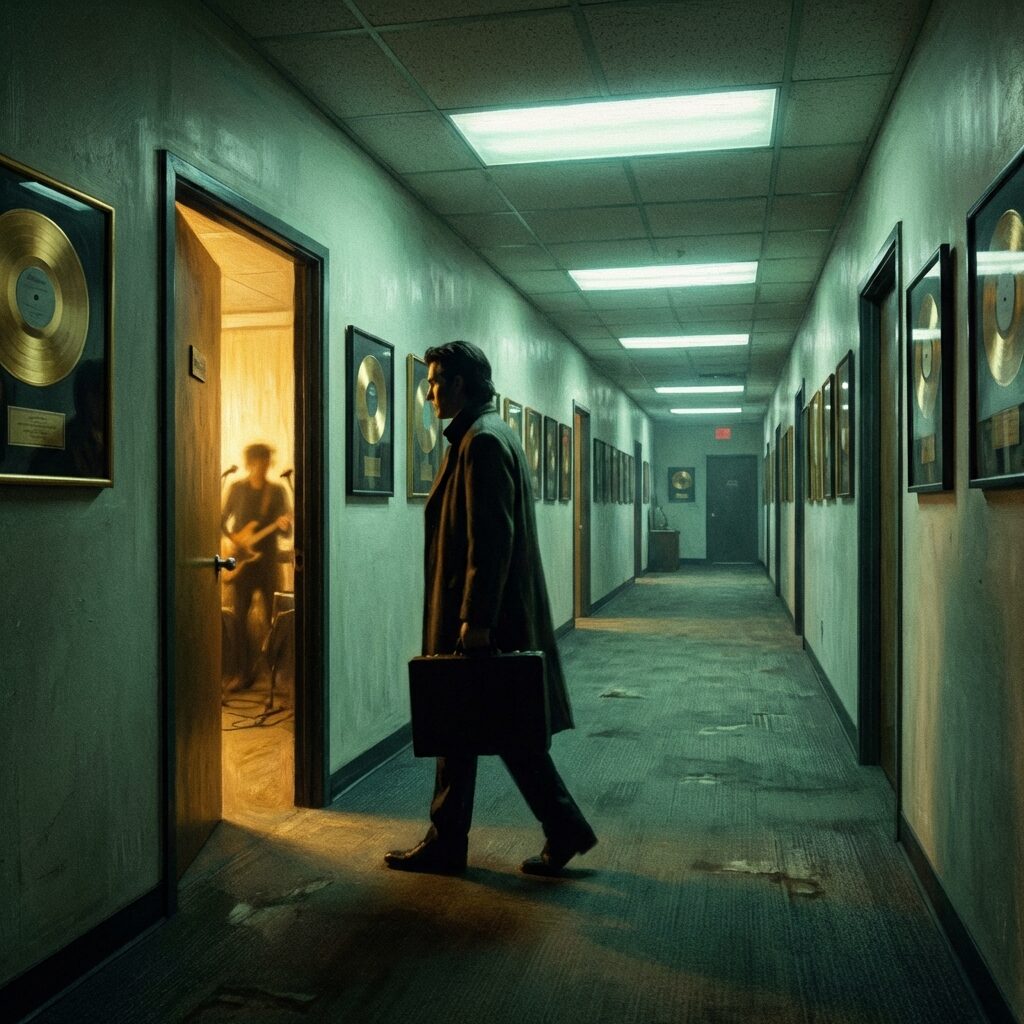
The rescue came from a direction nobody could have scripted. Steve Lillywhite, the producer behind U2’s War, the Pogues, a long list of records you’ve heard, happened to be walking through MCA’s offices for meetings that had nothing to do with Semisonic. He heard “Closing Time” playing from someone’s office. Stopped. Listened. Insisted it was a hit.
That’s it. That’s the whole intervention. A guy walking down a hallway, hearing a song through a wall, and saying that one. Without Lillywhite’s ears and his willingness to stick his neck out for a band he hadn’t worked with, you never hear “Closing Time.” You never sing it at last call. It sits in a drawer at MCA until someone throws the drawer away.
But even Lillywhite’s endorsement wasn’t enough on its own. The song needed an internal champion, someone at the label willing to fight for it through the machinery of radio promotion. That person was Nancy Levin, a new promotions executive at MCA who took one listen and decided this was her hill.
Wilson remembered a conversation with Levin on the eve of the single’s release: “She said, ‘Are you excited?’ and I said, ‘No, why?’ And she goes, ‘Because this song is going to be huge.’ And I said, ‘Well, I don’t know that. How do we know that?’ She was really annoyed with me.”
Levin’s instincts were right. She pushed the song through the system, got it to the right radio programmers, kept it on playlists long enough for audiences to grab hold of it. She was one of those people the music industry actually runs on, someone who hears something and knows, and then does the unglamorous work of making sure everyone else hears it too. Nancy Levin died in a dirt-biking accident in 2010.
And about that “unglamorous work”, let’s be honest about what it actually cost. Jacob Slichter went on ABC News Primetime in 2006 and laid it out with unusual candor: it cost approximately $700,000 to $800,000 to get “Closing Time” on the air and keep it there long enough for the public to latch on. Just to launch a song on alternative radio alone, not pop, not adult contemporary, just the alt-rock stations, cost a minimum of $200,000. Independent promoters served as middlemen between the label and radio stations, charging enormous sums to get songs added to playlists. Payola with a corporate credit card.
Think about that for a second. A song Wilson wrote about his daughter fighting to be born needed a lucky break from a wandering producer, a champion who died at 39, and three-quarters of a million dollars in radio promotion before anyone outside Minneapolis heard it. The songs you know from any given year aren’t the best songs that were written that year. They’re the ones where enough things went right.
No Single, No Problem
MCA never released “Closing Time” as a US commercial single, so if you heard it on the radio and wanted to own it, you had to buy the whole album. The song never charted on the Hot 100, but Feeling Strangely Fine went Platinum.

Here’s a piece of music industry strategy that was either brilliant or cynical. Probably both.
In the United States, “Closing Time” was never released as a commercial single. You couldn’t walk into a record store and buy the single. MCA pressed promotional copies for radio stations, catalog number MCAD-11733, if you’re keeping track, but if you were a regular person who heard the song and wanted to own it, you had exactly one option: buy the album. Feeling Strangely Fine. Twelve bucks at Sam Goody.
It worked. By withholding the commercial single, MCA made the song ineligible for the Billboard Hot 100, which at the time required physical single sales data. So “Closing Time”, one of the most ubiquitous songs of 1998, technically never charted on the Hot 100. But it moved albums. Feeling Strangely Fine was approaching 700,000 copies sold by October 1998 and was certified Platinum by the RIAA on March 24, 1999, exactly one year after the album’s release, for shipping over a million copies in the US alone. Worldwide, it moved over two million.
Where the song did chart was radio. “Closing Time” spent five weeks at number one on Billboard’s Modern Rock Tracks chart, reached number 11 on the Airplay chart, and hit number 13 on Mainstream Rock. On the Real American Top 40, it peaked at number 6 and hung around for 23 weeks from June through November 1998, up slow, down slow. Radio airplay officially began on April 27, 1998, about six weeks after the single went to stations.
The song earned a Grammy nomination for Best Rock Song at the 41st Annual Grammy Awards in 1999. It didn’t win. But for a band most of the industry had written off after a modest debut, the nomination alone said something.
Then came the second life, in 2011, when the song popped up in two high-profile spots almost simultaneously. In Friends with Benefits, Justin Timberlake’s character insists the song is by Third Eye Blind, a joke that lands because both bands live in the same hazy late-’90s corner of people’s memories. In The Office‘s eighth-season episode “Doomsday,” Andy Bernard tries to make “Closing Time” an end-of-workday tradition. Writer Amelie Gillette said she suggested the song because “it feels super, super collegiate to me.” Both appearances pushed “Closing Time” back onto charts in Australia and Ireland, where it actually reached its highest-ever peaks, more than a decade after its original release.
More Than a One-Hit Wonder
From bartenders using it to clear the room to the White House slapping it on a deportation video, “Closing Time” keeps getting repurposed by people who never understood it. Meanwhile, its songwriter quietly built one of the most impressive second acts in modern pop music.
Dan Wilson wanted “Closing Time” to become the song bartenders play at last call. That was the dream. Not a number one hit, not a Grammy, not a platinum album, just a song that lived in bars, coast to coast, as a functional part of the American drinking experience.
“I really thought that that was the greatest destiny for ‘Closing Time,’ that it would be used by all the bartenders, and it was actually,” Wilson told The Hollywood Reporter in 2010. Mission accomplished. The song is a tool. It’s the auditory equivalent of flipping the lights on. Bartenders from Portland, Maine to Portland, Oregon have been using it for twenty-seven years to say get out without having to say get out.
But the song took on a life well past last call. It became shorthand for endings, any ending. Friends used it when Rachel left Central Perk in 2001. The Simpsons dropped it into their ’90s flashback episode. Daria featured it. Weird Al Yankovic polka-fied it for his “Polka Power!” medley on Running with Scissors, which, if you know anything about ’90s music, is when a hit becomes permanent. You haven’t truly made it until Weird Al has played your song on the accordion. Danny McBride sings it after a fight scene in Due Date. It shows up in Cold Case, in Kevin (Probably) Saves the World. Wherever something ends on screen, the song is probably there.
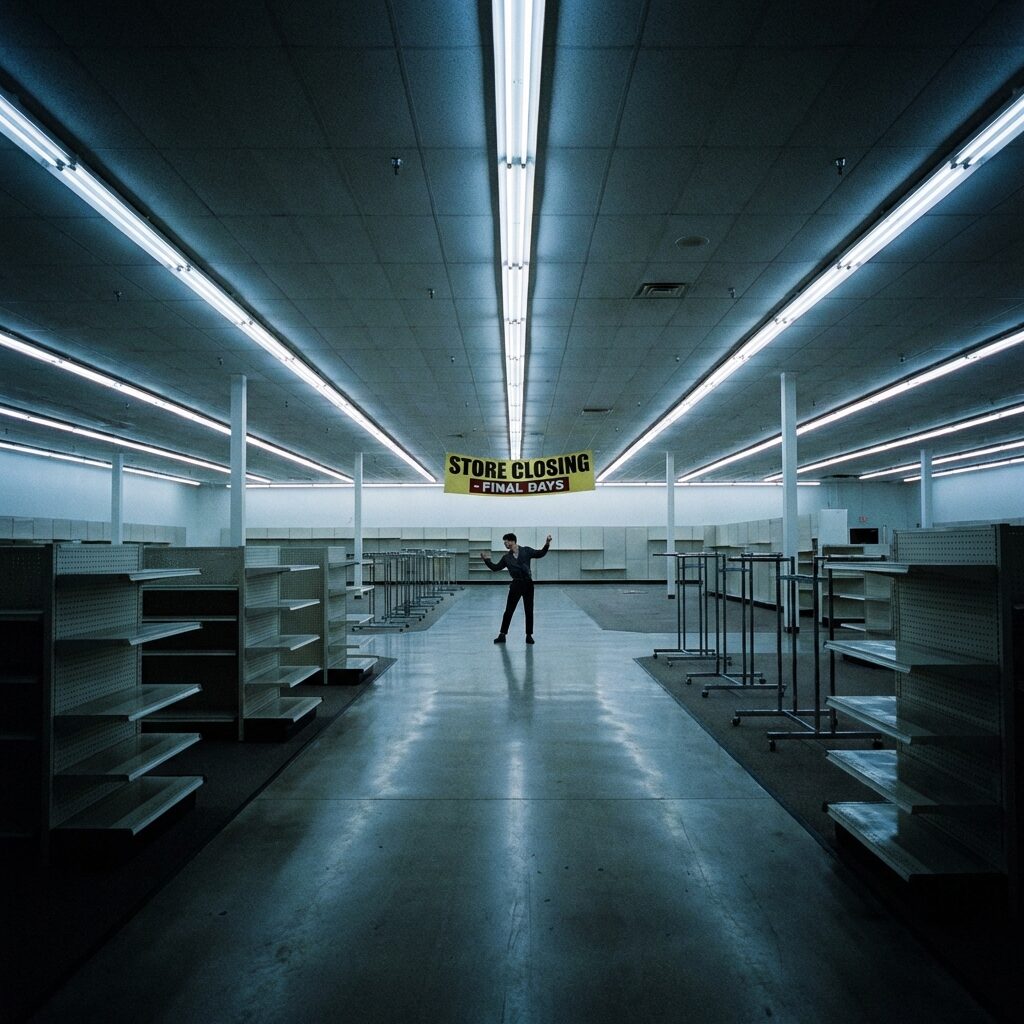
Some of its cultural moments have been genuinely moving. In 2015, five employees of a Canadian Target store that was closing for good made an unrehearsed farewell video. Liam McDonald, a formally trained vocalist, sang lead using a metal clothing-display bar as a makeshift microphone while two coworkers wheeled the three-piece band around the empty store on a flatbed cart. The video went viral. Slichter saw it and was shaken: “Really powerful; that slow walk through the empty store and the sounds of things being loaded in the background. I really hope these guys find jobs.” Five people in red polo shirts, singing a lullaby about birth in an empty box store about death. That’s what the song does. It just takes on whatever you’re feeling when you hear it.
And then there’s the Dallas story. On November 16, 2016, alternative station KDGE in Dallas/Fort Worth played “Closing Time” on a continuous loop. For hours. All day and into the next afternoon, nothing but “Closing Time,” over and over, while a prerecorded message redirected listeners to a sister station. The station was shutting down its alt-rock format. By December, it was playing adult contemporary. A radio station using a closing song to close itself. You can’t script that.
About that “one-hit wonder” label. In America, it’s technically accurate. “Closing Time” was Semisonic’s only stateside hit (in the UK, “Secret Smile” actually charted higher). Wilson has admitted he was defensive about it for a while. But what happened next makes the label feel almost irrelevant.
After Semisonic’s third album, All About Chemistry, underperformed in 2001 and the band was dropped from MCA, Wilson reinvented himself as a songwriter-for-hire. And not just any songwriter. He became one of the most sought-after collaborators in modern popular music. The list of credits is hard to believe: he co-wrote “Not Ready to Make Nice” for The Chicks, which won Song of the Year at the 2007 Grammys. He co-wrote “Someone Like You” for Adele, he’s the sole piano accompanist on that recording, and the album 21 won Album of the Year at the 2012 Grammys. He co-wrote “Treacherous” for Taylor Swift’s Red. He wrote “Home” for Dierks Bentley. His collaborator list reads like a fantasy draft of modern music: John Legend, Josh Groban, Chris Stapleton, Pink, Weezer, Nas, Carole King, Mitski.
The guy who wrote the song people yell along to at 2 AM also wrote the song people cry to alone in their apartments. If “Closing Time” is Wilson’s public face, grinning and fist-pumping at last call, then “Someone Like You” is the private one. Same songwriter. Same ear for a melody that gets stuck somewhere behind your ribs.
And then, in March 2025, the song was misread one more time. This time, it wasn’t beautiful.
On March 17, 2025, the White House posted a video to its official social media accounts showing a man in handcuffs being led by border patrol agents to a deportation flight. “BORDER PATROL” in capital letters. People climbing the stairs to a plane. The soundtrack: “Closing Time.” The implication was unmistakable, closing time, you don’t have to go home but you can’t stay here. A song about birth and hope, turned into a taunt against people being expelled from the country. It came after the deportation of 261 immigrants under the Alien Enemies Act of 1798.
Semisonic’s response was swift and unambiguous: “We did not authorize or condone the White House’s use of our song ‘Closing Time’ in any way. And no, they didn’t ask. The song is about joy and possibilities and hope, and they have missed the point entirely.”
They missed the point entirely. Of course they did. Everyone has been missing the point of “Closing Time” for twenty-seven years. But there’s a difference between a bartender missing the point lovingly, playing a birth song to close a bar, which is poetic in its own accidental way, and a government missing the point cruelly, turning a lullaby into a deportation soundtrack. The song joined a long list of music used by politicians without permission or understanding: Bruce Springsteen, Rihanna, Queen, R.E.M., Neil Young, the Rolling Stones, Céline Dion. The artists always object. The politicians never care. The songs outlast all of them.
Every New Beginning
The world adopted “Closing Time” as a song about endings, but Wilson wrote a song about arriving, and the gap between what he meant and what we hear is what keeps the song alive.

Here’s the thing about “Closing Time” that still gets me, after all these years of knowing the story.
The world adopted it as a closing song. An ending song. The song that plays when the party’s over, when the lights come on, when it’s time to go. We made it the anthem of last call, of goodbye, of you don’t have to go home but you can’t stay here.
But Dan Wilson wrote an opening song. A song about arriving. A song about the first terrifying moment of being alive in a world you didn’t ask to enter. The bouncer in the song isn’t kicking you out, he’s helping you be born.
Picture it one more time. February 1998. An ambulance pulls away from a hospital. In the back, Dan Wilson holds his daughter Coco, eleven ounces at birth, eleven months in the NICU, finally going home. The ambulance driver glances in the rearview mirror. “Hey, aren’t you in Semisonic?” He’s just heard “Closing Time” on the radio. The song about coming home is literally taking its songwriter home. I know who I want to take me home.
The gap between what Wilson meant and what the world heard, that’s what keeps “Closing Time” alive. Bartenders hear an ending. Target employees hear a farewell. A government sees a punchline for deportation. Wilson hears a lullaby. And every single one of them is responding to something real in the music, something that’s actually there. The song is big enough to hold all of it.
That’s how the good ones work, though. You hear “Closing Time” at twenty-one in a bar and it means one thing. You hear it in a delivery room a decade later and it cracks you open differently. The songwriter couldn’t have predicted most of what the song became, and you couldn’t have understood it until you lived long enough to need it.
Every new beginning comes from some other beginning’s end. Not Seneca. Dan Wilson. Minneapolis. Twenty minutes. A Guild F-30 and a joke nobody got.
The lights are coming on. But the song isn’t over, it’s just finding new people to mean something to.
🍼 Did you know “Closing Time” is secretly about childbirth? Dan Wilson’s daughter was born 3 months early and came home by ambulance the same day the single dropped. #Semisonic #90sRock #ClosingTime https://bit.ly/415fJTr

Click to Tweet