Royel Otis | Artist Feature
The Sexy Sword
Royel Otis have a billion streams but are best known for two covers, a paradox that says more about them than any hit single could, and one that keeps getting stranger the closer you look.

Here’s a fun exercise. Name the two biggest Royel Otis moments. Not their best songs, their biggest moments, the ones that broke through the algorithm and landed in the feeds of people who’d never heard the name before.
You thought of “Murder on the Dancefloor” and “Linger,” didn’t you? Neither of which they wrote. One belongs to Sophie Ellis-Bextor, the other to Dolores O’Riordan and the Cranberries. That’s a weird thing to sit with when you’re talking about a band with over one billion global streams, 9.6 million monthly Spotify listeners, four ARIA Awards, a Billboard number one, and a slot at Coachella 2026.
They know it, too. Asked about the covers overshadowing their originals, the duo told BBC News: “We’re just appreciative that so many people who would never have heard our band discovered us with those covers. So it’s a double-edged sword, but it’s a sexy sword.”
A sexy sword. Hold onto that, because it’s the most Royel Otis thing anyone in Royel Otis has ever said, charming, self-aware, deflecting with a wink when a straight answer might actually be more revealing. It also works as a frame for everything that follows.
Because the contradictions go well beyond the covers question. This is a band that debuted at number one on the ARIA Australian Albums Chart, placed seven tracks in Triple J’s Hottest 100 and 200, sold out over a hundred shows in a single year, topped college radio in the States, and got Billboard to declare they’re “on one of those runs where you best get on-board, or move clear out the way.” That’s the shiny side of the sword.
The other side: Anthony Fantano gave their second album a Strong 1 out of 10 and put it on his worst-of-the-year list. Their single “Moody” dropped during a national reckoning with femicide in Australia and was met with accusations of misogyny that a lawyer-drafted non-apology did nothing to defuse. And their guitarist, who performs under an assumed name with neon pink hair covering his face, spent the back half of 2025 in a federal courtroom trying to unmask anonymous Reddit users, only to have a judge issue a ruling so devastating it made headlines in Rolling Stone, Billboard, Stereogum, and NME.
Royel Otis might be the most interesting band in indie right now. Not because they’re the best, but because nothing about them adds up cleanly. The effortless charm turns out to be more calculated than it looks. The beachy vibes keep crashing into things that can’t be vibed away. And then there’s the carefully constructed image, which keeps colliding with a reality that doesn’t care how good your hooks are.
Let’s get into it.
Byron Bay to South London
The Royel Otis origin story shifts depending on who’s telling it, and their guitarist’s hidden musical past raises questions about just how “effortless” their emergence really was.
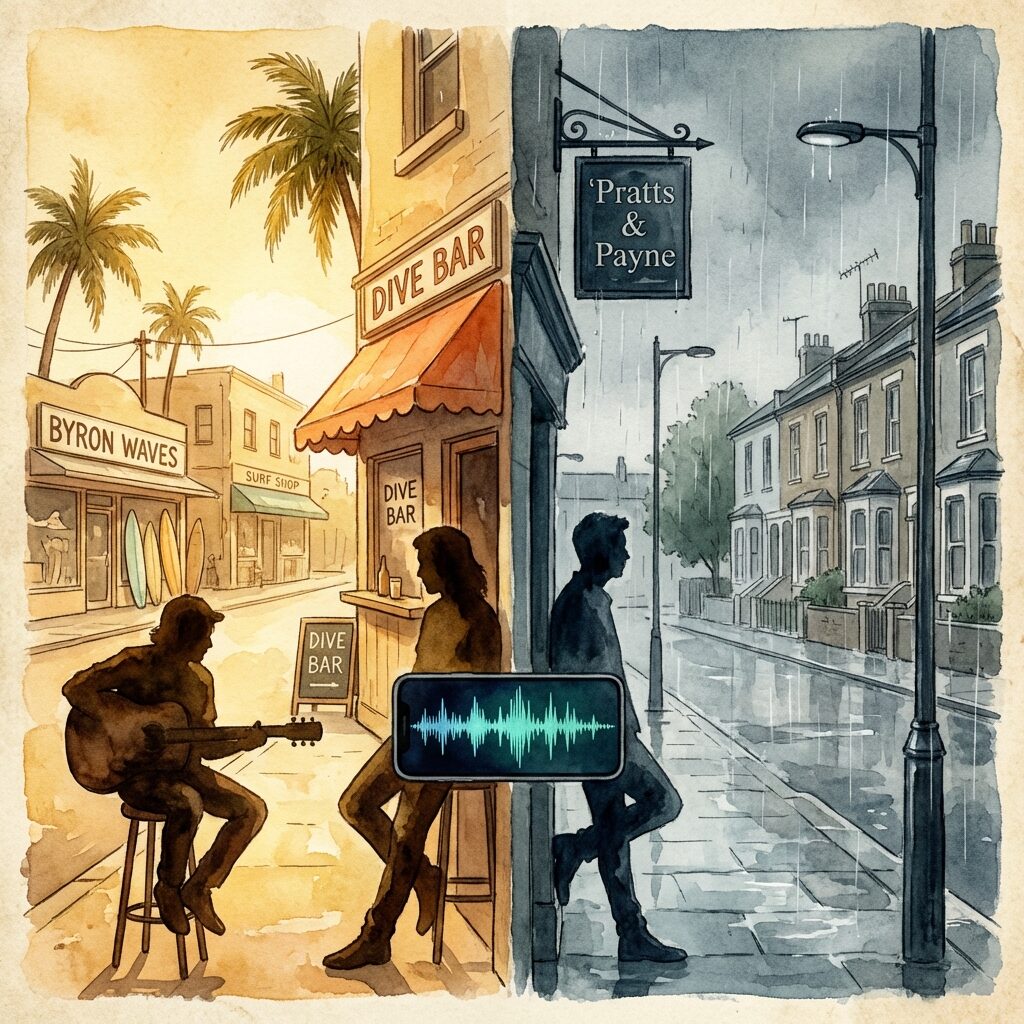
How Royel Maddell and Otis Pavlovic met depends on which interview you read. They were childhood friends. They were casual acquaintances. Pavlovic worked at a bar near Maddell’s house. Their families knew each other, Maddell’s dad was friends with Pavlovic’s uncle. They hung out on the same Byron Bay beaches and stayed in the same holiday homes. The specifics shift like sand, but the broad strokes remain: two guys from the same stretch of Australian coast who orbited each other for years before locking in.
The lock-in moment, at least, is consistent. After roughly the fifth time they’d hung out, Pavlovic, about to leave on a gap-year trip through the UK, Croatia, and France, emailed Maddell some demos. Maddell expected the worst. “I thought it was going to be horrible, because they usually are,” he told interviewers. “But the next morning, I played it while I was in the shower, and I was like, ‘Oh, this is sick.'” He called it “the collaboration he’d been chasing his whole life.”
Which is a revealing phrase from someone who, by that point, had been chasing collaborations for quite a while. Maddell, born Leroy Francis Bressington, 35 years old as of August 2025, had fronted the band Cabins in the mid-2010s, played in bands called Mossy and Sloan Peterson, released a solo EP called S.O.R.E. in 2018 under the name Leroy Francis on Mushroom Records, and spent a couple of years making music in New York’s punk scene before returning to Australia. This is a guy with a real résumé. Yet in a Triple M interview, he said he hadn’t “really” played in other bands before Royel Otis.
It’s a small thing, maybe. Bands mythologize their origins all the time. But the gap between Maddell’s actual history, multiple bands, a label deal, years of grinding, and the narrative of two Byron Bay mates stumbling into something over shower demos is worth noticing, because it tells you something about how deliberately this band’s image has been constructed. The pink hair, the assumed name (Royel is an anagram of Leroy), the face that’s always half-hidden, these aren’t accidents. They’re choices made by someone who’d already been around the block and knew exactly what kind of artist he wanted to be this time around.
Pavlovic, by contrast, was genuinely green. Raised as a musical theatre kid, he’d had “little bands and stuff with friends growing up, but we maybe played one or two gigs at most.” Royel Otis was, in his words, “the first proper music project for me.” He described the early dynamic as something that “started almost as a business partnership and then evolved into a full-blown friendship.”
They bonded over the Alessi Brothers’ “Seabird,” a 1976 yacht rock deep cut that works as a surprisingly good decoder ring for their whole sound, breezy harmonies, warm production, music that sounds like it was recorded with the windows open. They started making lo-fi demos at home with no formal plan for a band. Then COVID hit in 2020 and interrupted whatever momentum they’d built, forcing them into the remote-collaboration mode that launched a thousand bedroom-pop origin stories. The difference is that Royel Otis actually lived it, rather than just claiming it in press materials.
When they emerged on the other side with their debut EP Campus in October 2021, the foundation was already in place: Maddell’s experience disguised as spontaneity, and Pavlovic’s raw charisma filling in the rest. They had a shared instinct for hooks that stick. What nobody saw coming was the speed of everything that followed.
Formulaic on Purpose
Royel Otis make short, catchy, jangly pop songs, and whether that’s a feature or a limitation depends on what you think pop music is supposed to do.
Let’s talk about what Royel Otis actually sounds like, because the genre tags, indie pop, indie rock, new wave, pop rock, post-punk, psychedelic rock, tell you everything and nothing at the same time.
The core of it is jangly guitars. Not distorted, not heavy, not particularly complex. Just bright, reverb-drenched guitar tones sitting somewhere between the Smiths and MGMT. Pavlovic sings over the top in a near-monotone that’s either intimately cool or maddeningly flat, depending on your tolerance for vocal affect. The songs are short. The hooks are immediate. The production is glossy enough to sound good on a phone speaker but textured enough to reward headphones. And there’s a surf-tinged, slightly psychedelic shimmer over everything that makes it all feel like it’s happening at golden hour.
One critic described their output as “short, formulaic songs that prioritize pop accessibility while layering in dissonant noise or rhythmic urgency.” That’s meant as a dig, but it’s also just a pretty accurate description of what good pop music does. Whether there’s enough underneath the accessibility to hold up once the initial hit wears off is a different conversation.
The influence map is more specific than you might expect. The post-punk lineage is obvious (the Cure, Joy Division, the Smiths) but it’s been filtered through a very particular era of blog-friendly indie: MGMT’s Oracular Spectacular, Passion Pit’s manic synths, Phoenix’s immaculate pop architecture. Then there’s a whole other channel running through French disco and funk. Maddell has been open about it: “I love that period of music, Jamiroquai and stuff and like Modjo. All the early 2000s sort of disco. It’s very French-sounding as well.” He wanted “Nack Nostalgia” to “sound like a David Lynch film,” drawing on Angelo Badalamenti’s work for Twin Peaks and Mulholland Drive. That’s a surprisingly ambitious reference point for a band that often gets written off as beachside vibes merchants.
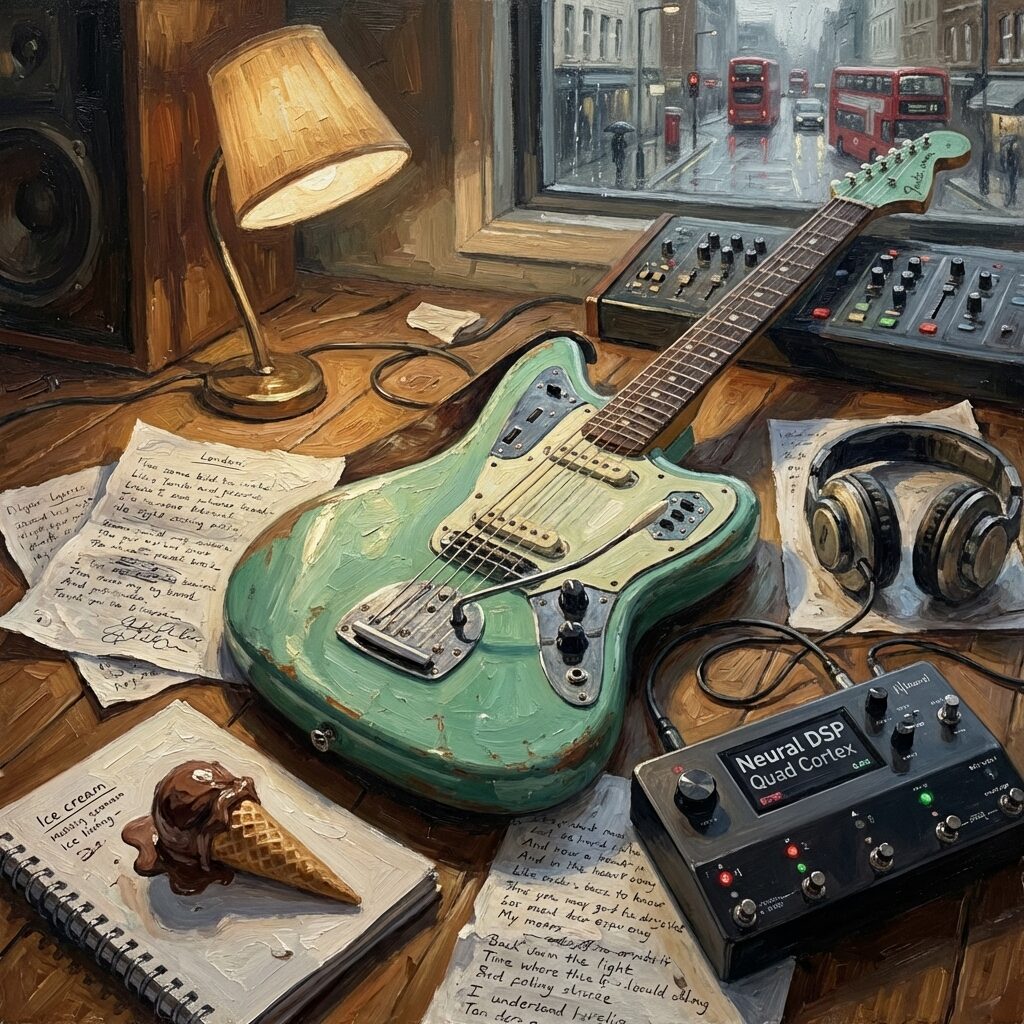
The gear tells a story, too. Maddell’s primary axe is a Fender ’62 Jaguar Reissue, a guitar that practically is jangly indie rock, the instrument of choice for everyone from Johnny Marr to Kevin Shields. He runs it through a Neural DSP Quad Cortex, a digital modeler that lets him access a huge range of tones without a pedalboard the size of a coffee table. His actual pedalboard is minimal: an MXR M133 Micro Amp for boost and a TC Electronic PolyTune 3 for tuning. That’s it. It’s a setup that says: I know exactly the tone I want, and I don’t need much to get there.
Pavlovic’s vocal delivery is the thing that divides people most sharply. It’s a deliberate monotone, not quite deadpan, not quite dreamy, hovering in a register that creates a sense of detachment even when the lyrics are supposedly emotional. Fans hear a stylistic choice that builds intimacy, like someone murmuring a confession. Fantano hears “vapid substancelessness.” I’d put it somewhere in between: effective on the right song, limiting on the wrong one, and increasingly a signature the band seems unable or unwilling to move past.
The songwriting process, or deliberate lack of one, is part of the mythology. “We don’t really have a procedure when it comes to writing songs,” Maddell has said. “Once we get an idea, the best way to get a vibe is to lay down a drumbeat and try the idea over it.” Pavlovic: “Sometimes one of us will have a voice note or demo and we’ll see what we can flesh out, but sometimes Royel or myself will have a full song ready.” There are anecdotes about ice cream runs in the middle of sessions, about lyrics being scribbled on napkins at the pub, about the whole thing operating on a “fuck it” philosophy that puts instinct ahead of craft.
“We’re making sure that we’re not overthinking stuff,” Pavlovic told an interviewer. “Some music can be so serious, or deep and meaningful, but with us, everyone is invited to the party.”
It’s a seductive way to work. It’s also one with a ceiling, and whether Royel Otis have hit it yet is the question their next few years will answer.
Someone Else’s Songs
A perfectly timed cover of “Murder on the Dancefloor” and a TikTok-viral “Linger” made Royel Otis famous, but when your biggest moments belong to other songwriters, that’s an identity problem the band hasn’t figured out yet.

In January 2024, Royel Otis walked into the Triple J studios in Sydney to record a Like a Version cover. They chose Sophie Ellis-Bextor’s “Murder on the Dancefloor”, a 2001 disco-pop banger that had, just weeks earlier, come roaring back into the public consciousness after Saltburn, Emerald Fennell’s film about class, obsession, and Barry Keoghan dancing naked through a mansion. The original was suddenly everywhere again. Everyone already had the song in their head.
Their version stripped the disco production and rebuilt it as shimmering indie guitar pop, Pavlovic’s airy vocal replacing Ellis-Bextor’s commanding belt, Maddell’s Jaguar jangling where synths and strings used to be. It shouldn’t have worked as well as it did. But they dropped it at exactly the right moment, and with covers, that matters as much as the arrangement. The cover hit number one on the Mediabase Alternative Rock Chart, number two on Billboard Alternative Airplay, number five on Billboard Rock & Alternative Airplay, number two on the ARIA Top 20 Australian Singles, and number two in the Triple J Hottest 100 of 2024. It was certified Gold in Australia. Across Triple J’s YouTube, Instagram, and TikTok, it racked up over 19 million views.
Sophie Ellis-Bextor herself gave it her blessing, eventually joining Royel Otis onstage at Reading Festival for a one-off performance. The kind of thing a PR team would kill to stage but could never actually pull off.
Then it happened again.
In April 2024, Royel Otis sat down for a SiriusXM Alt Nation session in New York and played a cover of “Linger” by the Cranberries. It was good, a gentle, slightly hazy take on one of the most beloved songs of the 1990s. But what happened next had nothing to do with them. A TikTok user called therockrevival posted a clip that received 2.8 million likes and 13.8 thousand comments. Another account, sonic.thrills, pulled in 861,000 likes. The thing snowballed.
Fans wouldn’t let up about a studio version. The band eventually caved, posting on TikTok: “We hear ya, here it is. Sorry for lingering too long, we were busy on the road.” The streaming release debuted at number 94 on the Billboard Hot 100, peaked at number 12 on Hot Alternative Songs, and accumulated over 229 million global streams. It got placed in the TV series The Summer I Turned Pretty. And at the 2025 Rolling Stone UK Awards, Royel Otis performed the song alongside Noel Hogan, the original Cranberries guitarist.
The best part of the “Linger” story is that they almost didn’t do it. Maddell: “I remember our drummer at the time was like, ‘You can’t do that. There are just certain songs you don’t touch.'” They tried it anyway. “It took us three attempts to get it right,” Pavlovic said. The drummer was wrong, obviously. But his instinct wasn’t crazy, there really are songs you don’t touch, songs where the original is so definitive that any cover is just karaoke with better gear. Royel Otis found a way to make “Linger” their own by stripping it down to something fragile and slightly yearning, closer to a whispered confession than Dolores O’Riordan’s full-throated ache. It worked because they weren’t trying to outdo the original. They were just offering another door into the same room.
But here’s the thing nobody in the band’s camp wants to talk about honestly: when your covers are outperforming your originals by orders of magnitude, what does that say about who you are as a band? “Murder on the Dancefloor” topped charts that no Royel Otis original had reached at that point. “Linger” hit the Billboard Hot 100 before any of their own songs did. The covers introduced millions of listeners to the band, yes, but they also set a bar that the originals haven’t cleared.
“It’s a double-edged sword, but it’s a sexy sword.” Sure. But a sword still cuts.
One Billion Streams Later
Royel Otis’s numbers are frankly ridiculous for a band with one album to their name, billion-plus streams, sold-out world tours, college radio dominance, and they’ve built a commercial trajectory that has outrun almost everyone’s expectations, including probably their own.

Let’s just run the numbers, because they don’t make sense for a band that put out their debut album in February 2024.
Over one billion total global streams. 9.6 million monthly Spotify listeners at peak. 661,000 Spotify followers. Added to more than eight million Spotify playlists globally. 150 million streams from the UK alone. 59 million YouTube views. Their debut, Pratts & Pain, entered the ARIA Australian Albums Chart at number one and the general ARIA Albums Chart at number ten. Its follow-up, Hickey, debuted at number five. “Moody” parked itself at number one on Billboard’s Adult Alternative Airplay chart for six to seven weeks running, their first Billboard chart-topper and, according to Billboard, the first new act in 2025 to score a Triple A crown.
The touring trajectory is where it gets weird, though. In April 2024, they sold out Amsterdam Bar & Hall in St. Paul, Minnesota, a 250-cap room. Five months later, in September, they’d graduated to First Avenue in Minneapolis, the venue Prince made famous in Purple Rain. Over the course of 2024, they played more than a hundred sold-out shows and moved over 250,000 tickets worldwide, including three nights at London’s Brixton Academy, their 81st gig of the year. Sixty thousand of those tickets were in the US alone. That’s a growth curve that borders on parody.
They placed seven tracks across the Triple J Hottest 100 and 200 in 2024, “Murder on the Dancefloor” at number two, “Heading for the Door” at 39, “Foam” at 44, “If Our Love Is Dead” at 86, with “Til the Morning,” “Clawfoot,” and the “Linger” cover landing in the Hottest 200. That made them one of the most represented artists in the entire poll.
Spotify has been doing a lot of the heavy lifting here. The platform picked them for its RADAR emerging artist program after “Oysters in My Pocket” landed on the Dopamine playlist in March 2022, and from there the flywheel did what flywheels do: more playlist adds fed more streams fed more playlist adds. “Going Kokomo” ended up on the EA Sports FC 24 soundtrack. “Nack Nostalgia” was featured in The Sims 4, and the band re-recorded the song in Simlish, which is either proof they’ve infiltrated every layer of pop culture or proof that nothing means anything anymore.
Maybe the most interesting stat: Royel Otis became the number-one most-played artist on US college radio across music specialty shows. College radio has always been the early warning system for which bands will actually last, R.E.M. broke there, the Pixies found their American audience there, Vampire Weekend went from blog curiosity to arena act there. If you’re dominating college radio, you’re reaching the people who will still be buying tickets in five years.
None of this is in dispute. The numbers are big and they got big fast. What I keep circling back to is whether the music underneath can hold up all that commercial weight, or whether we’re watching something that burns twice as bright and half as long.
Two Albums, Two Identities
Pratts & Pain was the scrappy indie credibility play; Hickey was the pop machinery record, and the gap between NME’s 4/5 and Fantano’s 1/10 maps the fault line over what indie music is allowed to be.

Pratts & Pain and Hickey are practically different bands.
That’s an exaggeration, but not by much. The debut was recorded over three weeks in early 2023 at Dan Carey’s home studio, Mr Dans, in South London. Carey is the English producer behind Fontaines D.C., Black Midi, Wet Leg, and Squid, a résumé that basically is indie credibility. The sessions were loose by design. The band would duck out to Pratts & Payne, the pub down the road that gave the album its name, to have “a pint, a few shots, and get some lyrics down” before heading back to record vocals. They experimented with what Maddell called “crazy, makeshift instruments” and “weird open tunings.” Some tracks, like “Daisy Chain,” were recorded in Byron Bay and then sent to Carey for additional production. Maddell was conscious of how geography bled into the sound: “If you record something in Byron, it sounds beachy. I think because we recorded a lot of stuff in Byron Bay in Australia, you can really hear the sound change in the album, because we recorded it in South London.”
The result sounds like a band finding its footing in real time, pop-leaning indie mixed with hazy psychedelia, with Carey’s production giving it a weight and texture the songs wouldn’t have had as bedroom demos. It debuted at number one on the ARIA Australian Albums Chart. The ARIA Awards gave it Best Rock Album and threw in Best Group, Best Engineered Release, and Best Produced Release for good measure, eight nominations total, four wins, the most-nominated artist of the year. The Grammy organization named Royel Otis among their 25 Artists to Watch in 2024.
“It just felt like we just became a lot looser and more natural and organic with songwriting,” Maddell told 1883 Magazine, “and decided to have fun with it, rather than take it way too seriously, like we sort of were before. We had a lot of pressure on us at that time, so we just thought, fuck it.”
Then came Hickey.
Released August 22, 2025, on Ourness via a new partnership with Capitol Records (signed November 2024), Hickey is something else entirely. The producer credits tell you everything: Julian Bunetta, Omer Fedi, Blake Slatkin, J Lloyd, hit-makers with credits touching everyone from One Direction to Kid Laroi. Co-writing sessions with Amy Allen, who’s written for Sabrina Carpenter, Harry Styles, and Olivia Rodrigo. Collaborations with Joshua Lloyd Watson and Lydia Kitto from Jungle. This isn’t a band recording in a mate’s home studio between pub runs. This is pop machinery.
The album title, they said, was “because love bites harder than any other emotion in the world.” Thirteen tracks, 38 minutes and 25 seconds. The themes are road-weary and relationship-haunted: “Our lives have had to change so much,” Maddell told interviewers. “We’ve had to make decisions to separate parts of our lives from other parts. It’s hard to hold down a relationship when you’re constantly saying goodbye.” The feeling behind the songs is genuine, even when the production around them is shinier than anything they’ve done before.
And the critical response? It split clean down the middle. NME gave it four out of five stars, praising the duo for “proudly leaning into what they do best.” When the Horn Blows called it “their most emotionally charged yet” and “another outstanding body of work.” Clash gave it a 7/10. The Independent landed at 3/5, noting “you can really relish these songs as outpourings of vulnerability, confusion and anger.”
Then there was Fantano.
Anthony Fantano, The Needle Drop, the most influential music critic on YouTube, gave Hickey a Strong 1 out of 10. Not a 4. Not a 3. A one. He called himself “actually deeply shocked at just how vapid, substanceless, toothless, soulless it all is” and put it on his Worst Albums of 2025 list.
The distance between NME’s 4/5 and Fantano’s 1/10 isn’t just a disagreement. It traces the actual fault line in contemporary indie music. NME is judging Royel Otis against their own ambitions and the pleasure their music delivers on its terms. Fantano is judging them against a standard of artistic substance and originality that the band has never claimed to be pursuing. They’re both right, in a way. And neither review fully gets at what Royel Otis actually is.
Consider “Good Times,” which borrows a beat from Hall & Oates’ 1981 hit “I Can’t Go For That.” Is it homage? Pastiche? A band tipping their hat to the pop lineage they’re consciously working within? Or is it exactly the substancelessness Fantano hears, a band that can replicate the feeling of great pop music without generating any of its own? I keep going back and forth on it, and I think that ambiguity is more interesting than a definitive answer in either direction.
The Mask Slips
Between misogyny accusations over “Moody,” a failed federal subpoena, and a judge’s devastating ruling, Royel Otis’s open-arms persona has run headfirst into problems that charm can’t talk its way out of.
On May 9, 2025, Royel Otis released “Moody.” The chorus goes: “She’s always givin’ it to me / Late nights, she always accusin’ / Last time, she said she would kill me / My girl’s a bitch when she’s moody / But she’s my everything.”
In a vacuum, it’s a relationship song with a provocative line. Not exactly new territory in rock music. But songs don’t exist in vacuums, and “Moody” didn’t land in one. It landed in an Australia deep in a grim national conversation about violence against women, with Australian Femicide Watch tracking deaths that were making regular headlines. The press release called it “a song about a girl.” The visualiser referenced Adrian Lyne’s 1997 adaptation of Nabokov’s Lolita. The Spotify artwork did the same.
A former schoolmate of Pavlovic told news.com.au: “In 2025, it’s disheartening to hear a local Australian artist, someone I know or I knew, casually refer to women as ‘bitches’ in their lyrics.” The backlash gathered momentum. And then came the response, not from the band themselves, but from Kay and Hughes Art and Entertainment Lawyers, who issued a statement that led with the song’s commercial success before offering: “This song is written from a specific perspective, it is not intended to convey a broader view or standpoint about women in general. We apologise if anyone understood those lyrics otherwise.”
If you’re keeping score: the band didn’t speak. Their lawyers did. The apology was for the audience’s understanding, not for anything the band had done. A non-apology apology that satisfied nobody and, worse, left the impression that there were adults in the room who’d told two twentysomethings to keep their mouths shut while the professionals handled it. Commentators pointed to artists like Taylor Swift, who changed a line in “Better Than Revenge” in 2023, and Beyoncé, who removed an ableist slur from “Heated” in 2022. Those were imperfect responses too, but they at least came from the artists themselves.
A pattern showed up on the band’s Instagram: positive comments stayed up, critical ones disappeared. Common enough in the social media age, but when you’re being accused of not taking criticism seriously, deleting the criticism is not a great look.
The “Moody” backlash might have faded on its own. These things usually do. But it arrived at exactly the wrong time, because a much more serious story was already gathering force.
In May 2025, the same month “Moody” dropped, a now-deleted thread appeared on the r/triplej subreddit alleging that guitarist Royel Maddell, whose real name is Leroy Bressington, had a sexual relationship with a minor who was also his music student. No criminal charges were filed. Bressington’s lawyer, Ben Kay, contacted Google to remove the threads from search results.
In October 2025, Bressington filed an application in the U.S. District Court for the Northern District of California, Reddit’s headquarters, to subpoena the platform for the names, email addresses, phone numbers, and IP addresses of the anonymous users who’d made the posts. His argument: he needed the information to evaluate whether to pursue a defamation lawsuit if the users turned out to be in Australia.
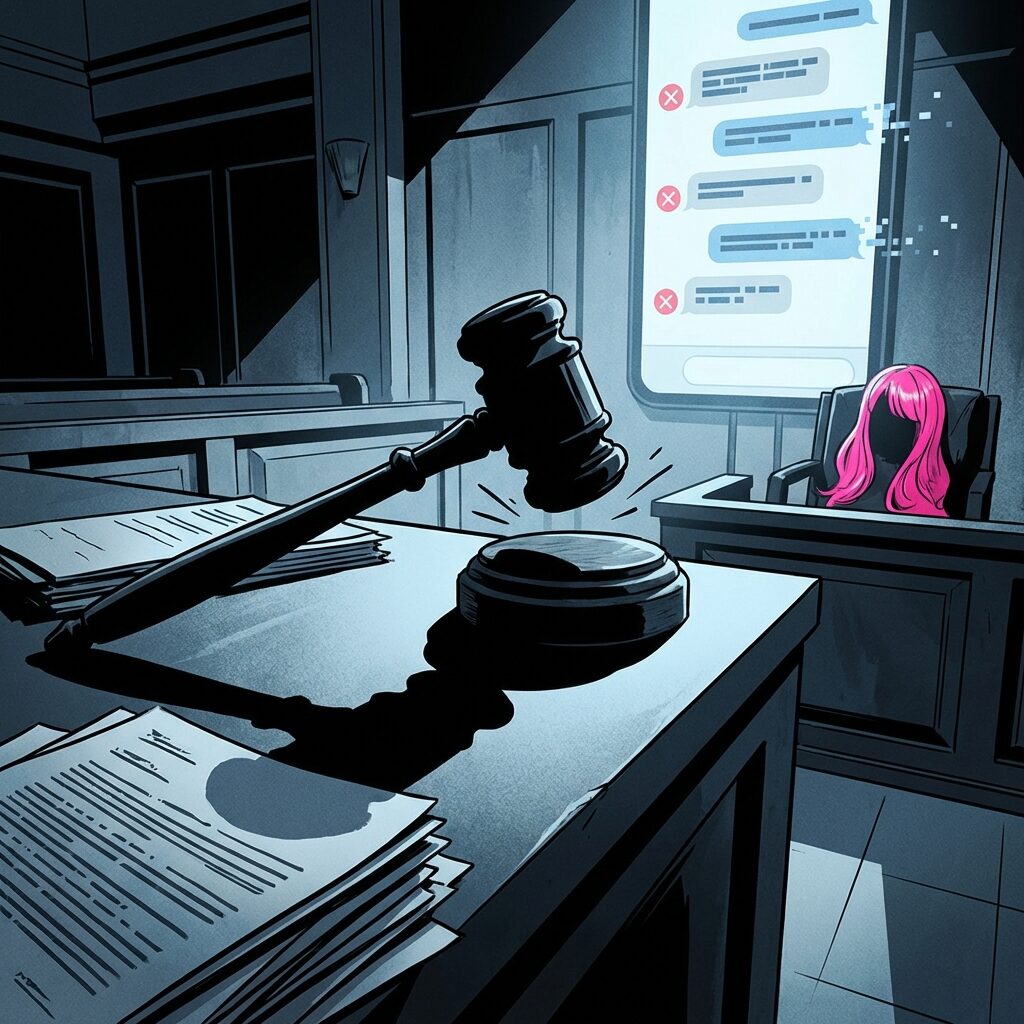
On December 24, 2025, Christmas Eve, U.S. District Judge William Alsup denied the application. The ruling was, to put it plainly, brutal. Judge Alsup called the request “overreaching” and “overburdensome.” He noted that Bressington had not actually filed a defamation lawsuit in Australia or anywhere else. He noted that Bressington’s lawyers said only that they were “prepared to initiate” a suit, not that they would. He noted that Bressington had denied some of the peripheral claims, allegations from an ex-partner, criminal charges, being dropped by a label, but, and I’m going to quote the ruling directly here: Bressington “has not specifically rejected as false one of the most basic assertions alleged: that when not a minor he had sex with a minor.”
The judge continued: “No litigation to stop these statements has been filed anywhere in the world. So far as we know, Bressington never has put pen to paper to inform any government authority anywhere in the world about the matters that concern this application.”
The ruling was reported in January 2026 by Rolling Stone, Billboard, Stereogum, NME, and others. As the AV Club observed: “In trying to scrub them from the realm of deeply-online rumor, Bressington instead upgraded them to headlines.”
No criminal charges have been filed. Allegations are not proof. The legal system exists for a reason, and anonymous Reddit posts are not established facts. But what the ruling did, what Judge Alsup’s language specifically did, was make it impossible to wave this away as internet noise. The attempt to bury the story through legal force blew it wide open instead, and the questions it raised haven’t gone anywhere.
And it makes you look at things differently. The pink hair. The assumed name. The face that’s always hidden. When Paste Magazine asked about it, the explanation was “personal insecurity and a desire to create a character who could be replaced.” That’s a perfectly reasonable answer. But after the ruling, some have pointed out that Maddell was reportedly blacklisted from Triple J under his real name, an unverified claim from Reddit that now lives in the same air as a federal judge’s observations about what Bressington did and didn’t deny. The two sit side by side, and people fill in the gaps themselves.
No Bass Player, No Problem
Royel Otis play without a bass player on purpose, trading low-end weight for a brighter, more open live sound. Combined with an over-the-top light show and a grueling 100-plus-date touring schedule, the physical cost eventually caught up when Maddell collapsed onstage at Dockville in August 2025.
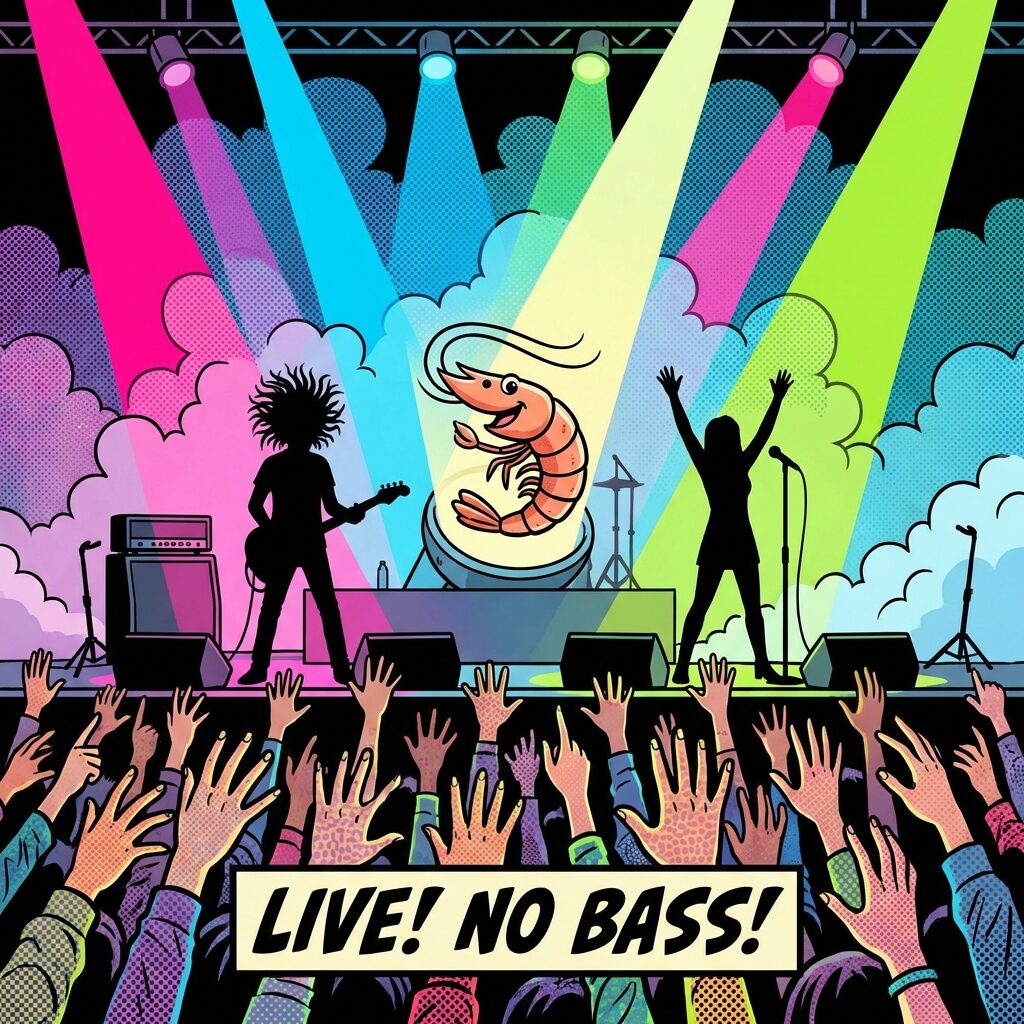
There’s no bass player. That’s the first thing you notice at a Royel Otis show, and it shapes everything about their live sound. Maddell handles bass on record, playing it on select tracks, but onstage they leave the low end at home. The result is a lighter, more immediate energy that floats where other bands would thump. You lose the ability to go dark or heavy, but you gain a brightness and a sense of space that makes the jangly guitars ring out like church bells in an empty room.
What they lack in low-end muscle, they make up for with spectacle. The light show is elaborate and colorful, the kind of production that bands usually don’t invest in until they’re headlining arenas, not grinding through 100-date touring cycles. And then there’s the giant shrimp figurine that appeared onstage at their First Avenue show in Minneapolis. Is it a joke? An inside reference? A commitment to absurdist stage design? Nobody’s explained it. It just sits there, enormous and crustacean, daring you to take the whole thing less seriously.
Tim Ayre rounds out the live lineup on keys, and he’s responsible for one of my favorite Royel Otis tour anecdotes. At that same First Avenue show in September 2024, Pavlovic announced to the crowd: “This is our second time in St. Paul.” Ayre, without missing a beat, corrected him: “We are, indeed, in Minneapolis.” A small moment, but it says a lot about where the band is right now. They’re moving so fast, playing so many rooms in so many cities, that the details start to blur. Charming or careless? Both, probably.
The pace caught up with them in August 2025. At the Dockville Festival, Maddell collapsed onstage. Shows at Lowlands and Pukkelpop were cancelled in the aftermath. A hundred-plus dates a year, continent-hopping, the constant churn of social media content, whatever was happening off-stage on top of all that. Bodies have limits, even young ones.
There’s a small detail from a BBC interview around this period that stuck with me. The duo appeared with what looked like beers, but they turned out to be alcohol-free Guinness. You barely notice it, but think about what it means. The band that recorded Pratts & Pain by ducking out for pints and shots between vocal takes was learning, slowly, how to survive the machine they’d built. Or that had been built around them.
If We Had It Our Way
Royel Otis is simultaneously overexposed and underexamined, a band whose contradictions are the most interesting thing about them, even as the machine grinds on regardless.
“I think if we had it our way, we probably wouldn’t be where we are.”
That’s Royel Otis talking to BBC News, and it might be the most honest thing either of them has said in an interview. Not the most quotable or charming, just the most honest. Because it acknowledges, however obliquely, that the gap between the band they set out to be and the band they’ve become is wider than anyone planned for.
They wanted to be loose. A party everyone’s invited to, where the songs are short and sweet and nobody’s overthinking anything. And on their own terms, that’s exactly what they are. The hooks land. The guitars shimmer. Pavlovic’s voice drifts over it all like smoke from a beach bonfire. You could tell the whole Royel Otis story as nothing but good vibes and improbable success, two Byron Bay kids who made it big on charm and melody.
But the world has a way of complicating the narratives we construct for ourselves. The covers problem hasn’t gone away, it’s just been papered over by “Moody” hitting number one, which brought its own set of problems. Critical opinion remains split between people who hear a great pop band and people who hear an empty one. The controversies haven’t been resolved so much as outlasted by the next news cycle. And the legal situation sits there, unaddressed in any meaningful public way, generating its own gravity.
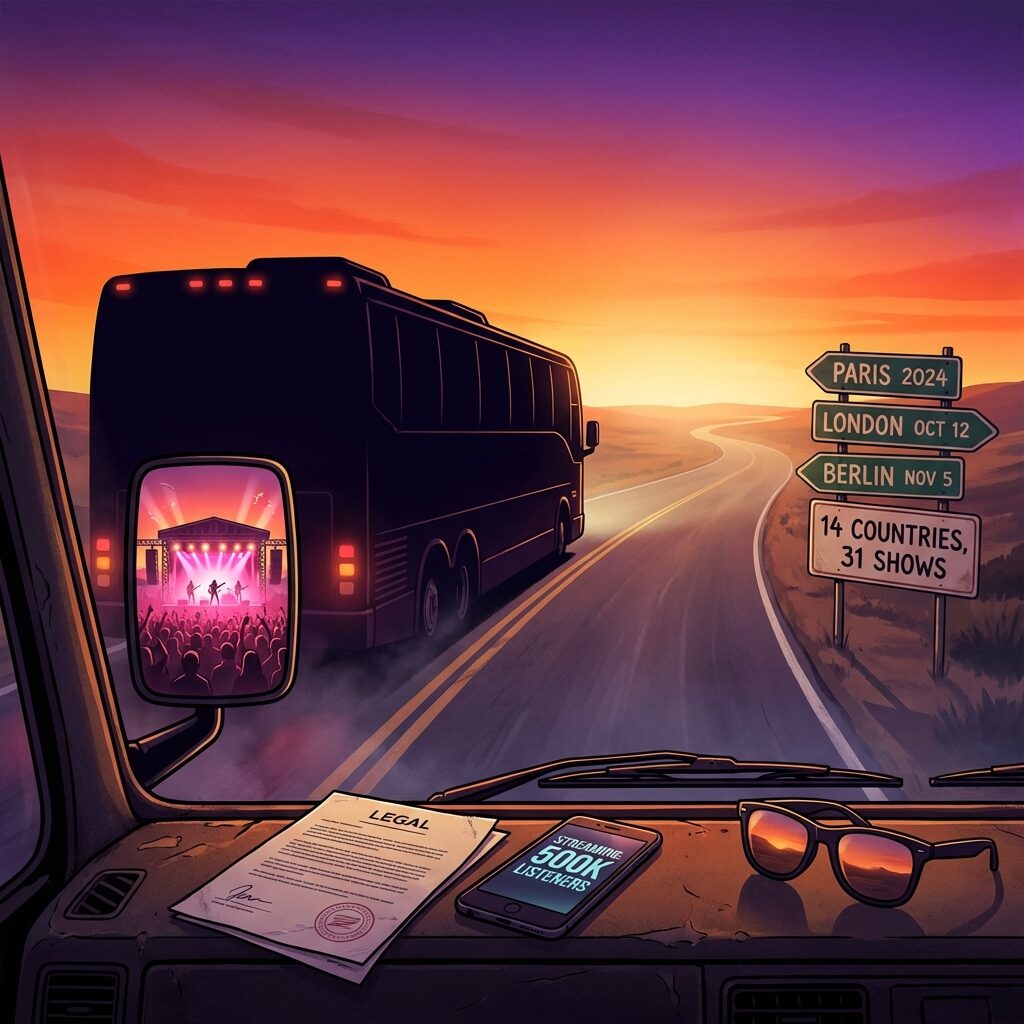
None of this stops the machine. Coachella 2026 is on the calendar for April. The “Meet Me in the Car” tour covers 14 countries and 31 dates. The Greek Theatre at UC Berkeley. Lollapalooza in Argentina, Brazil, Chile. Festival slots across Europe. The bookings were made, the tickets were sold, and the show goes on regardless of what’s unresolved offstage.
Andrew Klippel, founder of their label Ourness, has said: “Royel Otis are always writing, so I imagine after this cycle they will be back in the studio.” There will be a third album. More tours. The momentum is too strong for anything else. What I keep wondering is whether they’ll ever reckon with the contradictions or just keep outrunning them.
Royel Otis might be the rare band that’s simultaneously overexposed and underexamined. Everyone knows the hooks. Almost nobody’s asking what’s underneath them. Maybe that’s fine, maybe pop music doesn’t owe anyone a deeper reading. But I keep coming back to Maddell hiding behind that pink hair, singing someone else’s songs, performing under a name that’s an anagram of the name he doesn’t want you to know. You could read that as playful, mysterious. You could also read it as something else entirely.
The sexy sword cuts both ways. It always has. And Royel Otis is holding it by the blade.
Did you know? Royel Otis’s drummer told them NOT to cover “Linger” “There are just certain songs you don’t touch.” It took them 3 attempts, then it hit the Billboard Hot 100. 🎸🦐 #RoyelOtis #IndieRock #Linger https://bit.ly/47JguFw

Click to Tweet