The Song That Scared Stevie Nicks
Prince sent Stevie Nicks a ten-minute instrumental cassette hoping she’d write lyrics for it. She sent it back, saying it scared her, that it was too much for one person. She turned out to be right, but not in the way either of them expected.
Sometime in early 1983, Stevie Nicks pressed play on a cassette tape from Prince. Ten minutes of instrumental music poured out, big, sweeping, almost absurdly emotional. It was a demo for a song he wanted her to write lyrics for, riding the momentum of their recent collaboration on “Stand Back.” Nicks had been humming along to “Little Red Corvette” while cruising through Los Angeles when the melody for that song hit her, and Prince had dropped by the studio to lay down keyboards and guitar. They clicked. So Prince sent the tape.
She sent it back.
“I listened to it and I just got scared,” Nicks said later. “I called him back and said, ‘I can’t do it. I wish I could. It’s too much for me.'”
To understand what Prince did next, you need to know where his head was at. He was touring behind 1999, his commercial breakthrough, playing the same arenas that Bob Seger had just sold out. Night after night, Prince watched a white rock balladeer from Michigan command audiences with piano ballads and gravelly sincerity, audiences Prince couldn’t quite reach yet. He was 24 years old, already the most talented musician in any room he walked into, and he was chasing something he couldn’t manufacture alone: crossover.
What happened next is hard to square with everything else we know about Prince. This was a man so controlling he played nearly every instrument on his first five albums. He fired band members for playing a wrong note. He would later change his name to an unpronounceable symbol partly to assert ownership over his own identity. And he was about to write the biggest song of his career, one that would only work because he let other people change it.
The song started as a country ballad inspired by Bob Seger. It scared off Stevie Nicks. Then a 19-year-old guitarist reharmonized it in rehearsal, and an accidental piano riff became its most recognizable hook. It was recorded live at a Minneapolis nightclub where the audience was so confused by the new material that they barely clapped. Twenty-four years after that, Prince would play it at the Super Bowl in an actual rainstorm while 140 million people watched.
This is the story of “Purple Rain.” But more than that, it’s the story of what happens when a person who needs to control everything manages, just once, to stop.
From Bob Seger to B♭ Major
Prince’s keyboardist told him to write a ballad like Bob Seger. He listened, wrote “Purple Rain” as a country song first, then called Jonathan Cain to apologize because the chords sounded too much like “Faithfully.”
The whole thing started with a question Prince asked his keyboardist Matt “Dr.” Fink backstage on the 1999 tour. Why does Bob Seger connect? What is it about those arena-filling piano ballads that Prince, who could play circles around Seger on any instrument, couldn’t seem to pull off?
Fink didn’t sugarcoat it: “Well, it’s these big ballads that Bob Seger writes. It’s these songs like ‘We’ve Got Tonight’ and ‘Turn The Page.’ And that’s what people love.” Then he pushed it further: “It’s like country-rock, it’s white music. You should write a ballad like Bob Seger writes and you’ll cross right over.”
And Prince, who was allergic to taking suggestions from basically anyone, actually listened.
He first sketched out “Purple Rain” for the band in December 1982. The original version was written as a country song. Not country-influenced. Not country-adjacent. A straight-up country song. If you’ve only ever heard the finished product, that overdriven power ballad with the ringing guitar chords and the vocal that borders on a revival-tent sermon, the idea of it starting as country music sounds ridiculous. But it makes sense when you think about what Prince was actually after. He wasn’t writing a Prince song. He was trying to write a Bob Seger song, and when he ran it through his own instincts, he ended up somewhere closer to Nashville than Minneapolis.
This is when the Stevie Nicks cassette happened. Prince recorded a ten-minute instrumental version and sent it her way, hoping she’d write lyrics over the top. The timing made sense, “Stand Back” had just proven they could work together. But Nicks heard the tape and felt the weight of it. The song was too big, too emotionally demanding. She passed, and later said she was grateful: “I’m so glad that I didn’t, because he wrote it, and it became ‘Purple Rain.'”
Twenty-one years after sketching the song in rehearsal, Prince stood at the 2004 Rock and Roll Hall of Fame induction ceremony and said something almost nobody expected him to say about anything: someone else had shaped his work. “We are both Midwesterners,” Prince said of Seger, “and Seger had a lot of influence on me at the start of my career; he certainly influenced my writing.” For a guy who spent most of his career acting like he’d invented himself from scratch, this was a weird and kind of moving admission.
There’s another phone call from this period that says a lot about who Prince was when the cameras weren’t rolling. After recording the song, Prince called Jonathan Cain of Journey, worried the chord progressions sounded too close to Journey’s 1983 hit “Faithfully.” “I’m afraid that I might have taken too many of the chord progressions from your song ‘Faithfully’ and I’m a little concerned,” Prince told him. “If you want me to change it, I will.”
Sit with that for a second. Prince calling another musician to ask permission. Cain was cool about it: “Man, I’m just super-flattered that you even called. It shows you’re that classy of a guy. Good luck with the song. I know it’s gonna be a hit.” Cain never considered asking for a co-writing credit. “No, no, that’ll just bring bad juju on you,” he said. As thanks, Prince gave Journey members front-row concert tickets and sent Cain a Purple Rain tambourine. Later, a Minneapolis associate told Journey that Prince admired Neal Schon’s guitar playing, which had influenced him. Schon admitted: “Prince felt, I guess, it was obvious enough that he was worried we were going to sue him.”
Nobody sued. But the fact that Prince picked up the phone at all tells you something about what this song did to him. It loosened something. He asked for help. He admitted someone else got there first. He worried about stepping on toes. None of that was normal Prince behavior. “Purple Rain” was already changing him before anyone else had heard a note.
Six Hours That Changed Everything
A 19-year-old guitarist revoiced Prince’s country chords, a keyboardist stumbled onto the song’s most recognizable melody by accident, and six hours of rehearsal turned a demo into a finished arrangement.
The moment that turned “Purple Rain” from a solid country-rock ballad into the song you know happened at the end of a rehearsal. Prince, characteristically casual about big creative decisions, told the band: “I want to try something before we go home. It’s mellow.”
He started playing his country version. And then Wendy Melvoin, who was nineteen years old, started playing it differently.
Melvoin, daughter of Wrecking Crew pianist Mike Melvoin, raised in a house where jazz harmony was the background music of daily life, heard Prince’s straightforward chord changes and instinctively began inverting them. She added ninths. She kept the suspended chords but revoiced them, spreading the notes across the fretboard in ways that opened up the sound completely. Lisa Coleman, who’d watched the whole thing happen, described it precisely: “He was excited to hear it voiced differently. It took it out of that country feeling.”
Let me put this in plainer terms for the non-music-theory folks. When you play a standard B♭ major chord on guitar, it sounds fine. Sturdy. A little plain. When you play a B♭ add9, when you add that one extra note, the C, and spread the chord voicing so the notes ring against each other, it sounds like light coming through stained glass. That’s what Melvoin did to Prince’s song. She kept the same basic chord progression but made every chord glow.
“We kept all those suspended chords,” Melvoin later explained. “Then I put the ninth in there.” The description is technical, but the effect is the one you feel every time you hear the opening of “Purple Rain”, that wash of sound that gets under your skin before you can explain why. That came from a nineteen-year-old who heard something in Prince’s country demo that even he hadn’t heard yet.
And she wasn’t the only one reshaping the song. Dr. Fink, sitting at his Yamaha CP-70 electric grand piano, accidentally improvised a high-register melodic line that became one of the song’s most instantly recognizable elements. “It came from me, just by sheer accident,” Fink said. Prince “latched onto it and sang it.” The melody you hum when someone says “Purple Rain”? An accident. On the bass, Brownmark found a descending line on the outro that came organically, a part that tracked the song’s slow release of tension after its climax.
They played the song for six hours straight. By the end, they had it mostly written and arranged. Coleman’s description of what that rehearsal felt like is worth quoting in full: “Was like dancing together. We listened to each other with such intensity that I felt we all were hitting the crash cymbal when Bobby hit it… Wendy’s beautiful guitar voicing informed Prince’s melody, and Brownmark’s sensitivity to supporting a verse, and then doubling up on the outro with the descending line, all came organically that day.”
Here’s the thing about this moment. Prince could have stopped Melvoin. He could have said, “No, play it the way I wrote it”, which is exactly what he did in dozens of other sessions throughout his career. He was not a man known for accepting unsolicited reinterpretations of his work. But something about this song, at this particular rehearsal, made him listen instead of direct. He heard what the band was bringing and recognized it was better than what he’d started with. For a control-obsessed 24-year-old who played most of the instruments on his own records, choosing to get out of the way may have been the hardest thing he did that night. And the most consequential.
90 Degrees at First Avenue
On August 3, 1983, Prince recorded the live foundation of “Purple Rain” at a sweltering Minneapolis benefit concert, with an audience so unfamiliar with the new songs that the cheering had to be added later.
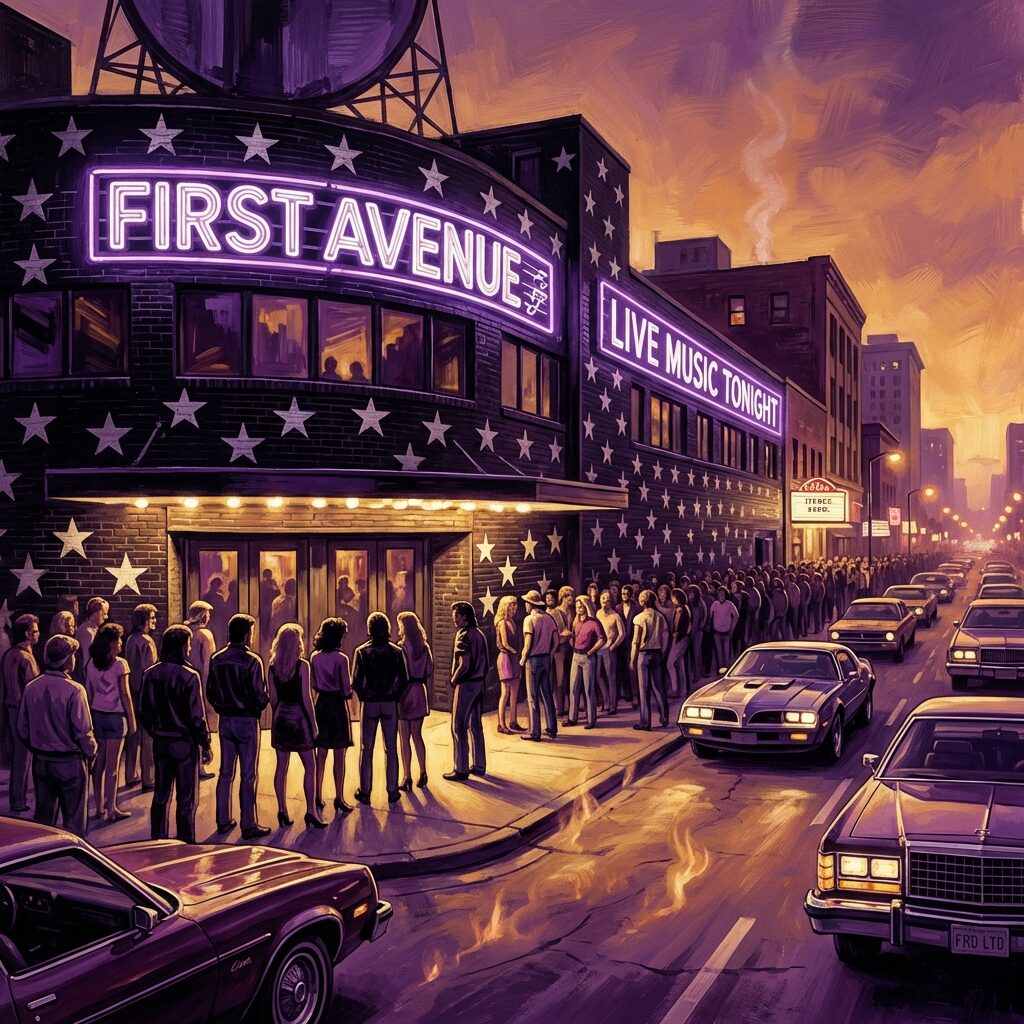
August 3, 1983. Minneapolis. A benefit concert for the Minnesota Dance Theatre at First Avenue, the nightclub Prince would make famous (or maybe it was the other way around). Tickets were $25, roughly five times what First Avenue normally charged, and they sold out in four days. About 1,200 people packed into a room where the temperature hit 90 degrees, the air thick with humidity and cigarette smoke.
This was Wendy Melvoin’s live debut. She was still nineteen. And this was the night that Prince’s backup band officially became The Revolution, not just session players executing his vision, but something that felt like an actual band. City Pages, the local alt-weekly, called the 70-minute set Prince’s “sweatiest and most soulful hometown concert yet.”
Outside the venue, David Rivkin, brother of drummer Bobby Z, working under the name David Z, sat in a 24-track Record Plant mobile truck with engineers Dave Hewitt and Kooster McAllister, trying to capture whatever was about to happen. Rivkin wasn’t entirely sure what he was recording. “I thought we were recording a concert, but I wasn’t sure if it was going to be a record, too,” he said. “I knew they were working on the movie as well. You just had to go in prepared to record whatever it was going to be as well as you could.”
What they captured that night became the basic tracks for three songs on Purple Rain: the title track, “I Would Die 4 U,” and “Baby I’m a Star.” Bobby Z was in full arena-rock mode. “For me it was natural,” he said. “I could give it the big rock beat and be John Bonham.” He wasn’t wrong, the drum part on “Purple Rain” has that Bonham weight to it, that sense of a drummer who hits the kit like he’s trying to communicate with someone on the other side of the building.
But here’s the detail that always gets me about the First Avenue recording. The audience was mostly silent. They didn’t know these songs. This wasn’t Prince running through hits, these were brand-new compositions that nobody in that room had ever heard before. The crowd had no idea what they were hearing. They just stood there in the heat and listened.
The cheering you hear at the end of “Purple Rain” on the album? Added later. The real audience didn’t know they were supposed to cheer. They were still trying to figure out what they’d just experienced.
Three songs from one sweaty night in Minneapolis. That’s what a Diamond-certified album was built on. Bobby Z put it simply: “It certainly was one of the best concerts we ever did.”
Why Those Chords Hit So Hard
What makes “Purple Rain” work, chord by chord and cut by cut: the add9 voicings, Prince’s ruthless editing of an eleven-minute live take, Lisa Coleman arranging strings by ear at the piano, and the studio gear that made a Hollywood room sound like a cathedral.
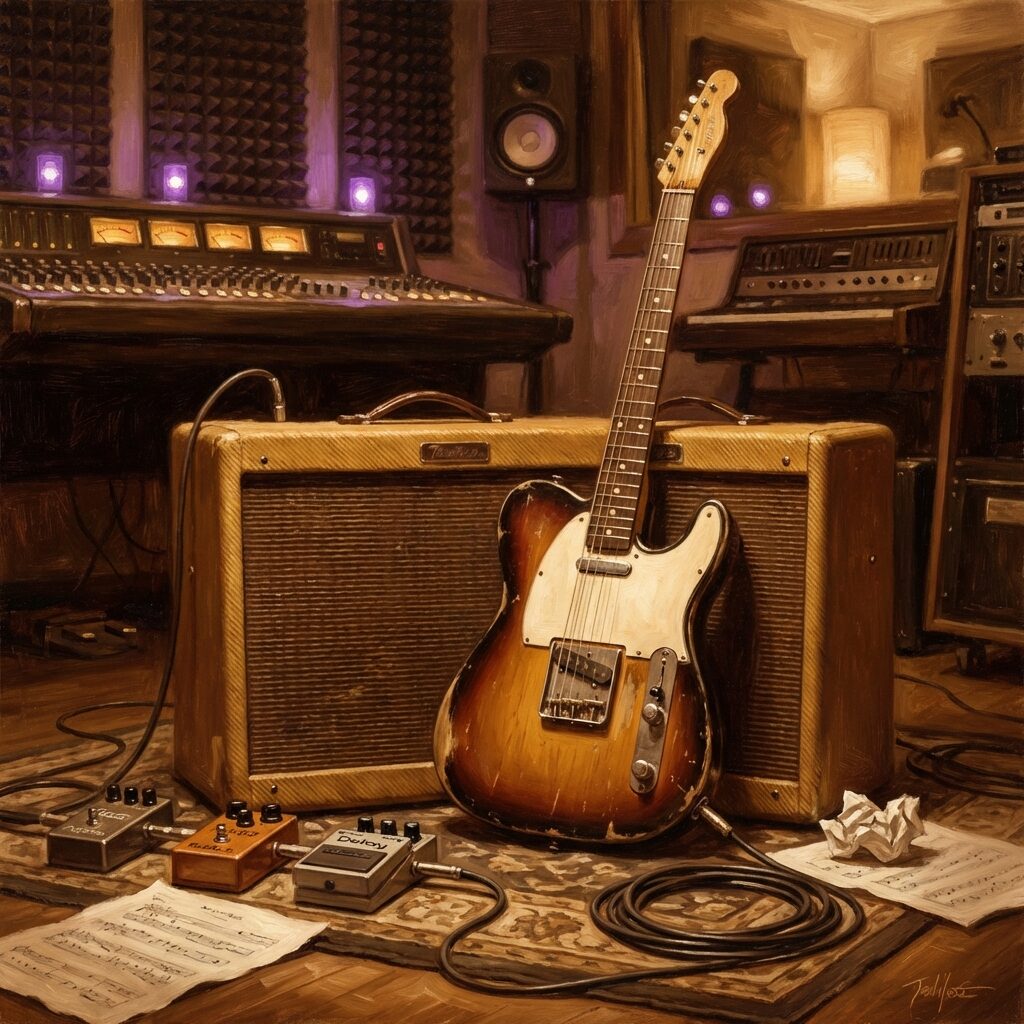
There are thousands of power ballads from the 1980s, and most of them aged into background noise. “Purple Rain” didn’t. The difference is in the details.
Start with the chords. The song is in B♭ major, and the core progression is I–vi–V–IV: B♭ add9 to Gm7 to F to E♭. If you play guitar, you’ve probably played this with a capo on the third fret using G–Em–D–C shapes. It’s a common progression. You’ve heard it in a hundred songs. But Wendy Melvoin’s voicings, those inversions and added ninths from rehearsal, turn standard changes into something that pulls at you differently. The add9 voicing on that opening B♭ chord is what gives the song its shimmer. Instead of three notes stacked neatly, you get notes that ring against each other, warm but with a slight catch in the harmony. That bit of tension hooks your ear before Prince even opens his mouth.
The song opens with two layered guitars, Prince on lead, Melvoin on rhythm, immediately joined by drums and piano. Prince’s Madcat Hohner Telecaster (bridge pickup, volume and tone both cranked to 10) and Melvoin’s modified purple Rickenbacker 330 (she’d swapped in G&L pickups and a hardtail bridge, with the F-holes filled in) created a sound that neither guitar could produce alone. Prince’s Telecaster was bright and cutting. Melvoin’s Rickenbacker was warm and jangling. You hear those two tonal characters together, and that’s a big part of why you recognize this song within two bars.
Then there’s the editing. The original live performance ran about eleven minutes. Prince trimmed it to 8:41 for the album, and every cut made the song better. The almost four-minute instrumental intro from the First Avenue take got chopped down to just four bars. An extra verse, reportedly about money, was removed because it broke the mood. A solo section was cut. The guitar solo’s rough edges were smoothed with subtle overdubs. The live snare got gated to make it cleaner and snappier. This is the part nobody romanticizes: knowing what to throw away. Prince took a rambling, inspired live performance and carved it into something that builds with real precision over eight and a half minutes.
Here’s a detail worth sitting with: the song holds exactly 113 BPM for all 8:41. No speeding up for the climax, no slowing down for the verses. The emotional build comes entirely from layering and dynamics. The drums hit harder. The keyboards swell. The strings enter. Prince’s vocal goes from conversational to pleading to completely unhinged. But the pulse never moves. That kind of discipline in a song this emotionally big is hard to pull off, and it works because everything else around the tempo is in constant motion.
Lisa Coleman arranged the strings, and the process was pure Prince-world improvisation. She sat at a piano and played each string part for the musicians to learn by ear. No written charts. Prince sat beside her approving parts in real time. The string players included violinist Ilene “Novi” Novog and cellists Suzie Katayama and David Coleman (Lisa’s brother). David got the call out of the blue: “Out of the blue, my sister calls me from Sunset Sound and said that they were doing some strings for a Prince song… So I ran through some scales and ran right down to the studio.” The strings were recorded at Sunset Sound’s Studio 3 by engineer David Leonard, using a pair of Telefunken 251 microphones for the violins and a Neumann U47 on the cello.
The overdubs and vocal re-recordings happened at Sunset Sound from August to September 1983, and according to Duane Tudahl’s book on Prince’s recording sessions, the entire overdub and mixing process took only five studio dates. Five dates. For a song that sounds like it took months to piece together in some vast stone room.
The studio gear matters here, too. Sunset Sound’s Studio 3 had a custom 1977 40-input API DeMideo console, an Ampex MM1200 tape machine, and a rack of outboard gear any engineer would have killed to work with: API 440 EQs, Universal Audio LA-2A leveling amplifiers, UREI 1176 compressors. But the two pieces that most shaped the sound of “Purple Rain” were the EMT 250 digital reverb and Lexicon Delta T digital delays. Those are what give the track its sense of enormous space, the feeling that Prince’s guitar is echoing off the walls of somewhere much bigger than a studio in Hollywood. Everyone reaches for “cathedral” and “church” when they describe this song, and they’re not wrong. The reverb and delay were set to make the room sound sacred.
On the keyboard side, the band used an Oberheim OB-8, Yamaha DX7, and Dr. Fink’s Yamaha CP-70 electric grand piano. Lisa Coleman later described Prince’s approach to synth sounds with characteristic bluntness: “Prince was incredibly bold in the way he would just use a preset and then brighten the fuck out of it!” No endless patch-designing, no tweaking for hours. Find a preset, crank the brightness, move on. He trusted his ears more than his process.
Blood in the Sky
Prince said purple rain meant the apocalypse, red and blue make purple, and when there’s blood in the sky, you hold onto the one you love. Lisa Coleman heard something gentler: a new beginning.
“When there’s blood in the sky, red and blue = purple… purple rain pertains to the end of the world and being with the one you love and letting your faith/God guide you through the purple rain.”
That’s Prince explaining the title. The world is ending, the sky is bleeding, and the only thing that matters is whether you’re with the right person when it all comes down. The B-side to the single was a track called “God,” recalling the Book of Genesis, which tells you where his head was at.
But Lisa Coleman offered a reading that’s gentler and maybe more interesting: “A new beginning. Purple, the sky at dawn; rain, the cleansing factor.” The end and the beginning at once. These interpretations don’t actually conflict. Certain strands of Christian theology understand the apocalypse as exactly that, destruction giving way to something new and pure. Prince was building his own private theology across records, and “Purple Rain” was the sermon he’d been working up to.
He’d been circling this image for a while. Listen to the title track of 1999, the album that preceded Purple Rain: “…could have sworn it was Judgment Day, the sky was all purple.” Same purple, same dread, just dressed up as a party. He kept returning to the color as a stand-in for divine wrath and renewal. By the time “Purple Rain” the song arrived, it felt like he’d finally said the thing plainly instead of burying it in synths and falsetto.
The phrase itself may be older than Prince. America’s 1972 hit “Ventura Highway,” written by Dewey Bunnell and peaking at #8 on the Hot 100, contains the line: “Sorry boy, but I’ve been hit by purple rain.” Multiple music journalists have argued Prince took the phrase directly from that song. When America’s Gerry Beckley was asked what “purple rain” meant in their version, he said simply: “You got me.” So the phrase went from meaning nothing in particular in 1972 to meaning everything in 1984. Prince didn’t invent it. He just made it impossible for anyone to hear those two words together without thinking of him. A 2022 trademark survey found that roughly 63% of respondents associate “purple rain” with Prince.
In the film, the song functions as an act of reconciliation. Prince’s character, the Kid, performs it as a tribute to his late father, and each verse connects to a different strained relationship in his life. But the moment that matters most is when the Kid credits Wendy and Lisa for writing the song. The real breakthrough of “Purple Rain” was Prince accepting collaboration, and the fictional version plays out that same surrender in the movie’s climax. The story the film tells about the song is actually true to how the song was made, which almost never happens.
The lyrics are simpler than you’d expect from Prince. “I never meant to cause you any sorrow / I never meant to cause you any pain.” No clever wordplay, no double meanings, no showing off. Just a man asking for forgiveness and offering himself as a guide through something he can barely name. When Prince sings “You say you want a leader / But you can’t seem to make up your mind,” he’s not being arrogant. He’s being desperate. And when the vocal cracks open in the final minutes and he starts repeating the title over and over, the song stops working as a song. It turns into something closer to a plea.
Blocked by Wham!, Crowned by Everything Else
The single peaked at #2, stuck behind “Wake Me Up Before You Go-Go” for two weeks, while the album held #1 for 24 consecutive weeks. Prince became only the third artist after Elvis and the Beatles to top the album, singles, and film charts at the same time, won Grammys and an Oscar at 26, and inadvertently launched the Parental Advisory sticker through “Darling Nikki.”
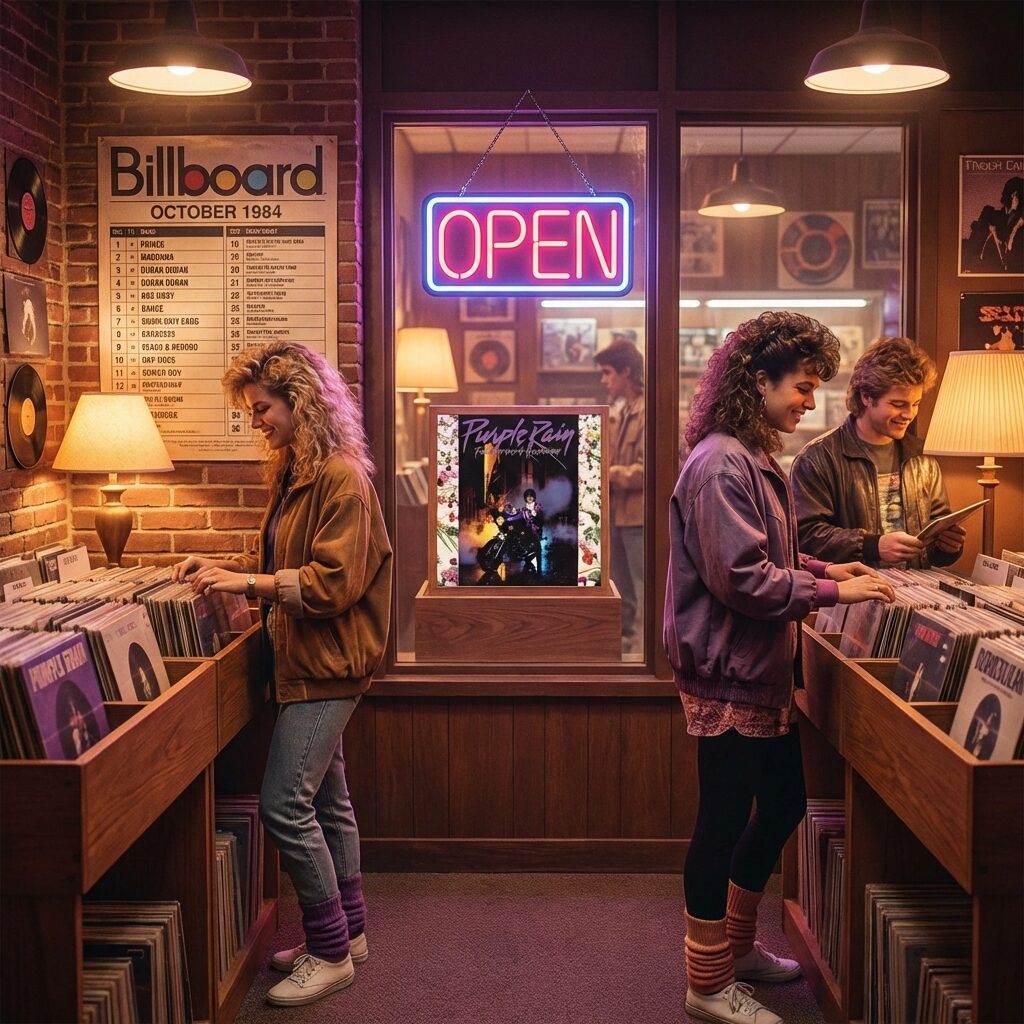
There’s something funny about “Purple Rain” peaking at #2 on the Billboard Hot 100. A song voted #18 on Rolling Stone’s all-time greatest list, a song that basically everyone agrees is one of the best of the twentieth century, and it sat at #2 for two straight weeks, blocked by Wham!’s “Wake Me Up Before You Go-Go.” George Michael and Andrew Ridgely standing between Prince and a #1 single. You can’t make that up.
The album, though, was a different story. It hit #1 on the Billboard 200 on August 4, 1984, and stayed there for 24 consecutive weeks, one of only eight albums in history to do that. It traded the top spot back and forth with Bruce Springsteen’s Born in the U.S.A., the two biggest records of 1984 swapping places week after week. The album moved a million units in its first month and 2.5 million before the film even opened on July 26. By year’s end, it had sold 8 million copies in the US. It went on to sell over 13 million domestically and an estimated 25 million worldwide, eventually earning Diamond certification from the RIAA.
And then there’s this: with the album at #1, the single “When Doves Cry” at #1 on the Hot 100, and the Purple Rain film #1 at the box office, Prince became only the third artist in history, after Elvis Presley and the Beatles, to simultaneously hold the top position in music, singles, and film. He was in the company of exactly two acts, and both of them needed a decade-plus head start.
The awards followed. At the 27th Grammy Awards, Prince won Best Rock Performance by a Duo or Group with Vocal, beating the Cars, Genesis, Van Halen, and Yes. He was the first Black artist to win in that category. He also won Best Album of Original Score Written for a Motion Picture. At the 57th Academy Awards, he took home the Oscar for Best Original Song Score. He was 26 years old, the youngest person to win that award, beating George Harrison, who’d been 27 when he won for Let It Be.
The album also wound up changing the music industry in a way nobody planned. “Darling Nikki,” another track on the record, so horrified Tipper Gore when she caught her eleven-year-old daughter Karenna listening to it that Gore co-founded the Parents Music Resource Center. The eventual result: the Parental Advisory sticker system. Prince was the only songwriter with two songs on the PMRC’s “Filthy Fifteen” list, “Darling Nikki” and Sheena Easton’s “Sugar Walls,” which he’d written. One album gave the world a generational rock song and got the government involved in record labeling.
Can You Make It Rain Harder?
When producers warned Prince about rain during the 2007 Super Bowl halftime show, he asked if they could make it rain harder. Then he went out and played twelve minutes that nobody has topped since.
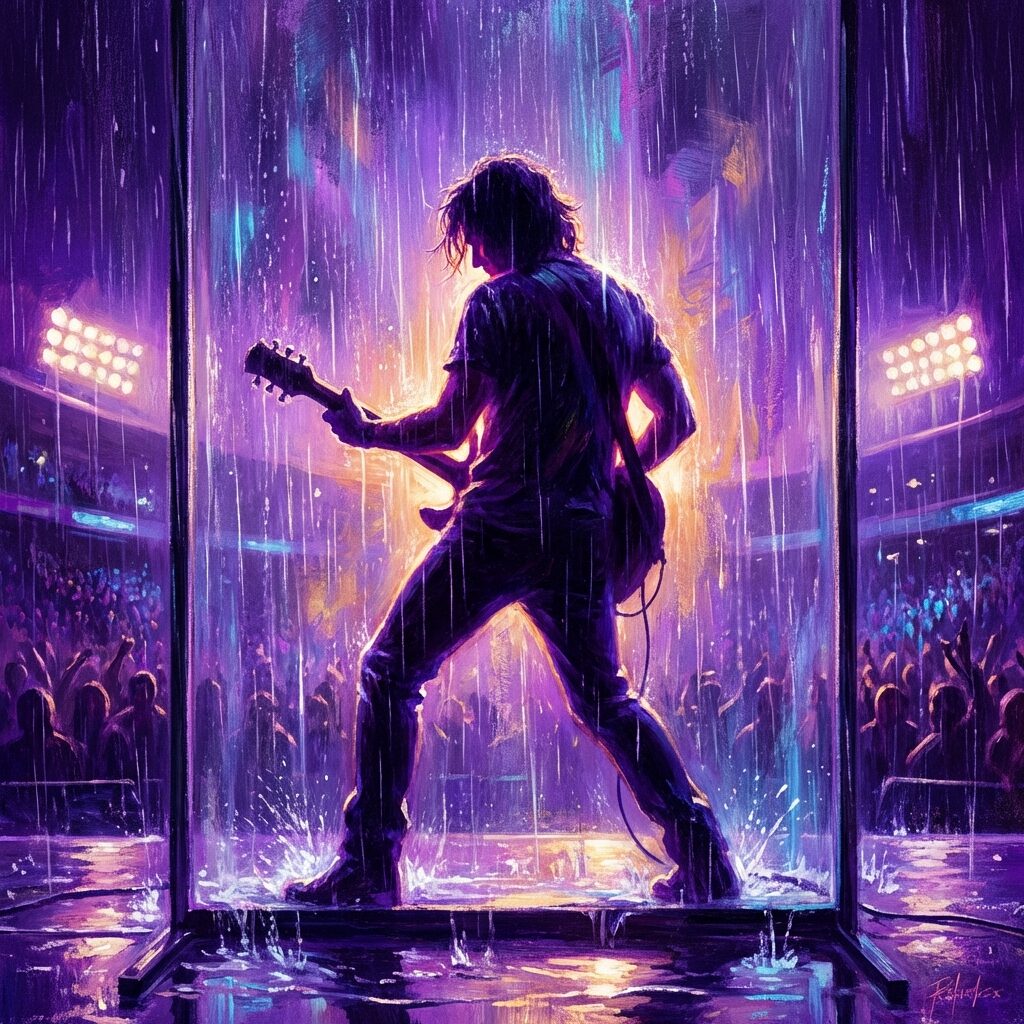
February 4, 2007. Dolphin Stadium, Miami Gardens, Florida. Super Bowl XLI. Indianapolis Colts versus Chicago Bears. And for the first time in Super Bowl history, it was raining.
Hours before the halftime show, producer Don Mischer found Prince and warned him about the weather. The stage would be wet. The equipment could malfunction. They could adjust the show, scale things back, figure out a contingency plan. Prince’s response, and I need you to understand that this is a real thing a human being actually said, was: “Can you make it rain harder?”
That might be the most Prince moment ever committed to record.
What followed was twelve minutes that 140 million people watched and nobody has stopped talking about since. Prince opened with “We Will Rock You,” then ripped through “Let’s Go Crazy,” “Proud Mary,” “1999,” “Baby I’m a Star,” and a medley of “All Along the Watchtower” and the Foo Fighters’ “Best of You”, all in the pouring rain, all flawless. Think about that setlist for a second. Prince wasn’t just playing his own hits. He was playing Queen. Creedence. Hendrix. He was planting his flag in all of rock history, not the R&B category where the industry kept trying to file him.
Then came “Purple Rain.” With the Florida A&M University Marching Band backing him, Prince played behind a giant screen, his silhouette projected for the stadium and the cameras. The imagery was, there’s no polite way to say this, suggestive as hell. The shape of Prince and his guitar, backlit and larger than life, was phallic in a way that couldn’t possibly have been accidental. This was three years after the Janet Jackson wardrobe malfunction at Super Bowl XXXVIII, which had sent the NFL into a panic about halftime show content. Prince’s response to that anxiety was to create an image more provocative than anything Jackson had done, but abstract enough that nobody could technically object. The man was trolling the NFL on their own stage, on their biggest night, and they couldn’t do a thing about it.
Kelefa Sanneh of the New York Times wrote that it would “surely go down as one of the most thrilling halftime shows ever; certainly the most unpredictable, and perhaps the best.” He wasn’t wrong. It’s been nearly twenty years, and I still haven’t heard anyone make a credible case for another halftime show being better.
The best part of the whole story: after the show, Don Mischer flew to Beijing. Reporters there asked him how many water trucks it took to create the rain effect. They couldn’t believe it was real. But it was. Prince asked for rain, and it rained.
The Song That Keeps Returning
From Springsteen’s purple-lit tribute to a 608% Spotify spike after the Stranger Things finale, “Purple Rain” keeps reaching new listeners. Prince’s last public performance was a solo piano version, one week before his death.

On April 21, 2016, Prince was found unconscious in an elevator at Paisley Park. He died of a fentanyl overdose at age 57.
Two days later, Bruce Springsteen and the E Street Band took the stage at the Barclays Center in Brooklyn. The stage flooded with purple light. Every band member wore something purple, unprecedented for a group that almost exclusively performs in black. Nils Lofgren played Prince’s guitar solo. Springsteen said what a lot of musicians were feeling: “There’s never been anyone better. Bandleader, showman, arranger… Whenever I would catch one of Prince’s shows, I would always leave humbled. I’m going to miss that. We’re going to miss that.”
“Purple Rain” re-entered the Hot 100 at #4. It topped iTunes in the US and UK. The album shot back to #2 on the Billboard 200 with 69,000 equivalent copies in a single tracking week. Five Prince songs re-entered the Hot 100 at once. Most living artists couldn’t move those numbers.
Then there’s Dwight Yoakam. A country artist, recording a bluegrass cover of “Purple Rain” on the third day of sessions for his album Swimmin’ Pools, Movie Stars…, because he’d just learned Prince had died. He replaced electric guitar with fiddle and mandolin, stripping the song back to something that sounds, improbably, like it could have been the country version Prince originally wrote in December 1982. Yoakam initially dismissed it as “just an ill-advised moment of emotional expression.” Former Warner Bros. Records president Lenny Waronker convinced him to include it as the album’s closing track. The country song had come back to country. Yoakam later said: “The first time I heard it, it stopped me in my car. I thought it spoke volumes about the honest willingness of the person who wrote it to bare his heart to the world through his music.”
People kept stumbling into it. In early 2026, the Stranger Things finale used “Purple Rain,” and the numbers were absurd: a 608% Spotify streaming spike, 4.3 million streams between January 2 and 5. “When Doves Cry” got a 336% bump. The Prince Estate’s decision to license the music was reportedly influenced by the massive commercial windfall Kate Bush’s “Running Up That Hill” got from an earlier season of the show. A new generation heard the song for the first time and had the same reaction every generation has had, not quite believing something could sound that huge and that exposed at once.
Even the trademark fights tell you something. When a Bang Energy affiliate tried to register “Purple Rain” as a trademark for energy drinks in 2020, Prince’s estate fought it and won. The deciding factor: a survey showing roughly 63% of respondents associated the phrase “purple rain” with Prince. He didn’t invent those two words. But he made them his. The estate’s argument was simple: “‘Purple rain’ is not a word in the English language. Prince chose the phrase and made it famous.”
But the detail from 2016 that stays with me is this. On April 14, one week before his death, Prince performed at the Fox Theatre in Atlanta. It was part of the Piano & A Microphone Tour, just Prince, alone, at a piano. No Revolution. No band. No backup singers. He played over 40 songs across two shows that night. The final song of the final show, the last song Prince ever played publicly, was “Purple Rain.” Solo piano. Just the song and the man who wrote it, with everything else stripped away.
He’d spent the last few days of his life unwell. His plane had made an emergency landing in Moline, Illinois, the day after the Fox Theatre shows. Doctors advised him to stay. He went home.
One week later he was gone, and the last thing he’d given an audience was the song that had always been too much for any one person.
The Country Song That Ended the World
Prince’s greatest song required the thing he was worst at: letting go of control. Stevie Nicks was right, it was too much for one person. That’s why it took all of them.
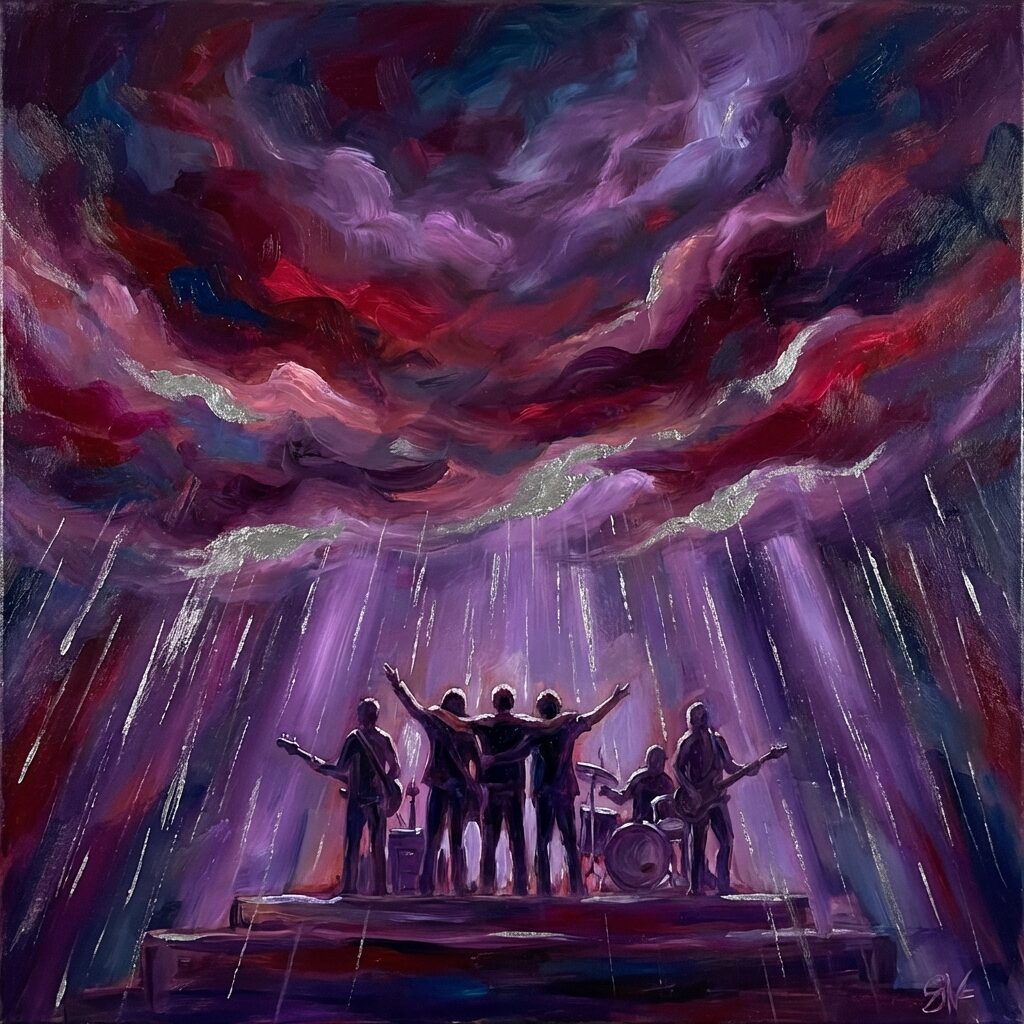
So here’s the whole arc. Prince asks his keyboardist why Bob Seger is more popular. He writes a country song. He sends it to Stevie Nicks, who sends it back. He brings it to rehearsal, where a 19-year-old guitarist reharmonizes it into something new. A keyboardist stumbles onto the hook by accident. A bassist finds the perfect outro line organically. They play it for six hours and walk out with a different song than the one they’d walked in with.
He records it live at a Minneapolis nightclub where the audience doesn’t even clap. He calls Jonathan Cain to apologize for borrowing chord changes. He lets Lisa Coleman arrange the strings by ear while he sits beside her and nods. He trims four minutes of intro down to four bars. He cuts the verse about money. He takes an eleven-minute sprawl and makes it 8:41.
Then the thing just detonates. Number one album for 24 straight weeks. Grammy. Oscar. The Super Bowl in the rain. A 608% streaming spike forty-two years after it was written, because a Netflix show introduced it to kids who hadn’t been born when Prince died.
The strange part is that Prince’s greatest song required the thing he was worst at: letting go. Every stage involved someone else making it better. Fink’s advice. Melvoin’s chords. Fink’s accident at the keys. Coleman’s arrangements. Cain’s blessing over the phone. What started as one man’s scheme to cross over into Bob Seger’s audience turned into a song about the end of the world that people keep finding, forty years on, in ways nobody planned for. The “new beginning” Lisa Coleman described.
Stevie Nicks heard the ten-minute demo and said it was too much for her. She was right, honestly. It was too much for any one person. That’s why it took all of them.
🎸 Did you know? Prince originally wrote “Purple Rain” as a country song inspired by Bob Seger, then called Journey to apologize for sounding too much like “Faithfully.” 💜 #Prince #PurpleRain #MusicHistory https://bit.ly/4uJUx39

Click to Tweet