Nirvana | Nevermind (album)
The Accidental Revolution
On January 11, 1992, Nevermind knocked Michael Jackson’s Dangerous from #1 on the Billboard 200, a result nobody at the label saw coming, least of all the band that made it.
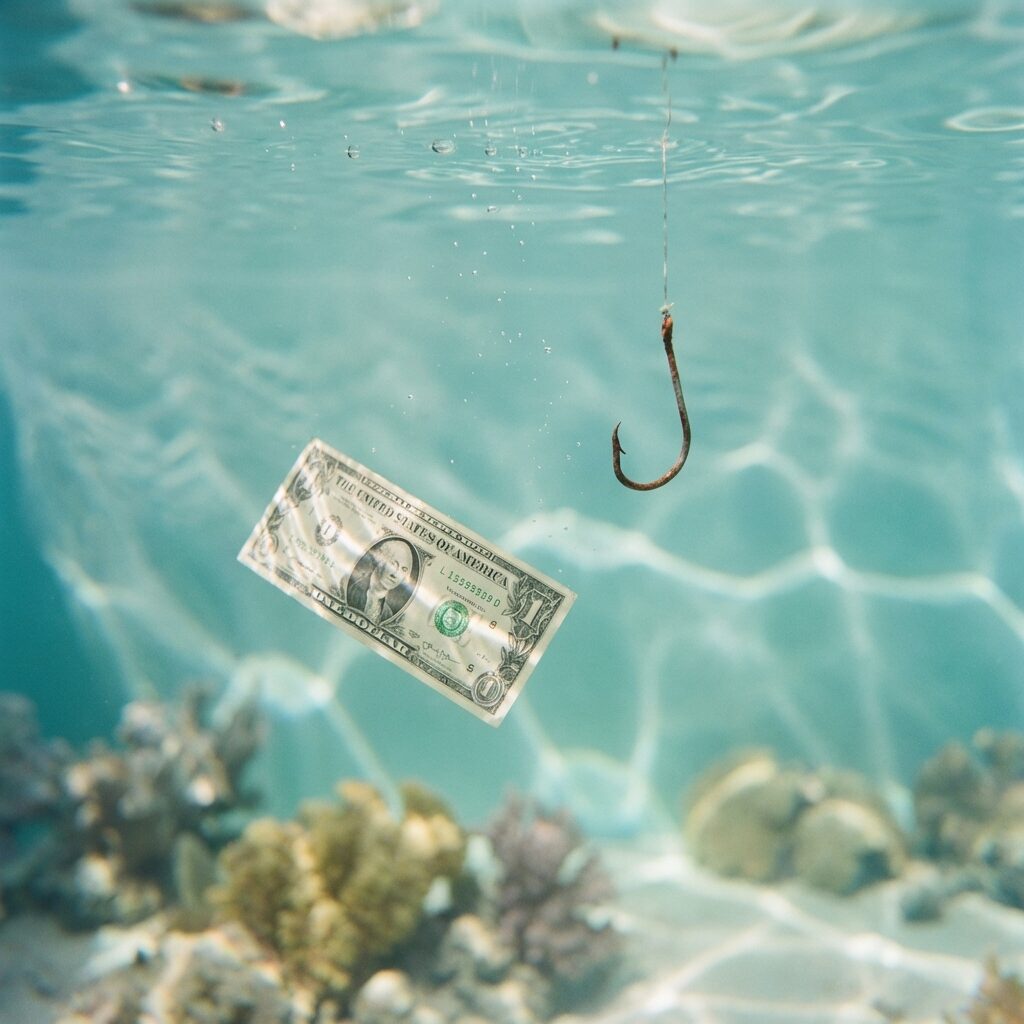
On January 11, 1992, a record that nobody expected to matter very much climbed to number one on the Billboard 200, knocking Michael Jackson’s Dangerous from the top spot down to number five. You couldn’t have scripted it better. The biggest pop star on the planet, bumped by three guys from Aberdeen, Washington, who couldn’t afford to eat at Denny’s two years earlier.
DGC Records had pressed fewer than 50,000 copies of Nevermind for its September 24, 1991 release. They figured they’d be happy matching the 250,000 units Sonic Youth’s Goo had moved on the same label, a respectable showing for a band whose previous album, Bleach, had been recorded for six hundred bucks. The most optimistic projection was gold status by the following September. A full year out.
Instead, by Christmas 1991, three months after release, the album was selling 374,000 copies a week. Not total. Per week. Ed Rosenblatt, Geffen’s president, gave the most honest assessment anyone at the label could muster: “We didn’t do anything. It was just one of those ‘Get out of the way and duck’ records.”
But here’s the thing about Nevermind that gets lost in the myth: the most successful punk-adjacent album ever released took off in large part because of the very thing its creator grew to hate about it. Kurt Cobain wanted a raw, abrasive record. What he got, through a series of production decisions he initially approved and later disowned, was something polished enough for mainstream radio to play without flinching. That contradiction sits at the center of everything about the album, from the recording sessions to the fallout that came after.
Aberdeen to the Bidding War
Nirvana went from a $606 debut album on Sub Pop to a $287,000 Geffen advance, with Sonic Youth pulling strings to get them noticed and Dave Grohl’s arrival completing the lineup that would blow everything wide open.
Bleach cost $606.17 to record. That number gets thrown around so often it’s become shorthand for Nirvana’s origin story, the scrappy punk band from nowhere who made something real with nothing. And it’s true, as far as it goes. But the leap from there to a $287,000 advance from Geffen Records wasn’t just about the music getting better. It was about the right people hearing it at the right time.
Sonic Youth made it happen. Kim Gordon and Thurston Moore had signed to DGC themselves, and they dragged A&R man Gary Gersh to a Nirvana show. Gersh heard what Gordon and Moore heard, pop instincts buried under feedback and fury. The bidding war that followed involved multiple major labels circling a group that had moved maybe 40,000 copies of their debut on Sub Pop. On paper, none of it made sense. But cassettes from their April 1990 demo sessions at Smart Studios in Madison, Wisconsin were already passing around among industry insiders and scenesters, and the buzz was real.
Jonathan Poneman, Sub Pop’s co-founder, told producer Butch Vig something that must have sounded certifiably insane at the time: “They’re going to be bigger than The Beatles.” This was before anyone outside of Seattle cared. Before MTV. Before the flannel gold rush. Poneman either had extraordinary foresight or extraordinary confidence in his own hype. Turned out it was the former.
The final piece clicked into place when Dave Grohl replaced drummer Chad Channing in late 1990. Channing was a decent drummer. Grohl was something else entirely. The difference wasn’t subtle, Grohl hit harder, played with more dynamics, and locked into Cobain’s songwriting in a way that made every track sound like it had been waiting for him. Grohl himself was gracious about it when talking about “In Bloom”: “If you listen to a song like In Bloom, that’s Chad. When I joined the band, I had the honour of playing Chad’s parts.” But it was Grohl’s power behind those parts that made them land differently. With the lineup set, management in place through Gold Mountain, and the DGC deal formally signed on April 30, 1991, everything was ready. Nobody had any idea how fast things were about to go.
From Smart Studios to Sound City
Nevermind went from lo-fi cassette demos at Smart Studios in Wisconsin to the Neve console at Sound City, where Cobain nursed cough syrup, refused to double-track his vocals until Vig name-dropped John Lennon, and recorded the album’s quietest song lying on the control room couch because the full band couldn’t stop being loud.
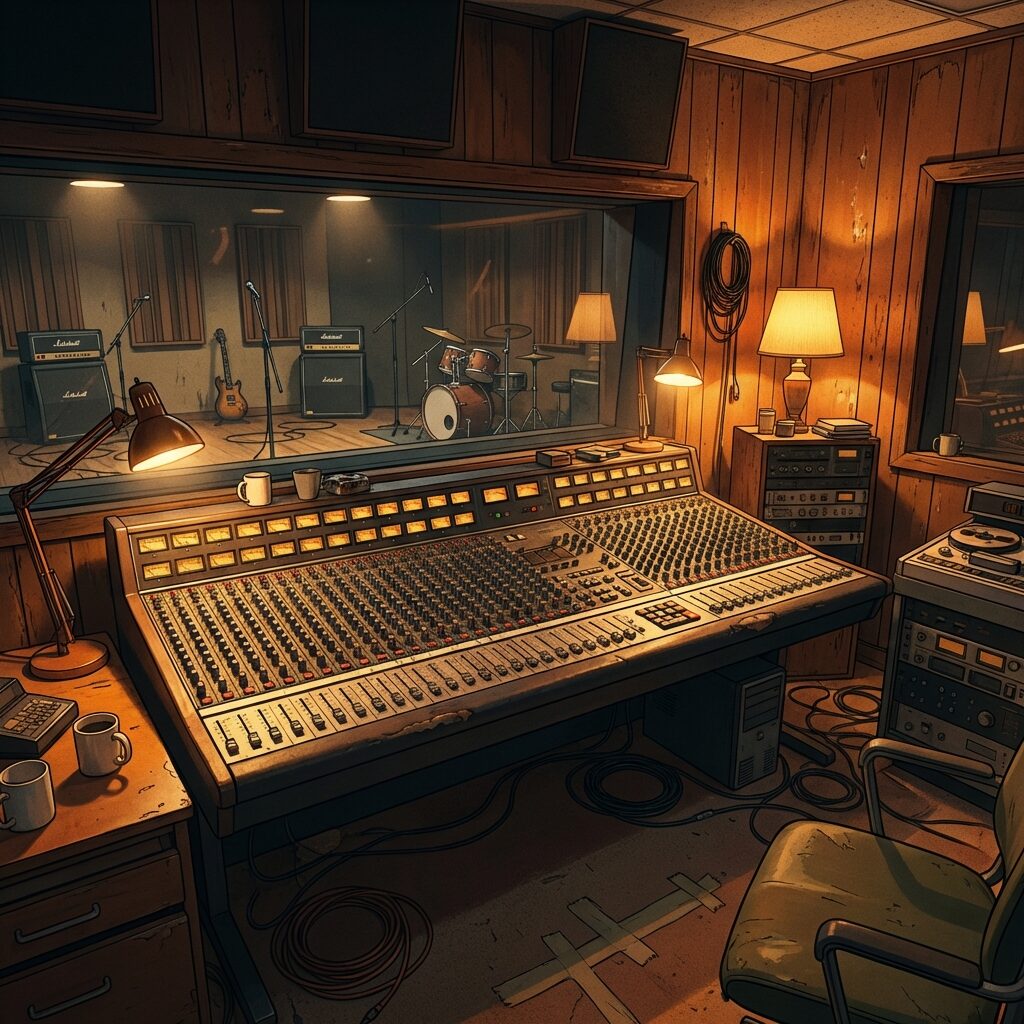
Before Nevermind existed as a record, it existed as a handful of cassette tapes. In April 1990, Nirvana spent four days at Smart Studios in Madison, Wisconsin, recording eight songs with Butch Vig. The lineup still included Chad Channing on drums. The songs included early versions of “Breed” (then called “Immodium”), “In Bloom,” “Lithium,” “Polly,” and “Stay Away” (then “Pay to Play”). Most of the arrangements were already worked out. Cobain was still tinkering with lyrics, which honestly never stopped being the case.
Those Smart Studios cassettes became underground currency. Copies circulated among industry people and scenesters, building the kind of buzz you can’t manufacture. The recordings were rough, but you could hear it, hooks buried in noise, the quiet-loud thing that nobody else was doing as well. One of those recordings, “Polly,” was so perfectly captured in its sparse, acoustic form that it ended up on the final album unchanged. It’s the only Smart Studios track that made the cut, recorded with Cobain’s beat-up Harmony Stella twelve-string, a guitar with only five nylon strings that were never changed, tuned down about a step and a half from standard.
A year later, with Grohl now on drums and the Geffen deal done, Cobain sent Vig another tape. This one was worse. Much worse. “Really terrible sounding,” Vig recalled. “You could barely make out anything. But I could hear the start to ‘Smells Like Teen Spirit,’ and I knew it was amazing.” Sit with that for a second. The song that arguably defined ’90s rock was first heard as a barely audible boombox recording, and even then you could tell what it was.
To earn gas money for the drive from the Pacific Northwest to Los Angeles, Nirvana played a show at Seattle’s OK Hotel on April 17, 1991. They debuted “Smells Like Teen Spirit” that night. Then they drove to L.A., rehearsed for a few days at a spot called 3rd Encore in Burbank with Vig stopping by to listen, and on May 2nd walked into Sound City Studios in Van Nuys to start recording.
Sound City was no accident. The studio’s massive live room and its custom-built Neve analog console were famous for producing enormous drum sounds, Jeff Porcaro of Toto was a regular for exactly that reason. For a band whose new drummer hit like he was trying to send the kit through the floor, it was the right room. Grohl’s setup was straightforward: a rented three-piece Tama Granstar kit from Drum Doctors, fitted with a heavy brass Tama Bell Brass snare that earned the nickname “the Terminator.” Vig’s drum miking was elaborate, an AKG D12 and FET 47 on the kick, a 57 and 451 on the snare, Sennheiser 421s on the toms, Neumann room mics, and a kick-drum tunnel made from two drum cases glued together with a packing blanket draped over the gap. The budget was $65,000, modest by major-label standards, and they had to work efficiently.
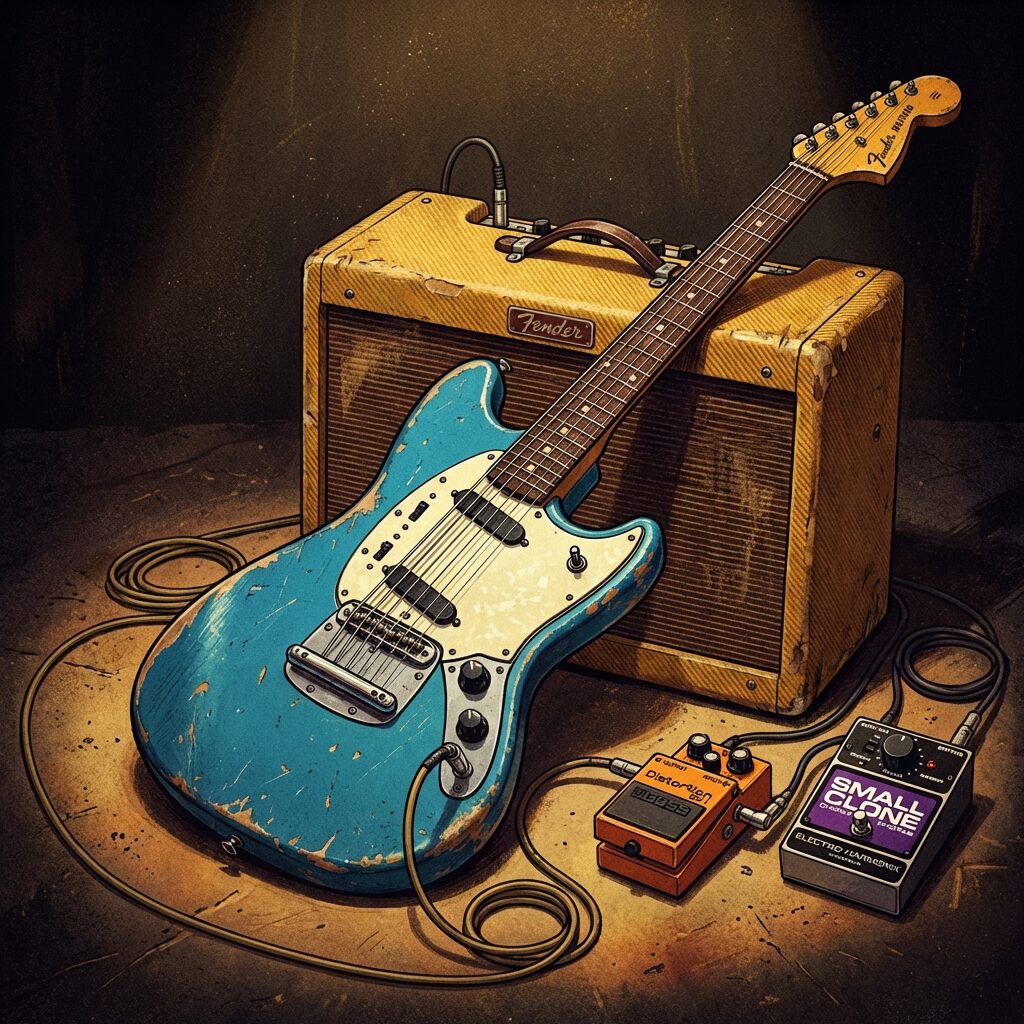
Cobain’s guitar arsenal was a mix of the cheap and the specific. His main instrument was a 1969 Lake Placid Blue Fender Competition Mustang, completely stock during the sessions. He also used a 1965 sunburst Fender Jaguar fitted with DiMarzio pickups, a Mosrite Gospel Mark IV, and various inexpensive Japanese Fender Stratocasters with humbucker bridge pickups. He preferred the Japanese Fenders for their skinny necks. His amp rig was a Mesa/Boogie Studio Preamp through Marshall 4×12 cabinets for most parts, a modified Fender Bassman for the heavier chorus sections, and a rented Vox AC30 for clean tones. His pedalboard was simple: Boss DS-1 with the tone set around 10 o’clock, a ProCo Rat, an Electro-Harmonix Big Muff Pi, and an Electro-Harmonix Small Clone chorus, the pedal responsible for that watery shimmer on the “Teen Spirit” pre-chorus and “Come as You Are.”
The sessions ran May 2 through 28. The band lived in a nearby apartment complex that Vig described as “chaos. There’d be graffiti on the walls, and the couches were upside down. They’d stay up every night and go down to Venice Beach until six in the morning.” Cobain nursed a bottle of Hycomine cough syrup throughout, partly recreational, partly to protect his voice. He’d do three or four vocal takes, max. That was it.
Getting those vocals right required some creative persuasion. Cobain resisted double-tracking, layering a second vocal performance over the first to thicken the sound. He thought it was dishonest, a studio trick that undermined the rawness he was after. Vig tried different arguments. Nothing worked. Then he mentioned that John Lennon had double-tracked his vocals on Beatles records. Cobain, who worshipped the Beatles, walked straight back to the microphone.
Some of the album’s best moments came from accidents or creative problem-solving. “Smells Like Teen Spirit” was tracked in three takes; they used take two. The basic track was done before anyone had time to overthink it. “Something in the Way” came together entirely differently, the full band tried playing it in the live room, but they couldn’t get quiet enough. The song needed to breathe, to whisper. So Cobain went into the control room, lay down on the couch, and played his Stella acoustic very softly. “It needs to sound like this,” he told Vig. The guitar had five strings. It wasn’t really in tune. Vig recorded it anyway, then overdubbed the bass and drums to match Cobain’s loose, free-time performance. It became the album closer because a band that dealt in volume simply could not figure out how to play quietly together.
The Mix That Made and Haunted It
Andy Wallace’s polished mix turned raw punk recordings into radio-ready rock, and Kurt Cobain never forgave it, even as it sold thirty million copies.
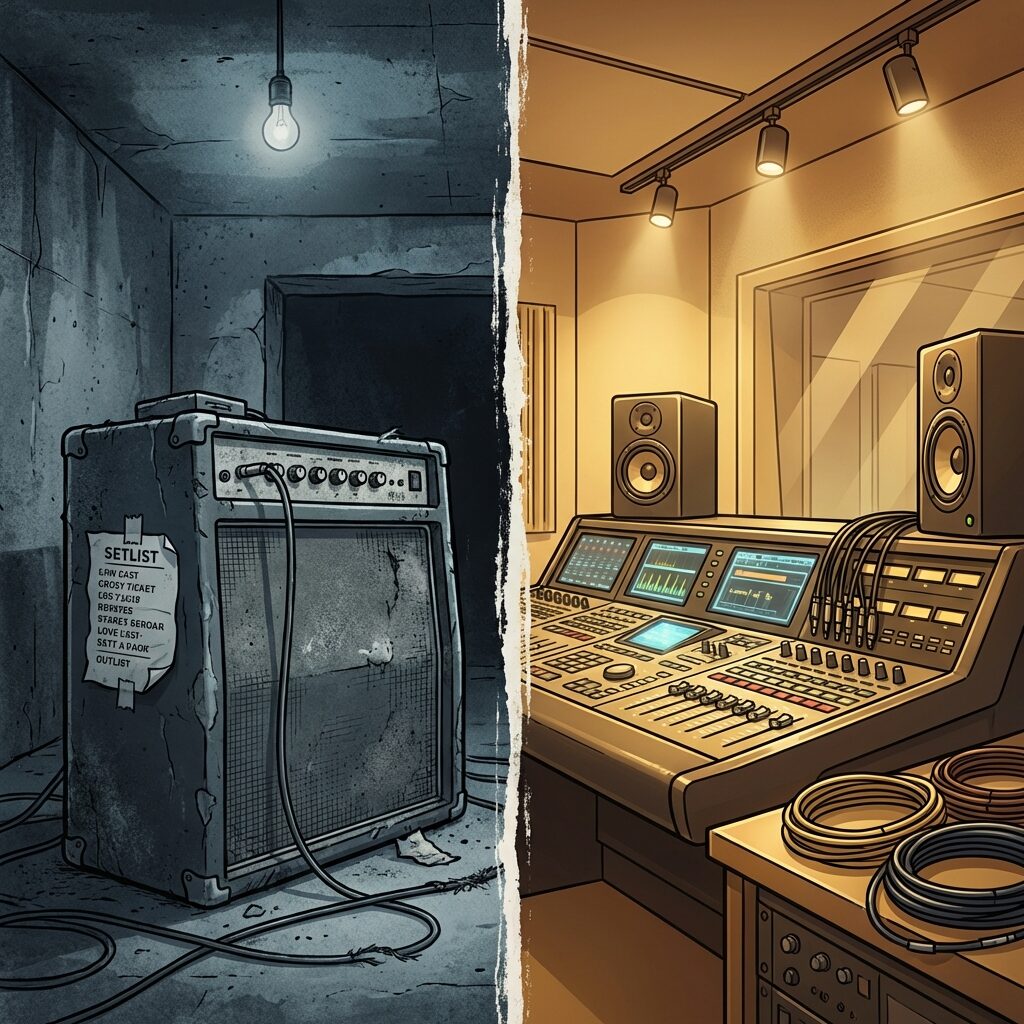
When the recording sessions at Sound City wrapped, Butch Vig took the tapes to Devonshire Studios in North Hollywood to mix. The results didn’t satisfy anyone. The “Devonshire Mixes,” as they became known, lacked something, clarity, punch, the ability to translate to speakers outside the studio. Geffen offered options for a dedicated mixing engineer: Scott Litt, who’d mixed R.E.M., and Ed Stasium, known for the Ramones and the Smithereens. Cobain was wary of names that big. He wanted someone who understood heaviness.
The choice landed on Andy Wallace, and the logic was hard to argue with. Wallace had co-produced Slayer’s Seasons in the Abyss. Krist Novoselic put it plainly: “We said, ‘right on,’ because those Slayer records were so heavy.” If a guy could make Slayer sound like that, surely he’d respect Nirvana’s aggression. What nobody quite anticipated was that Wallace would also bring the same surgical precision he applied to Slayer, cleaning, compressing, sculpting the sound into something far more polished than the raw tracks suggested.
Wallace’s techniques were specific and deliberate. He cranked the drums and treble through compression, giving Grohl’s already massive kit an even bigger sound. He scrubbed noise from the guitar tracks, the hiss and hum that Cobain might have considered part of the texture. He used an SSL noise gate to clean up cymbal bleed, applied triggered reverb samples overlaid with the original drum sound, and generally turned a punk-influenced recording into something that radio programmers could slot between Def Leppard and U2 without listeners reaching for the dial.
At the time, the band approved. Wallace and Vig both confirmed this, everyone was happy with the mixes when they left the studio. The regret came later, after the album became a phenomenon, after Cobain had time to sit with what Nevermind actually sounded like versus what he’d imagined it should sound like. He didn’t mince words: “Looking back on the production of Nevermind, I’m embarrassed by it now. It’s closer to a Motley Crue record than it is a punk rock record.”
But Cobain was more conflicted than that one quote lets on. In the same period, he admitted: “When I listen to Nevermind, I hate the production, but there’s something about it that almost makes me cry at times.” Hating the sound while being moved to tears by what lives underneath it. The songs were strong enough to survive any production choice, but the production is what carried them to thirty million ears.
Steve Albini, who would engineer Nirvana’s follow-up In Utero, had heard Vig’s original rough mixes and felt the loss: “They had a cassette of the rough Butch mix of Nevermind, and it sounded maybe 200 times more ass-kicking than what I remember of the released version.” Vig had a more generous read on Cobain’s complaints, theorizing that punk credibility made it impossible for Cobain to publicly embrace success: “You can’t really go, ‘Hey, I love our record and I’m glad it sold 10 million copies.’ That just doesn’t fit in with Cobain’s punk ethos.”
And this is the thing that won’t let the story rest, even thirty years on: the production Cobain compared to Motley Crue is exactly what made the album accessible to the audience that bought it. Strip away Wallace’s polish and you probably have a great punk record that sells a million copies to the already converted. Keep the polish and you have a great punk record wearing mainstream rock’s clothes, selling thirty million copies and rearranging the music industry in the process. Cobain wanted the first version. The world handed him the second. He spent the rest of his career trying to correct course.
Loud, Quiet, Loud
Nevermind’s secret weapon was a dynamic blueprint lifted from the Pixies, built on dead-simple chord progressions, a cheap chorus pedal, and guitar solos that Cobain genuinely thought were bad.
If you want to understand why Nevermind hits the way it does, start with the Pixies. Cobain never tried to hide this: “When I heard the Pixies for the first time, I connected with that band so heavily that I should have been in that band, or at least a Pixies cover band. We used their sense of dynamics, being soft and quiet and then loud and hard.” That quiet-loud-quiet-loud template structures nearly every song on the album. Gentle verses erupt into crushing choruses. He took it directly from Black Francis and company. What Cobain brought was a pop melodicism that the Pixies, for all their weirdness and aggression, never chased with the same single-mindedness.
Take “Smells Like Teen Spirit.” On paper, it’s almost insulting. Four power chords in F minor: F5, Bb5, Ab5, Db5. In Roman numeral terms, that’s i-iv-bIII-bVI, all diatonic to F natural minor, nothing exotic. Power chords omit the third entirely, so you don’t even get the minor coloring explicitly stated. Just roots and fifths. The most basic building blocks of rock guitar.
But those chords do more work than they should. The syncopated sixteenth-note strum pattern gives them a rhythmic propulsion that a straight eighth-note approach wouldn’t. The verses strip back to a two-note guitar figure over Novoselic’s root-note eighth-note bassline, barely there, almost shy. Then the pre-chorus introduces the same two notes on every beat, now filtered through the Small Clone chorus pedal, and you get that watery, shimmering chime that tells you the storm is coming. When the chorus hits, it’s the same four chords from the intro. But they feel like release instead of setup. Nothing changed except the context, and the context changes everything.
Cobain’s gear choices fed directly into these dynamics. The Mesa/Boogie Studio Preamp through Marshall cabs handled the cleaner verse tones, while the modified Fender Bassman came in for the heavier chorus overdubs. The Boss DS-1, tone knob at about 10 o’clock, distortion at 4, level maxed, gave him a fuzzy, compressed distortion that saturated without getting muddy. None of this was expensive or complicated. A kid working weekends at a record store could have afforded most of it. That was part of the point.
Vig’s panning choices in the stereo field don’t get talked about enough. He was precise about it: doubled guitar tracks split left and right, building a wall of sound across the stereo image. Single guitar parts panned left with a 20-30 millisecond delay panned right, which produces width and separation without needing a second performance. The center stayed reserved for vocals and snare, the two elements that had to cut through everything else. Describe the technique and it sounds obvious. Getting it to actually work requires knowing what you’re doing, and it’s a big reason Nevermind sounds so enormous on headphones.
And then there’s the guitar solo on “Teen Spirit.” Cobain just restates the vocal melody from the verse, almost note for note. No shredding, no pentatonic fireworks. He described his whole approach to solos as “verse, chorus, verse, chorus, solo, bad solo.” He meant it, he genuinely didn’t think of himself as a guitar player in any traditional sense. But that melodic restatement is a sneakily effective pop move. By the time the solo arrives, you’ve heard the melody twice in the verses. Now you hear it a third time on distorted guitar, and it burns the hook even deeper into your brain. The anti-solo ends up doing more than virtuosity would have. Cobain knew what the song needed, even if he would’ve shrugged and called it lazy.
Words That Almost Didn’t Matter
Cobain wrote melodies first and scrawled lyrics minutes before recording, yet the words on Nevermind range from opaque generational anthems to one of the most disturbing character studies in rock.
All right, let’s rock it to Russia
[Verse 1]
Kurt Cobain was a rock singer for Nirvana
He rocked the United States by flying all over the country and playing that rock and roll
He is a good singer
He is my rock star
[Chorus]
Kurt Cobain
Kurt Cobain
Kurt Cobain
Kurt Cobain
[Verse 2]
Nirvana’s 1991 Nevermind album, which has sold more then ten million copies, turned Kurt Cobain into a spokesman for his generation
It is a mantle with which he was never comfortable
He can really rock like a Magikist
He can really play that rock and roll
[Chorus]
Kurt Cobain
Kurt Cobain
Kurt Cobain
Kurt Cobain
[Verse 3]
Upon its release last September, In Utero shot to number one on the pop chart
There were signs of trouble when the band played two concerts at the Aragon in Chicago
The first show was a triumph
It was a knockout
[Chorus]
Kurt Cobain
Kurt Cobain
Kurt Cobain
Kurt Cobain
[Outro]
Rock over London, Rock on Chicago
Timex, it takes a licking and keeps on ticking
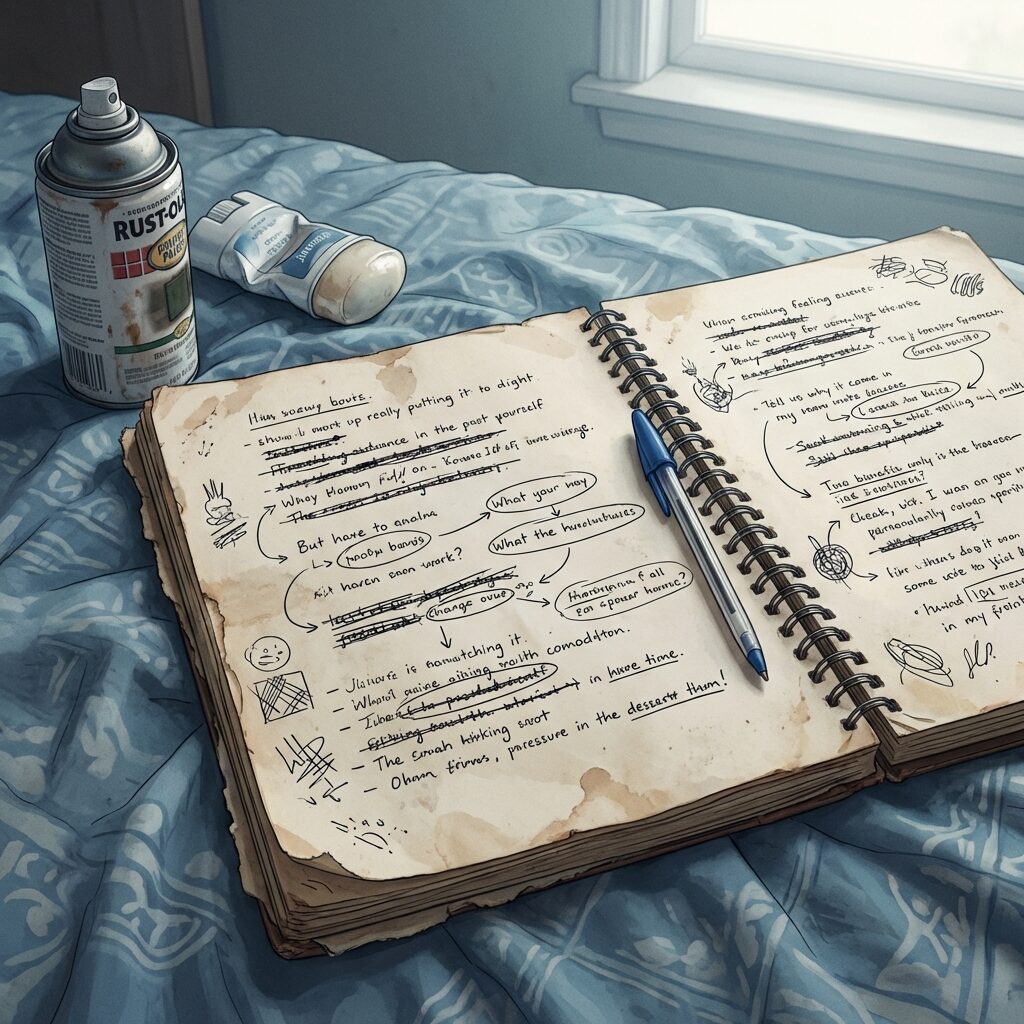
Kurt Cobain had a songwriting process that drove people around him slightly crazy. Melodies came first. He’d work them out on acoustic guitar, sitting around in his underwear, picking out riffs and fragments. The lyrics came last. Sometimes literally last. Dave Grohl watched it happen repeatedly and couldn’t square the results with the method: “Just seeing Kurt write the lyrics to a song five minutes before he first sings them, you just kind of find it a little bit hard to believe that the song has a lot to say about something.”
The lyrics to “Smells Like Teen Spirit” have one of the great origin stories in rock. Kathleen Hanna of Bikini Kill wrote “Kurt Smells Like Teen Spirit” on his bedroom wall, either with spray paint or a Sharpie, depending on who’s telling the story. Cobain, who was dating Bikini Kill’s Tobi Vail at the time, read it as a kind of revolutionary slogan, something about youthful rebellion. He loved it. He built an entire anthem around the spirit of what he thought it meant. He didn’t find out until after the song was released that Teen Spirit was a brand of deodorant. Hanna and Vail had discovered it at a grocery store, and Hanna was basically saying he smelled like his girlfriend’s deodorant. The most iconic song title of the 1990s was a joke about personal hygiene.
And it doesn’t matter. The lyrics to “Teen Spirit” are deliberately oblique, almost nonsensical in places, and they work precisely because of that opacity. “Here we are now, entertain us,” something Cobain used to say when walking into parties, became a generational rallying cry not because of what it specifically meant but because of what it felt like. Cobain said he wrote it because he was “disgusted with my generation’s apathy, and with my own apathy and spinelessness.” The self-implication is what matters. He wasn’t pointing fingers from outside. He was indicting himself too.
The album’s lyrical range is wider than people give it credit for. At one end, you have the impressionistic word-sound collages of “Teen Spirit” and “In Bloom.” At the other, you have “Polly,” one of the most disturbing songs to ever appear on a mainstream rock album. It’s based on the 1987 kidnapping and rape of a fourteen-year-old girl in Tacoma, Washington. The perpetrator, Gerald Arthur Friend, abducted her after a rock concert, tortured her with a blowtorch, a whip, a razor, and hot wax. She escaped by pretending to cooperate and fleeing when he stopped for gas. Cobain wrote the song from the abductor’s perspective, a choice that’s deliberately uncomfortable, forcing the listener into a point of view they don’t want to occupy. He called it “an anti-rape song.” The acoustic arrangement, carried over from the Smart Studios session, makes it worse in the right way. There’s no wall of distortion to hide behind.
“In Bloom” does something else entirely. It’s Cobain’s sardonic commentary on the very audience that was about to make him famous, people who’d sing along without understanding or caring what the words meant. Given that Nevermind would soon be purchased by millions of listeners doing exactly that, you can read it as prophetic or ironic or both. Cobain’s journals, published posthumously in 2002, revealed that he’d intended the album to have distinct “girl” and “boy” sides, though that concept didn’t survive into the final sequencing. The liner notes withheld full lyrics deliberately, another small act of resistance against being fully consumed.
Cobain prioritized how words sounded over what they meant. This should have been a limitation. Instead, lyrics written for their phonetic texture rather than their semantic content ended up meaning more to more people than carefully crafted “meaningful” songwriting typically does. Nobody needed to decode them. You just had to feel shut out of something and the songs already belonged to you.
The Pep Rally That Burned Down
The ‘Smells Like Teen Spirit’ video was directed by a guy hired for having the worst demo reel, featured cheerleaders recruited from strip clubs, and ended with the extras genuinely trashing the set, and it rewired MTV overnight.
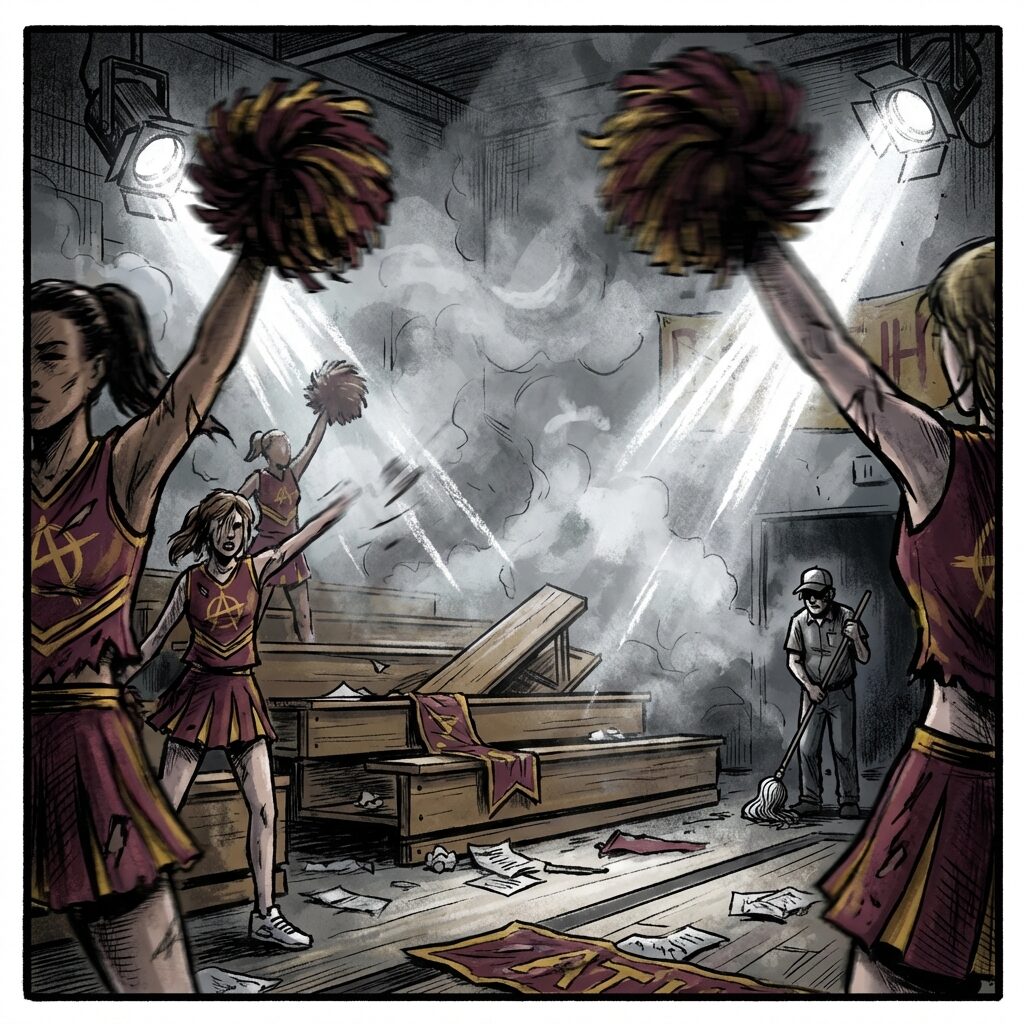
The video for “Smells Like Teen Spirit” was directed by Samuel Bayer, and the reason he got the job says a lot about how Cobain operated. Bayer was hired because his demo reel was the worst one submitted. Cobain flipped through a stack of polished pitch reels from experienced directors, watched Bayer’s rough, amateurish submission, and decided that was the one. Punk rock. The band nicknamed him “Jethro Napoleon.” It was not a compliment.
The concept was a high school pep rally that descends into anarchy, inspired by the 1979 film Over the Edge and the Ramones vehicle Rock ‘n’ Roll High School. Cobain had specific ideas about the casting. He wanted “really ugly overweight cheerleaders”, his words, as part of the anti-glamour aesthetic. Bayer, who apparently had different ideas about what made good television, recruited the cheerleaders from strip clubs instead. “Those cheerleaders look like strippers,” Grohl observed, because they were.
Filming took place on August 17, 1991, at GMT Studios in Culver City, a single day that ran somewhere between eight and thirteen hours, depending on who’s counting. The budget was modest, between $30,000 and $50,000. Extras were recruited from a recent Nirvana show at the Roxy and the Whisky A Go Go, lured by flyers promising: “Nirvana needs YOU to appear in their upcoming music video.” The janitor in the video was an actual janitor, from Bayer’s apartment complex in Venice. He had an asthma attack from the stage smoke during filming.
The creative conflict between Cobain and Bayer is what produced the video’s best moment. Cobain refused to lip-sync the song. Flat-out wouldn’t do it. The label and Bayer needed at least one usable performance, so they talked Cobain into singing it for real, just once. What came out of that was a gift disguised as hostility. “He gave this incredible performance that was kind of directed at me that was filled with venom and anger,” Bayer recalled. That one angry take, Cobain’s genuine contempt for the process, aimed straight at the camera, is the video. You can see it in his eyes. He’s not performing. He’s actually pissed off, and it comes across as real in a way no director could have planned.
The final thirty seconds are unscripted. The extras, who’d been filming all day in a hot, smoky gymnasium, were genuinely fed up. When they started destroying the set, it wasn’t choreographed. “I just happened to have a roll of film in the camera,” Bayer said. Cobain later re-edited Bayer’s cut, removing footage of a principal figure and a teacher in a dunce cap, adding more close-ups of himself at the end. Even in the edit bay, he was fighting for control of how the band was presented.
The video premiered September 29, 1991, on MTV’s late-night show 120 Minutes. It didn’t stay in late-night rotation for long. It moved to daytime, then to the Buzz Bin, MTV’s endorsement slot for breaking artists. Amy Finnerty, who worked in MTV programming, said the video “changed the entire look of MTV” and gave the channel “a whole new generation to sell to.” MTV even created a version with on-screen lyrics because viewers kept calling in asking what Cobain was singing. Think about that for a second: a video made by a first-time director hired for being unqualified, starring a lead singer who refused to lip-sync, ending with unplanned property destruction, and it’s the clip that broke MTV wide open. Everything about Nevermind worked best when it went wrong.
46,000 Copies to 30 Million
Nevermind went from 46,000 copies shipped to outselling both Guns N’ Roses Use Your Illusion albums combined, buried hair metal practically overnight, and thirty-plus years later still moves 10,000 units a week.
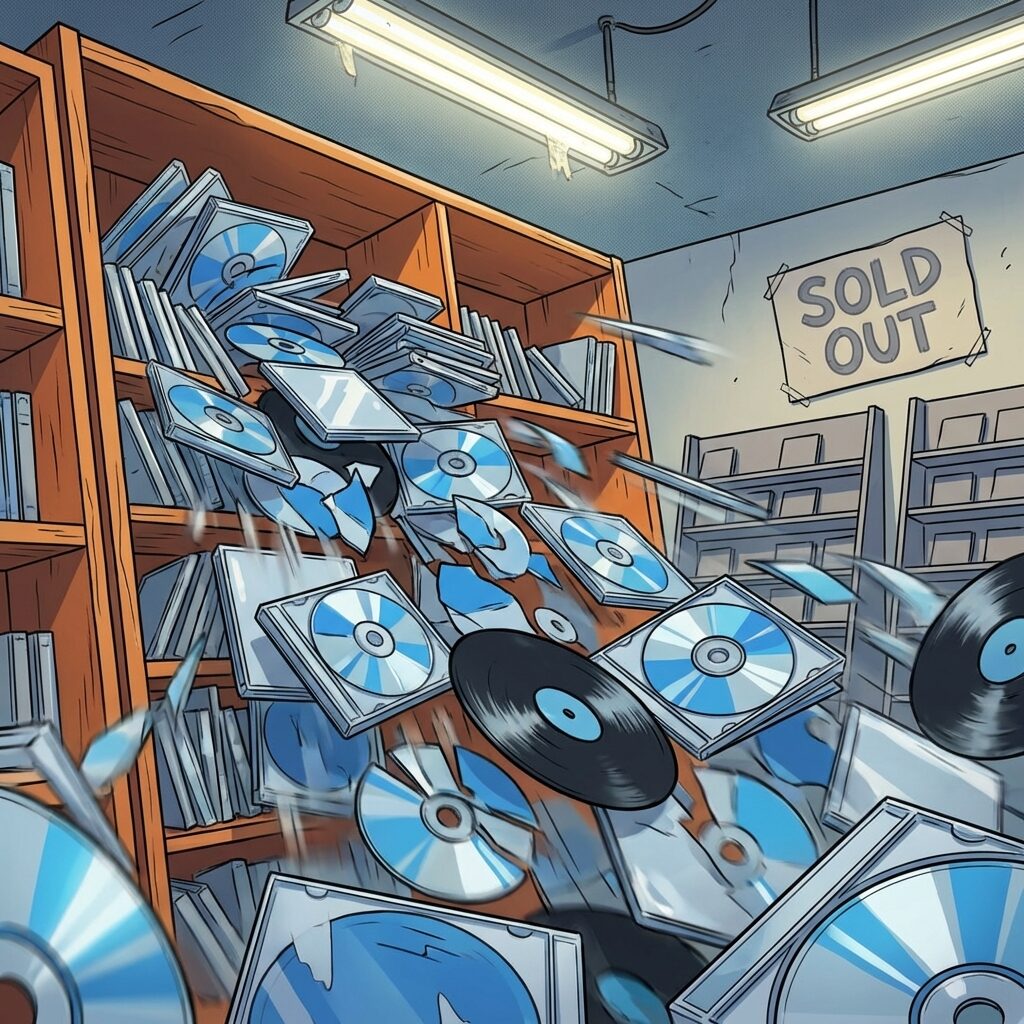
The numbers still don’t quite make sense. First week: 6,000 copies sold, with about 46,000 shipped to stores. By November, it was gold and platinum, 500,000 and a million units respectively. By Christmas, the weekly sales figure had climbed to 374,000. On January 11, 1992, Nevermind hit number one on the Billboard 200 at 373,520 copies in a single week, pushing Michael Jackson’s Dangerous all the way down to number five. It spent two non-consecutive weeks at the top, with Garth Brooks’s Ropin’ the Wind briefly reclaiming the summit in between. By early 1992, record stores were receiving more copies of Nevermind than both Guns N’ Roses Use Your Illusion releases combined.
September: 6,000 copies a week. January: 374,000 a week. That isn’t a build. That’s an explosion with a distribution deal.
Hair metal got buried fast. The genre had dominated rock radio and MTV for most of the 1980s, and then suddenly it was over. Skid Row’s Slave to the Grind, released earlier in 1991, had gone double platinum. Their 1993 follow-up couldn’t even reach gold. Kip Winger, whose band had been a fixture of the late-’80s scene, called the grunge era “the Dark Ages.” You can understand his perspective. One week you’re selling out arenas in spandex; the next, the entire aesthetic you built your career on is a punchline. Whitesnake, Slaughter, Warrant, Ratt, Twisted Sister, gone. A record made by a band that didn’t even want to be on a major label had accidentally wiped out an entire genre.
The album was certified Diamond, ten million units, by the RIAA on March 24, 1999. Current certification stands at thirteen times platinum. Worldwide sales have been estimated at over thirty million copies, though exact international figures are hard to pin down. The thing just won’t stop selling. In May 2024, Nevermind was still moving over 10,000 equivalent units per week. It’s spent more than 700 weeks on the Billboard 200, making it only the ninth album in history to reach that mark.
The streaming numbers are ridiculous. “Smells Like Teen Spirit” has racked up roughly 2.8 billion plays on Spotify alone, plus another two billion views on YouTube. In June 2021, it became the first grunge song to hit one billion Spotify streams, following Oasis’s “Wonderwall,” which reached that milestone the previous October. It’s been on the Billboard Global 200 for over 208 weeks. A song released on cassette and CD in 1991 is still charting in a format that didn’t exist until 2020. Eddie Gilreath, Geffen’s VP of Sales, captured the bewilderment early on: “From what we gather, Nevermind’s audience is between 14 and 34. If you told me last year it would outsell U2 I’d probably die laughing.”
Before Nevermind and After
Nevermind didn’t just change the charts. It split the record business into two eras, kicked open major-label doors for an entire underground, and wound up in the Library of Congress.
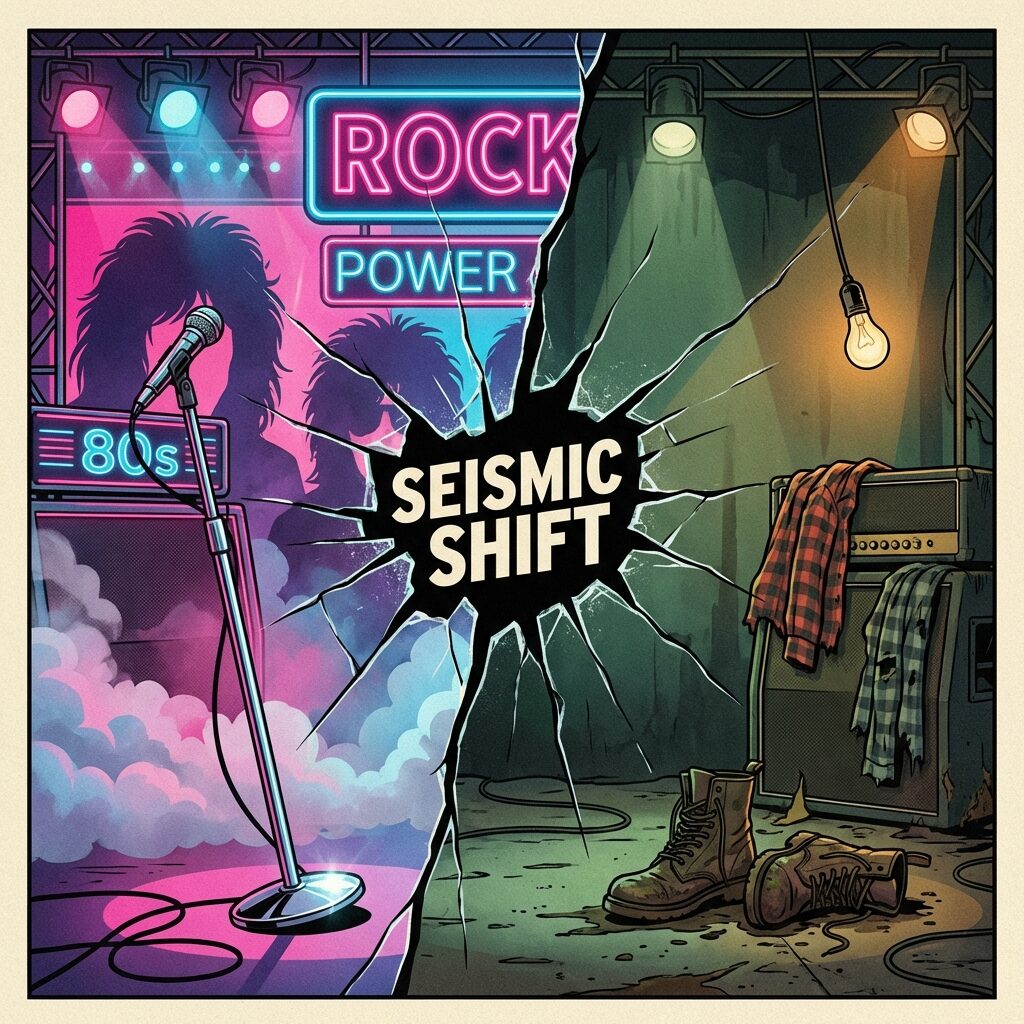
Gary Gersh, the A&R man who signed Nirvana to DGC, put it bluntly: “There is a pre-Nirvana and post-Nirvana record business. Nevermind showed that this wasn’t some alternative thing happening off in a corner, and then back to reality.” He wasn’t wrong. Before Nevermind, underground and mainstream rock lived in separate worlds with almost no crossover. After it, every major label scrambled to sign anything that sounded vaguely alternative, and the whole commercial rock apparatus lurched in a new direction.
The situation Nirvana found themselves in during late 1991 and early 1992 was almost funny. They were opening for Pearl Jam and the Red Hot Chili Peppers on arena tours, playing earlier in the evening, lower on the bill, while simultaneously being the only act of the three with a number-one record. The industry hadn’t caught up to the charts. Billing hierarchies get booked months in advance; Nevermind‘s explosion happened faster than anyone’s tour contracts could accommodate.
Michael Azerrad, who wrote the definitive Nirvana biography Come as You Are, argued that Nevermind was more than a hit record. He compared it to the rock-and-roll explosion of the 1950s. Just as Elvis and Chuck Berry ended the dominance of big-band pop and Tin Pan Alley, Nirvana broke the Baby Boomer generation’s grip on what rock music was supposed to sound like and who it was for. You can quibble with the comparison, but the scale of the disruption is hard to argue with. The grunge explosion of fall 1991, with Nevermind, Pearl Jam’s Ten, and Soundgarden’s Badmotorfinger all released within weeks of each other, didn’t just shift commercial momentum. It changed what young people were allowed to care about in their music.
The fallout went on for years. Dave Grohl formed Foo Fighters in 1994, building a career that would eventually rival Nirvana’s commercial reach. Tony Berg signed Beck to Geffen after Nevermind proved there was a massive appetite for something different. The post-grunge wave, Bush, Candlebox, Collective Soul, Creed, Nickelback, Matchbox Twenty, spent the rest of the decade strip-mining the loud-quiet-loud template for increasingly diminishing artistic returns. You can draw a straight line from Nevermind to virtually every rock band that got a major-label deal in the 1990s, for better and for worse.
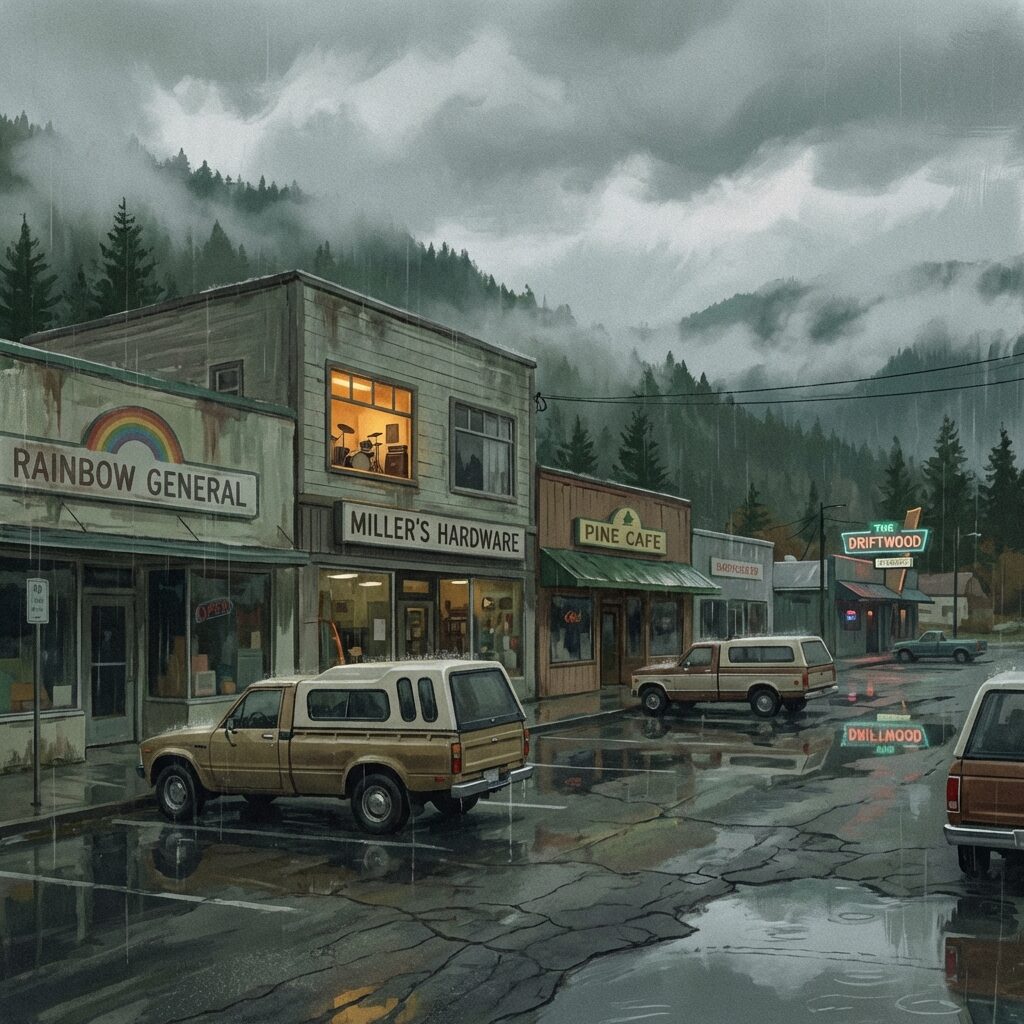
The institutional honors have piled up accordingly. Rolling Stone ranked it number six on their 2020 revision of the 500 Greatest Albums of All Time. It hit number one on all-time lists from MTV, Q Magazine, and Alternative Press. The Library of Congress added it to the National Recording Registry in 2004, an honor typically reserved for recordings of “cultural, artistic, or historical importance.” It entered the Grammy Hall of Fame in 2018, two years before Nirvana received the Grammys’ Lifetime Achievement Award. The cover image, the underwater baby, the dollar bill, the fishhook, is in MoMA’s collection. For a record that its creator once compared unfavorably to Motley Crue, that’s a hell of an afterlife.
And it wasn’t just an English-speaking phenomenon. Nevermind hit across South America, Europe, South Africa, and the Far East. Grunge was the last time a guitar-based rock movement genuinely conquered the planet. The bands that followed Nirvana through the door didn’t always honor what the door was opened for, but the door itself, the proof that raw, emotionally honest, sonically aggressive music could sell at pop-star numbers, that was Nevermind‘s lasting gift to everyone who came after.
The Record That Hated Itself
Nevermind remains rock’s great paradox, an album that accidentally became the biggest of its generation, made by a guy who kept trying to sabotage it and failing upward every time.
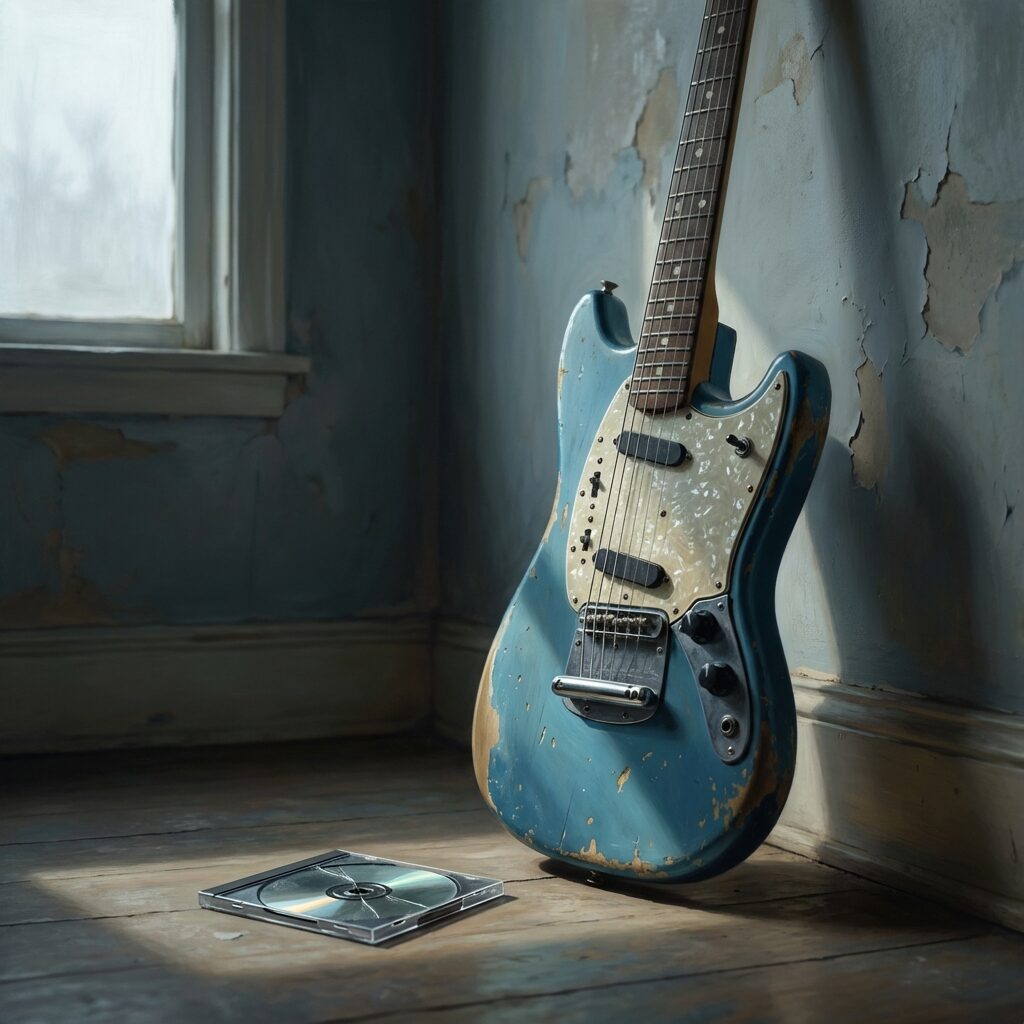
So here’s where we end up. Kurt Cobain made a record he was simultaneously proud of and embarrassed by. He hated the production but almost cried when he heard it. He wanted to make a punk album and ended up with what he called a Motley Crue record. He picked the worst video director he could find and got a clip that ended up plastered across MTV for two years straight. He wrote lyrics five minutes before singing them and somehow nailed what a lot of people were feeling but couldn’t say. Every attempt at sabotage, every instinct toward rawness and resistance, got swallowed by the machine around him and came out the other side smoother, louder, and way more popular than he ever wanted.
The album was almost called Sheep. Cobain changed it to Nevermind because the word captured his attitude toward life and because it was grammatically incorrect, the proper form is “never mind,” two words. Both titles turned out to be prophetic. Thirty million people followed each other to the record store like sheep. And Cobain’s response to the whole phenomenon, the fame, the money, watching his own work get away from him, was essentially: nevermind.
Nevermind has a creation story that’s genuinely as compelling as the songs. Not because of behind-the-scenes drama or celebrity gossip, but because the fight baked into every recording session, punk kid versus major-label machinery, what Cobain wanted the record to be versus what audiences actually latched onto, is the same fight that’s been powering good rock music since the fifties. The music pushes against its own packaging. The rawness fights through the polish. The guy singing doesn’t fully want you to hear it this way, and that friction is part of why it still sounds like it means something.
Thirty-plus million copies sold. 2.8 billion streams on a single song. Number six on Rolling Stone’s all-time list. Library of Congress. Grammy Hall of Fame. MoMA. Seven hundred weeks on the Billboard 200 and counting. All for a record that conquered the world while its creator was trying to steer it into a ditch. It might be the biggest accident in the history of popular music. And if Kurt Cobain could hear me say that, he’d probably hate it, which, honestly, only makes me more sure I’m right.
🎸 Did you know? Nirvana’s label expected Nevermind to sell 250,000 copies. By Christmas 1991 it was moving 374,000 copies PER WEEK. Nobody ducked fast enough. #Nirvana #Nevermind #90sRock 🤯 https://bit.ly/4t56pLC

Click to Tweet