Third Eye Blind | Semi-Charmed Life
The Brightest Dark Song
A song about crystal meth addiction became one of the most beloved pop anthems of the ’90s. Nearly three decades later, people are still finding out they were tricked, and the deception runs deeper than just the lyrics.
Here’s something that happens on TikTok roughly once a month: a twenty-something posts a video of themselves reading the lyrics to “Semi-Charmed Life” for the first time. Their face goes through about four stages of grief. The comments fill up with #ChildhoodRuined. And the rest of us who figured this out sometime around 2006 nod along like, yeah. Welcome to the club.
Because “Semi-Charmed Life” might be the best trick ever pulled in pop music. Not the best song, though it’s up there, but the best misdirection. A song about crystal meth addiction, sexual desperation, and a life that’s collapsing behind a glossy smile, wrapped in a melody so aggressively sunny that Dave Grohl told Spin magazine in 1998 it was the refrain from the previous year he most wished he’d written. Dave Grohl. The guy who wrote “Everlong.” He wanted that doo-doo-doo.
Stephan Jenkins, the man who wrote and sang it, has never been coy about what he made. “It’s a dirty, filthy song about snorting speed and getting blow jobs,” he told Billboard in 1997. “It really is funny that people play it on the radio.” He said this while the song was climbing to number four on the Hot 100. While soccer moms were singing the chorus in minivans. While radio programmers across America were trying to figure out which parts to censor and which parts to pretend they hadn’t noticed.
Jenkins designed “Semi-Charmed Life” to fool you. The bright guitar riff, the bouncing rhythm, the irresistible doo-doo-doo hook lifted straight from Lou Reed. All of it engineered to sound like the best day of your summer while describing the worst year of someone’s life. And it worked. For nearly three decades, it worked.
What nobody talks about is that the deception doesn’t stop at the lyrics. The song’s own origin story is just as propped-up, just as semi-charmed, as the life it describes. Bought riffs. Disputed credits. A $10,000 handshake that erased a co-writer from history. A producer who went on the record saying people got screwed. The song about a beautiful lie has been living one of its own since before it was ever recorded.
So let me tell you how deep this goes.
A Closet on Haight Street
Before Third Eye Blind existed, Stephan Jenkins was a rapper sleeping in a closet in San Francisco, and the riff that would define a generation belonged to someone else.
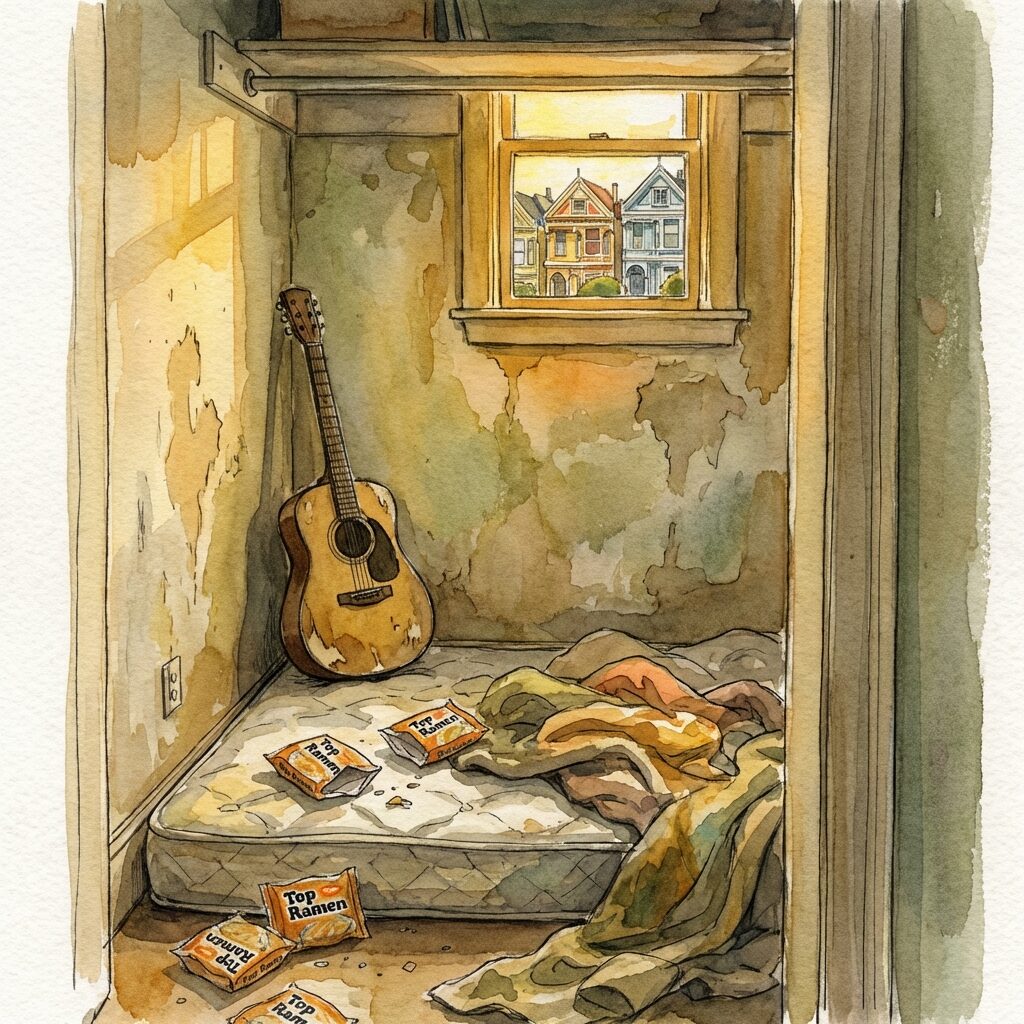
Before he was the frontman of Third Eye Blind, before the record deals and the lawsuits and the stadium tours, Stephan Jenkins was sleeping in a closet.
Literally. A closet. On lower Haight Street in San Francisco, sometime around 1990, eating Top Ramen and absorbing the city whole. He’d later call this period “my 1967, my Summer of Love”, which tells you a lot about how Jenkins narrates his own life. Most people would call sleeping in a closet and eating ramen a rough patch. Jenkins called it his origin story.
And in a way, it was. Because this is where “Semi-Charmed Life” got its start, years before the song had a name or a band to play it. In 1992, Jenkins formed a rap duo called Puck and Natty, later renamed Puck and Zen, with Herman Anthony Chunn, a rapper from Detroit who went by Zen. Jenkins rapped. Chunn played guitar. And somewhere in those sessions, Chunn wrote a guitar riff. Bright, bouncy, with that ascending pattern that would eventually get a hundred million people singing doo-doo-doo.
Puck and Natty had a minor moment. They got a track called “Just Wanna Be Your Friend” onto a Beverly Hills 90210 soundtrack. Capitol Records sniffed around. But the duo imploded over production disagreements with the label, and that was that. Except for the riff. The riff stuck.
What happened next is where the story gets uncomfortable. With help from manager Eric Godtland, Jenkins paid Chunn $10,000 to buy out the rights to the guitar riffs, including the one that would become “Semi-Charmed Life.” Godtland, to his credit, reportedly advised Chunn against selling. But Jenkins pushed. “I kept going until it was my song,” he told an interviewer, adding to SFGate: “He wrote part of the music, part of the riff.”
Ten thousand dollars. In 1997, “Semi-Charmed Life” would spend eight weeks at number one on Modern Rock Tracks, peak at number four on the Hot 100, and help push a debut album to six-times-platinum sales, over six million copies in the US alone. That $10,000 bought Jenkins a career. What it bought Chunn was the right to watch someone else get famous playing his riff.
But before all that, there’s a scene worth knowing about. During those scrappy San Francisco years, Jenkins found himself sitting in a room with another struggling musician, a waitress who worked down the street named Linda Perry. They played each other their songs. Jenkins played an early sketch of what would become “Semi-Charmed Life.” Perry played an early version of “What’s Up?” Two songs, one room. Those tracks would go on to sell a combined 17 million records across two different bands, Third Eye Blind and 4 Non Blondes. Jenkins says he didn’t appreciate what that session was until decades later.
The riff had a sound. It needed a subject. That came at a Primus concert, where Jenkins watched friends cycle through the glittering highs and jaw-clenching lows of crystal meth. “It’s about a time in my life when it seemed like all of my friends just sort of tapped out on speed,” he told Billboard. The observation found the riff, and both found the San Francisco street-level desperation of a guy who’d been sleeping in closets and rapping over borrowed guitar parts. That’s where “Semi-Charmed Life” actually comes from. Not a polished songwriting session. A closet, a $10,000 check, and a concert where everyone around you is tweaking.
Five Tries for the Groove
It took five demo iterations, $10,000 in tape stock, four different guitars, and sessions at Skywalker Ranch to capture a groove that Jenkins could hear in his head but couldn’t get onto tape.
“Semi-Charmed Life” was not born fully formed. Jenkins dragged it through five separate demo iterations, each one chasing something he could hear in his head but couldn’t get onto tape.
Bassist Arion Salazar, who was there for the early versions, described what the song started as: “a one-dimensional, acoustic guitar troubadour-y first position thing with basic guitar chords and some bohemian rapping.” If you’re having trouble picturing that, imagine a coffeehouse open mic performer trying to channel both Lou Reed and A Tribe Called Quest simultaneously, and not quite pulling off either. That was demo one.
The problem was the groove. Jenkins knew the riff was good. He knew the melody was there. But something in the rhythm wasn’t cooking. “I kept recording it because the groove wasn’t right,” he recalled. RCA had given him money to work on demos, and he burned through iteration after iteration. A 1995 demo exists, good enough to be considered for the compilation album A Collection years later, but still not right. In that version, the lyric was “crystal methylene will lift you up until you break,” a word Jenkins would later sharpen to the blunter “crystal meth.” He was getting more explicit as the song evolved, not less. He trusted the Trojan horse enough to stop disguising the payload.
The breakthrough came when Jenkins went back to basics. He returned to the drum machine loop from the original demo and layered drummer Brad Hargreaves’ live playing over the top of it. The rigid loop underneath, the breathing drums on top. That collision gave the song its relentless forward momentum. It’s why “Semi-Charmed Life” feels like it’s always accelerating even though the tempo holds steady at 102 BPM. The groove wasn’t one thing. It was two things stacked.
Kevin Cadogan, the band’s guitarist, says he was co-writing with Jenkins and Salazar during sessions at TML Studios as early as 1994. Third Eye Blind started recording a third demo with producer Eric Valentine from late 1995 into February 1996, partially funded by RCA. The song was being shaped by multiple hands across multiple years, even if the credits would eventually tell a simpler story.
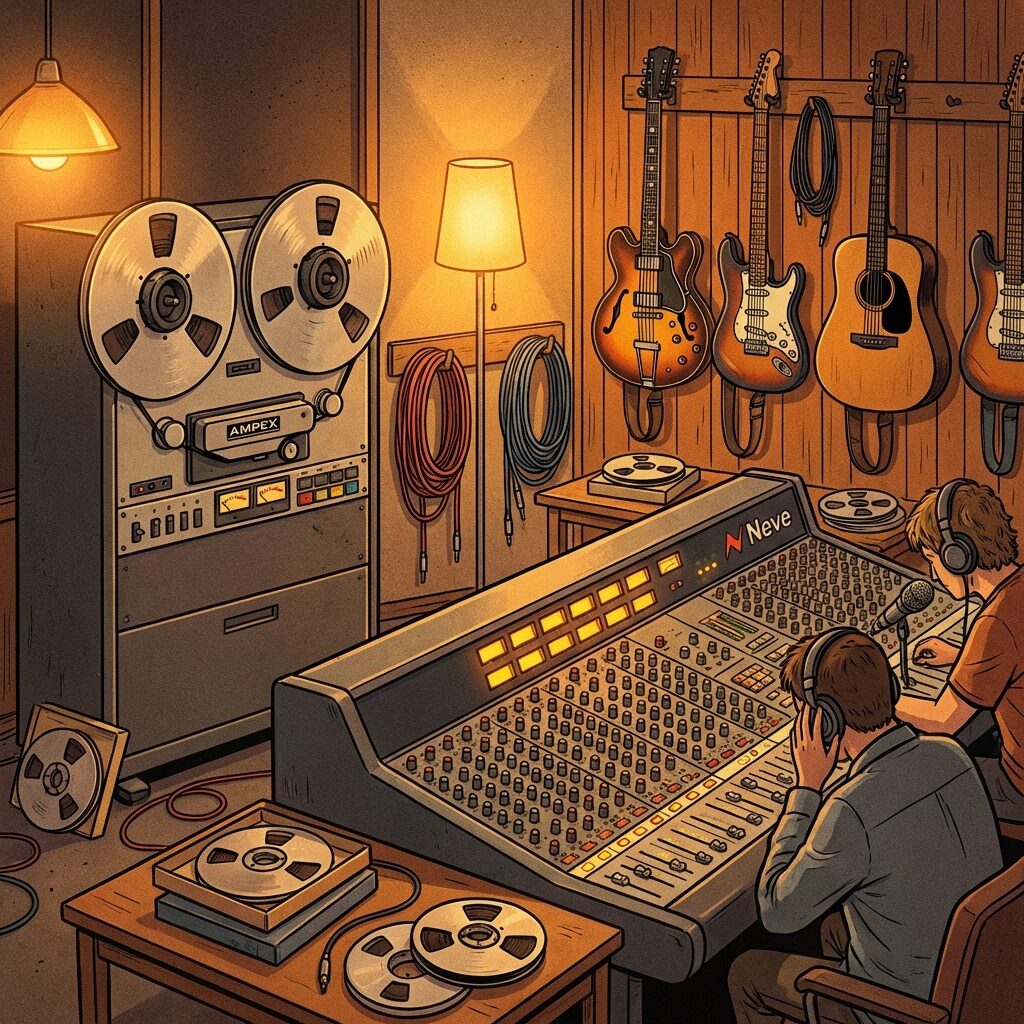
The final recording happened in 1996 across several Bay Area studios: Toast Studios (also known as Coast Recorders), Skywalker Ranch, and H.O.S. Valentine, who co-produced with Jenkins, made a choice that shaped the song’s sound more than most listeners realize. He recorded the whole thing directly to analog tape. No computers. The core rhythm section, drums, bass, rhythm guitar, was captured live on an Ampex MM1200 two-inch sixteen-track recorder running at 30 inches per second. The tape stock was premium 3M 996, and Valentine burned through roughly $10,000 worth of it. The tape alone cost as much as the riff.
Valentine mixed on a Neve 8078 console using a Studer A800 tape recorder. Every bit of warmth, every slight compression artifact, every subtle saturation you hear on that recording is magnetic tape doing what magnetic tape does. There’s a thickness to the sound of “Semi-Charmed Life” that you don’t get from digital recording, a way the low end pushes and the high end rounds off. Pure analog.
On top of that foundation, Cadogan built a wall of guitars. Four of them: an Epiphone Casino, a Hamer electric, a Gibson J-200 acoustic, and a Gretsch Country Gentleman. Each guitar has a different tonal character. The Casino’s hollow-body jangle, the Hamer’s midrange bite, the J-200’s booming acoustic warmth, the Gretsch’s smooth, slightly nasal twang. Layered together, they create that dense, shimmering guitar texture that fills every corner of the mix without ever feeling cluttered. Phil Spector’s wall-of-sound approach applied to ’90s alt-rock. A huge part of why the song sounds so big even on a car radio with one working speaker.
When it came time to pick a lead single, Elektra Records wanted “Semi-Charmed Life.” The band had planned to lead with “Losing a Whole Year.” Jenkins resisted, feeling the song wasn’t representative of the album as a whole. Cadogan worried about the explicit content, whether radio stations would even touch it. The label pushed. The label was right. Sometimes the suits hear what the musicians can’t: this is the one.
Three Chords and a Lie
G-D-C. That’s it. The same three chords for the entire song, yet it never feels like a loop, thanks to arrangement tricks, hip-hop cadence in the verses, and a melody that quietly fights its own harmony.

Let’s talk about what’s actually happening in this song musically, because the trick Jenkins pulled isn’t just lyrical. It’s structural.
“Semi-Charmed Life” runs on three chords: G, D, and C. That’s it. The verse is G-D-C. The chorus is G-D-C. The bridge wanders briefly through G/B and A minor, but functionally, you’re hearing the same I-V-IV progression looped for four minutes and twenty-eight seconds. These are the three most important chords in the key of G Major, the 1st, 5th, and 4th scale degrees. A guitarist can learn the whole thing in about ten minutes.
So why doesn’t it feel like a loop?
Because Jenkins was smart about where he put the other kind of complexity. The chord progression stays locked so everything else can move around it. The verses come in this rapid-fire, semi-rapped cadence, a holdover from his Puck and Natty days, syllables packed tight, rhythmic emphasis landing in weird places. Then the chorus blows the doors open into a wide, anthemic belt. Same chords. Totally different energy. The movement comes from contrast, not harmony.
Jenkins was explicit about this being intentional. “Speed’s a very bright, shiny drug, and I wanted the song to sound like that, but I also wanted the frustration in there,” he told Billboard. “That’s why you have that bright, melodic chorus but also that dirty guitar sound.” He’s describing the bright/dark split at the musical level, the chorus sounds like the high, the verses sound like the hustle to get there.
Then there’s the hook. That doo-doo-doo. Jenkins has been upfront about where it came from: Lou Reed’s “Walk on the Wild Side,” the 1972 classic about the denizens of Andy Warhol’s Factory. It wasn’t a subconscious lift, it was a conscious homage. Jenkins saw “Semi-Charmed Life” as a San Francisco answer song to Reed’s New York portrait. “When I wrote it, I thought of my life at the time, I thought of Lou Reed and how I thought Lou Reed had nothing on the way that we were living,” he told Kerrang!. Both songs use a deceptively gentle vocal hook to pull you into stories about drug use and the sex trade. Reed did it with a strolling bass line and deadpan delivery. Jenkins did it with power chords and a grin. Same trick, different decade, different coast.
There’s a subtler thing going on too. According to Hooktheory’s analysis, “Semi-Charmed Life” has higher-than-average chord-melody tension, the melody notes Jenkins sings don’t always sit comfortably on the chords underneath them. They rub against each other in small ways. You probably don’t hear this consciously. What you hear is that the song feels slightly unsettled beneath all that brightness, like something’s off even though you can’t say what. That friction mirrors the lyrical strategy almost perfectly: everything seems fine on the surface, but listen closely enough and there’s grit underneath.
Salazar described the song’s sound as incorporating “shoegazer and big guitar-chord soundscape” elements, which is an interesting way to frame it. Shoegaze uses walls of distorted guitar to build an immersive, almost overwhelming sonic environment, think My Bloody Valentine or Slowdive. “Semi-Charmed Life” isn’t shoegaze, obviously, but it borrows that idea of layered guitars creating a space rather than just playing a part. Cadogan’s four-guitar layering builds exactly that kind of enveloping texture. Billboard called the overall sound “a more aggressive The Smiths or a moodier Jellyfish”, a comparison that nails the mix of jangly melody and emotional undertow.
Hiding in Plain Sight
The drug references in “Semi-Charmed Life” aren’t hidden, they’re right there in the lyrics, including the words “doing crystal meth.” Listeners just never caught them because the melody was too catchy to listen through.
Doo-doo-doo, doo-doo-doo-doo
Doo-doo-doo, doo-doo-doo-doo
Doo-doo-doo, doo-doo-doo-doo
Doo-doo-doo[Verse 1]
I’m packed and I’m holdin’
I’m smilin’, she livin’, she golden
She lives for me, says she lives for me, ovation
Her own motivation
She comes ’round and she goes down on me
And I’ll make you smile like a drug for you
Do ever what you want to do, comin’ over you
Keep on smilin’ what we go through
One stop to the rhythm that divides you
[Pre-Chorus]
And I speak to you like the chorus to the verse
Chop another line like a coda with a curse
Come on like a freak show takes the stage
We give ’em the games she play, she say
[Chorus]
I want somethin’ else
To get me through this
Semi-charmed kind of life, baby, baby
I want somethin’ else
I’m not listenin’ when you say
Goodbye
[Refrain]
Doo-doo-doo, doo-doo-doo-doo
Doo-doo-doo, doo-doo-doo-doo
Doo-doo-doo, doo-doo-doo-doo
Doo-doo-doo
[Verse 2]
The sky was gold, it was rose
I was takin’ sips up into my nose
And I wish I could get back there, some place back there
Smilin’ in the pictures you would take
Doin’ crystal meth will lift you up until you break
It won’t stop, I won’t come down, I keep stock
With a tick-tock rhythm, a bump for the drop
And then I bumped up, I took the hit that I was given
Then I bumped again, then I bumped again, I said
[Pre-Chorus]
How do I get back there to
The place where I fell asleep inside you?
How do I get myself back to
The place where you said
[Chorus]
I want somethin’ else
To get me through this
Semi-charmed kind of life, baby, baby
I want somethin’ else
I’m not listenin’ when you say
Goodbye
[Bridge]
I believe in the sand beneath my toes
The beach gives a feelin’, an earthy feelin’
I believe in the faith that grows
And the four right chords can make me cry
When I’m with you, I feel like I could die
And that would be alright, alright
[Verse 3]
And when the plane came in, she said she was crashin’
The velvet, it rips in the city
We tripped on the urge to feel alive
But now, I’m strugglin’ to survive
Those days you were wearin’ that velvet dress
You’re the priestess, I must confess
Those little red panties, they pass the test
Slides up around the belly, face down on the mattress
One, and you hold me
And we are broken
Still, it’s all that I want to do, just a little now
Feel myself, head made of the ground
I’m scared, I’m not comin’ down
No, no
And I won’t run for my life
She’s got her jaws now locked down in a smile
But nothing is alright, alright
[Chorus]
And I want somethin’ else
To get me through this life, baby
I want somethin’ else
Not listenin’ when you say
Goodbye
Goodbye
Goodbye
Goodbye
[Refrain]
Doo-doo-doo, doo-doo-doo-doo
Doo-doo-doo, doo-doo-doo-doo
Doo-doo-doo, doo-doo-doo-doo
[Outro]
The sky was gold, it was rose (Doo-doo-doo, doo-doo-doo-doo)
I was takin’ sips up into my nose (Doo-doo-doo, doo-doo-doo-doo)
And I wish I could get back there, some place back there (Doo-doo-doo, doo-doo-doo-doo)
In the place we used to start
Doo-doo-doo, doo-doo-doo-doo
Doo-doo-doo, doo-doo-doo-doo
Doo-doo-doo, doo-doo-doo-doo (I want somethin’ else)

Here’s what kills me about “Semi-Charmed Life”: the lyrics aren’t even subtle. Jenkins wasn’t hiding drug references in clever metaphors that required a PhD in semiotics to decode. He was saying it right there, out loud, into a microphone, and nobody cared because the melody was too good.
Walk through it with me. “I’m packed and I’m holding”, that’s carrying drugs. “She comes round and she goes down on me”, that one’s not about drugs, but it’s not exactly a Hallmark card either. “Bumped again”, taking a bump of meth. “Taking sips of it through my nose”, snorting it. And then, the line that should have been the giveaway to every program director in America: “Doing crystal meth will lift you up until you break.” He literally says the words “doing crystal meth.” In the song. That radio stations played. During afternoon drive time. While your mom drove you to soccer practice.
Radio stations handled it however they felt like. Some back-masked the words “crystal meth,” playing them in reverse so they became a garbled blip. Others cut entire sections. The clean radio edit removed the breakdown with the “velvet dress” and “little red panties” lyrics, chopping nearly a full minute off the song’s runtime, bringing it down from 4:28 to 3:42. But even the edited version still had plenty of drug imagery sailing through unnoticed. “The plane came in, she said she was crashing”, that’s a comedown from a high, disguised as what sounds like it could be about air travel. “Chop another line like a coda with a curse”, that’s prepping a line of meth, dressed up in musical terminology that makes it sound almost poetic.
What’s stranger is that Jenkins made the lyrics more explicit as the song evolved. In the 1995 demo, the key line was “crystal methylene will lift you up until you break”, “methylene” being a chemical term that added a layer of abstraction. By the time the song hit the album, Jenkins had stripped that away entirely. “Crystal meth.” Two words. No ambiguity. He was daring the audience to notice, and the audience said no thank you, we’re too busy singing doo-doo-doo.
The Chipmunks incident is where this gets truly absurd. In 2007, the Alvin and the Chipmunks video game included a cover version. In the squeaky-voiced rendition, “Doing crystal meth” became “Dreaming of this state.” “She goes down on me” became “She walks up to me.” Someone, some actual human being at a desk, had to sit down and write family-friendly replacement lyrics for a song about snorting speed. If you need proof that the melody can override literally anything, that’s it. A children’s franchise heard this song and thought they could just swap a few words and make it work.
Jenkins explained the title itself in equally blunt terms: “A life that’s all propped up. You know, the beautiful who lead bright and shiny lives that on the inside are all fucked up.” A semi-charmed life. Not fully charmed, not actually good. Just propped up enough to look that way from a distance. The song works the same way, if you think about it. A pop anthem that sounds joyful until you actually read the words.
At early club shows, when tickets were six dollars and the band was playing to whoever showed up, Jenkins would yell out “this song is about fucking” before launching into it. He wasn’t hiding anything. The audience just wasn’t listening.
The Slow Burn to #4
Released to modern rock radio in February 1997, “Semi-Charmed Life” debuted at #17 on the Hot 100 and climbed to #4, spending 43 weeks on the chart while dragging a debut album from #135 to six-times platinum.

“Semi-Charmed Life” was released to modern rock radio on February 18, 1997, about seven weeks before the album dropped on April 8. It debuted on the Billboard Hot 100 at number 17 on July 5, 1997, which is already a strong entry for an alt-rock single from a debut album by a band most of America hadn’t heard of yet.
Then it kept climbing. It peaked at number four on the Hot 100 on August 9, 1997, and spent a total of 43 weeks on the chart, running all the way through to April 25, 1998. On the Modern Rock Tracks chart, where alt-rock lived, it parked at number one for eight consecutive weeks and finished as the number-one song on the year-end chart. It also hit number one on Mainstream Top 40, eventually landing at number 53 on that chart’s all-time rankings. It reached number three on Adult Top 40 and number six on Adult Alternative Songs. This song was on every format and reaching every demographic. It didn’t cross over from alt-rock to pop. It colonized the entire radio dial.
The album tells an even better story. Third Eye Blind entered the Billboard 200 at number 135. Not exactly a smash debut. But the album was a slow burn, creeping upward week after week as “Semi-Charmed Life” pulled it along, eventually peaking at number 25. It spent over 104 weeks on the chart, two full years, and was certified six-times platinum by the RIAA in August 2001. Over six million copies sold in the US. Roughly twelve million worldwide. Three singles from the album cracked the Hot 100 top ten: “Semi-Charmed Life” at four, “Jumper” at five, and “How’s It Going to Be” at nine. Three top-ten singles from a debut album by a band that entered the chart at 135. That’s what one great single can do when it’s this great.
KROQ music director Lisa Worden called it “an immediate pop-rock hit” with “huge potential” that led to “instant airplay and heavy rotation.” Which is radio-speak for: we played this thing constantly and nobody ever changed the channel.
Jenkins remembers the moment it became real. “The first time I heard any song of mine on the radio, I was driving from Oakland to San Francisco and I heard ‘Semi-Charmed Life’ on Live 105 and I saw the city there and I thought, ‘This is my city.'” He’d gone from sleeping in a closet on Haight Street to hearing himself on the radio while driving into the skyline of the city he’d been writing about. “It gave me an incredibly lifted feeling,” he said. You don’t need to like Jenkins, and plenty of people in this story don’t, to understand what that moment must have felt like.
The Song That Won’t Leave
From Contact to TikTok, from opening for the Rolling Stones to nail polish lines, “Semi-Charmed Life” has threaded itself through three decades of American pop culture. It keeps finding new audiences because nobody can quite pin down what it is.
You know a song has made it when it stops being a song and becomes shorthand. “Semi-Charmed Life” doesn’t just play, it signals. It means “the ’90s.” It means summer. It means that particular strain of American optimism that existed after grunge burned off and before 9/11 changed the channel. Film and TV directors caught on fast.
The placements started immediately. In 1997, Robert Zemeckis used it in Contact during the opening shot sequence, part of a jumble of radio transmissions establishing the present day. It showed up in Excess Baggage the same year. Then Wild Things in 1998. Dirty Work, where it plays as Norm MacDonald’s character comes home to find his life falling apart, which is weirdly appropriate if you actually listen to the lyrics. American Pie in 1999 used it in the film but left it off the official soundtrack, for whatever reason. It kept turning up through the 2000s and 2010s, Gigli in 2003, Game Night in 2018, The Lovebirds in 2020. Any time a director needed to communicate “fun, energetic, ’90s” without spelling it out, they grabbed “Semi-Charmed Life.”
The song also opened real doors for the band. The commercial success of “Semi-Charmed Life” and follow-up single “Graduate” earned Third Eye Blind opening slots on U2’s PopMart Tour and the Rolling Stones’ Bridges to Babylon tour. Worth pausing on that. A band whose debut album entered the chart at 135 was playing stadiums in front of Rolling Stones audiences. That’s not how careers normally work. That’s what one song can do when it connects with basically everyone at once.
It was everywhere in ’90s media. Beavis and Butt-Head featured it in 1997. Bill Nye the Science Guy parodied it as “Atoms in My Life.” The band performed on Saturday Night Live in 1998 and at the Billboard Music Awards on December 8, 1997, where Jenkins took home the trophy for Modern Rock Track of the Year. They co-headlined a college tour with Smash Mouth, toured amphitheaters with the Goo Goo Dolls, and rode the MTV Campus Invasion and Bonfire tours. The song was the engine behind all of it.
What’s strange is that it never really stopped. Most ’90s alt-rock hits had their run and then settled into nostalgia rotation on classic rock stations. “Semi-Charmed Life” kept finding new listeners. The TikTok thing, kids figuring out what they’ve actually been singing all these years, posting their horrified reactions, turned the song into something self-renewing. Every few months, a new wave of people has the revelation, and it cycles back around.
In January 2022, Third Eye Blind collaborated with Smith & Cult on a nail polish line featuring a color called “Semi-Charmed” for the album’s 25th anniversary. In 2025, Instacart featured the song in its summer TV campaign, a spot called “Family Outings,” culminating in a live Third Eye Blind concert event that drew over 1,300 attendees. Nearly 30 years after release, the song still has commercial pull. Brands still want to license it. People still show up.
The Ringer, in their “60 Songs That Explain the ’90s” series in 2021, called it “catchy, gritty, subversive, ridiculous, incandescent.” Those five words shouldn’t work together to describe one song, but they all land. That’s probably why it lasts. It’s doing too many things at once for anyone to get tired of it.
Who Really Wrote This?
BMI credits Jenkins alone. Court filings list three writers. A karaoke database lists four. The producer says people got screwed. Who really wrote “Semi-Charmed Life” depends on who you ask, and who had the better lawyer.
This is the part that gets awkward.
Ask BMI, the performing rights organization that tracks who gets paid when a song gets played, who wrote “Semi-Charmed Life,” and the answer is clean: Stephan Jenkins. Sole writer. Work ID 1942578. Copyright held by BMG Platinum Songs, attributed exclusively to Jenkins. That’s the official story. That’s what the checks reflect.
Now ask anyone else. SecondHandSongs, a reputable music database, credits Kevin Cadogan, Stephan Jenkins, and Arion Salazar as joint writers. Karaoke versions of the song list four songwriters: Jenkins, Puck (USA), presumably referencing the Puck and Natty era, Kevin Rene Cadogan, and Arion Gabriel Salazar. MTV’s own coverage of the first lawsuit stated that Cadogan “shared songwriting credit with Stephan Jenkins on 16 of the 27 songs on 1997’s self-titled debut and 1999’s Blue, including the hits Semi-Charmed Life.”
So which is it? One writer or four? The answer depends on whether you’re looking at publishing credits or album liner notes, and whether you believe the person who controls the business entity gets to define reality.
Cadogan’s version of events goes like this: he was co-writing with Jenkins and Salazar at TML Studios as early as 1994, contributing arrangements and recordings that shaped the song across its multiple demo iterations. He was there for the four-guitar layering sessions, playing the Epiphone Casino and the Gretsch Country Gentleman that built the song’s wall of sound. He co-funded the music video with Jenkins. He was a creative partner, or at least, he thought he was.
Then came the business structure. In 1996, on the eve of signing with Elektra Records, reportedly the largest publishing deal ever for an unsigned artist at the time, Jenkins established Third Eye Blind Inc. and directed manager Godtland and attorney Thomas Mandelbaum to issue 100% of the company’s shares to himself. Not an even split among band members. Not a majority stake with minority shares for others. All of it. One hundred percent. Cadogan told the New York Times he discovered this arrangement and refused to sign further contracts until shares were issued to him.
On January 26, 2000, after a show at the Sundance Film Festival, Cadogan was fired. The way he tells it, he was left stranded in Utah with the hotel bill slid under his door while the rest of the band went on to perform on The Tonight Show with his replacement, Tony Fredianelli. In June 2000, Cadogan filed a multi-million dollar lawsuit citing fraud, wrongful termination, and breach of contract, claiming production, recording, and songwriter copyrights had been withheld.
That first round of litigation was resolved in early 2003. But the credits didn’t change. Then, in August 2018, Cadogan filed copyright registrations listing himself, Jenkins, and Salazar as joint authors on four tracks from the 20th-anniversary reissue, including “Semi-Charmed Life.” He followed up with a copyright infringement lawsuit in federal court in California in October 2018. On Twitter, Cadogan wrote: “Didn’t expect the news to get out this fast. My lawyer is great though and not afraid to go all the way to trial. He got a jury verdict against Jenkins in 2011.” That referenced the Fredianelli case, where a California jury had awarded the replacement guitarist approximately $438,000 to $448,000 after Jenkins was found to have taken money and assets.
Cadogan’s 2018 lawsuit was voluntarily dismissed with prejudice on August 21, 2019. No public details on the resolution. The official credits remain unchanged. Jenkins is still the sole credited songwriter.
Producer Eric Valentine, who was in the room for the final recording sessions, told the San Francisco Chronicle: “Semi-Charmed Life had been around for many years. There are a lot of people who contributed to that tune and didn’t get credit.” That’s about as blunt as a producer gets without filing his own lawsuit.
Salazar, the bassist, offered his own take to FLOOD Magazine: “It really is as simple as ‘we wrote it, it’s our music, it’s a part of our legacy.'”
In 2016, Cadogan, Salazar, and Fredianelli formed a band called XEB and started performing Third Eye Blind songs live. Jenkins sent cease-and-desist letters. Eventbrite removed all Third Eye Blind references from XEB’s event listings. Cadogan called the cease-and-desist “silly” and “an extension of Jenkins’s harassment.” So now you’ve got three musicians who helped build one of the biggest songs of the ’90s, playing their own music under a different name because they don’t legally own it. Whether or not you buy Cadogan’s version, that tells you something about how the industry works.
Still Semi-Charmed
A song designed to be a beautiful lie about an ugly truth turned out to have its own buried lie underneath, and that gap between surface and substance is exactly why people keep discovering it.
So let’s circle back to where we started. The central metaphor. The thing that makes this song more interesting than it has any right to be, nearly three decades after it first tricked America into singing about crystal meth at backyard barbecues.
“Semi-Charmed Life” is a song about a life that’s propped up. Bright and shiny on the surface, dark and messy underneath. Jenkins said it himself, it’s about “the beautiful who lead bright and shiny lives that on the inside are all fucked up.” And the song is that. The melody is the bright surface. The lyrics are the mess underneath. Every listener who ever sang along without hearing what they were singing was living out the song’s thesis in real time.
But most writing about this song stops there, at the lyrics-versus-melody trick. Nobody talks about how the song’s own backstory runs the same con. The riff sounds original, but it was bought for $10,000 from a collaborator who was advised not to sell. The credits say one writer, but the producer, the bassist, the guitarist, and a federal copyright registration all suggest otherwise. The recording sounds effortless, but it took five demo iterations across multiple years and studios to get the groove right. The radio played it clean, but the lyrics are filthy. At every level, creation, recording, crediting, broadcasting, the surface story and the real story don’t match. The song is its own metaphor. Semi-charmed origin for a semi-charmed song.
There are signs that some of the old wounds may be healing. On March 13, 2025, Third Eye Blind released “Like A Lullaby,” co-produced by Jenkins and Eric Valentine. It’s the first collaboration between producer and band since the debut album, the one that started all of this. The creative partnership, at least, outlasted all the legal ones.
Jenkins himself seems at peace with the song that defined him, even if it sometimes threatens to overshadow everything else he’s done. “I like playing Semi-Charmed Life because I see it come alive in the faces of my audience, which is a real treat to be a part of,” he told Kerrang!. “So I don’t begrudge that song.” That’s a generous way to feel about a track that will probably be the first line of your obituary no matter what else you accomplish.
In the end, the trick Jenkins pulled was more perfect than he probably intended. He designed a song to sound like one thing and mean another, a pop anthem that was really about addiction, a summer jam that was really a cry for help. And that gap between surface and substance didn’t weaken it. It’s why people keep coming back. Every generation stumbles onto the dark layer and feels like they’ve cracked a code. Every TikTok reaction video is someone having the same “wait, WHAT?” moment that listeners have been having since 1997. The trick never gets old because the song is built to be discovered twice, once for the melody, once for the meaning.
It’s been propping up careers, lawsuits, film soundtracks, and TikTok content for almost thirty years now. A song about speed that hasn’t slowed down. A beautiful lie about an ugly truth, with its own ugly truth buried underneath.
Semi-charmed, all the way down.
Did you know? Third Eye Blind’s “Semi-Charmed Life” riff was written by someone else, Stephan Jenkins bought it for $10,000 against his own manager’s advice 🎸💊 #ThirdEyeBlind #90sRock #SemiCharmedLife https://bit.ly/3O6vHK4

Click to Tweet