Sabrina Carpenter | Coachella 2026 Feature
Woman of Her Word
Sabrina Carpenter closed her 2024 Coachella set with a promise to come back as headliner. Two years later, she’s topping Friday’s poster, at a festival that badly needed her.
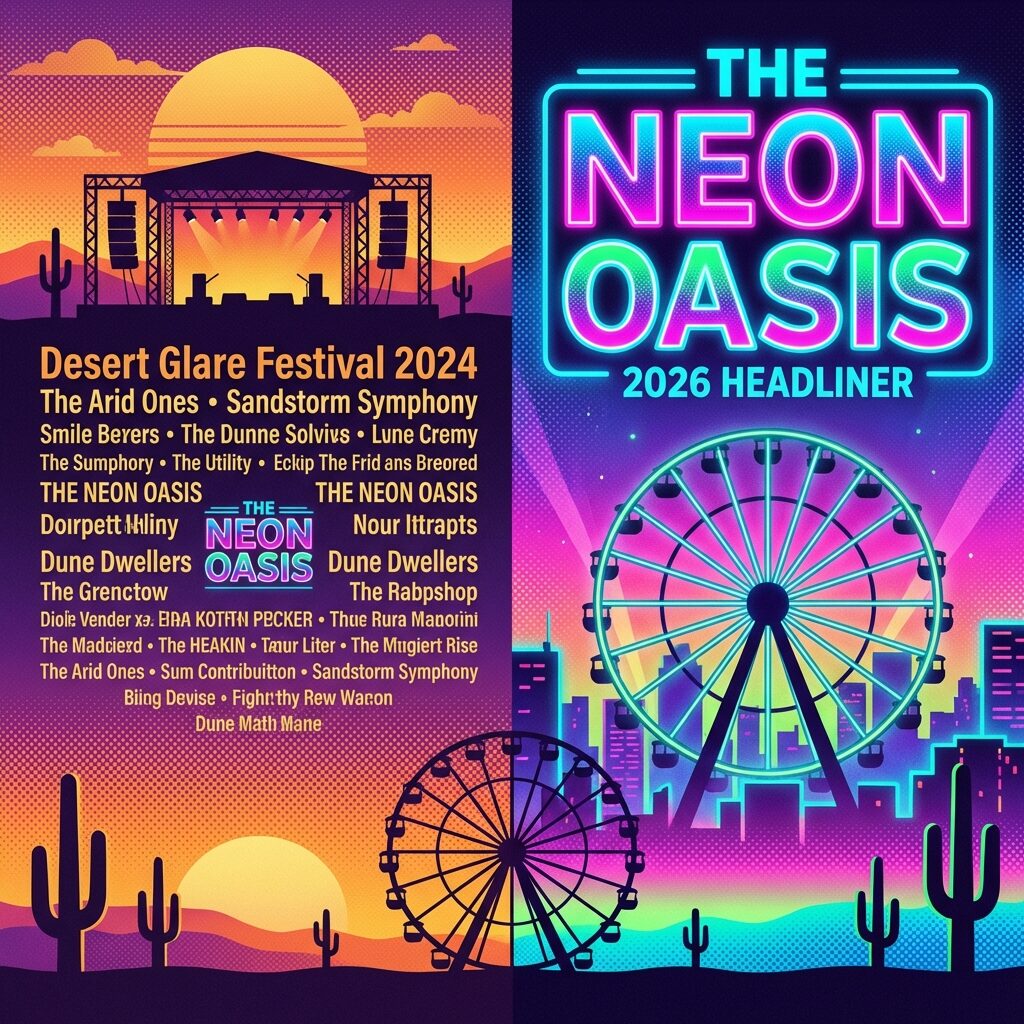
April 19, 2024. Weekend 2 at Coachella. The sun is dipping behind the Empire Polo Club and Sabrina Carpenter is wrapping up a mid-afternoon set on the mainstage, third line from the top of the poster, slotted between Young Miko and Lil Uzi Vert. She’s already pulled out 13 songs. She’s already debuted “Espresso,” which she casually dropped just hours earlier with a social media shrug: “Just wanted to put out a little song before Coachella.” And now she’s closing with “Nonsense,” the track from Emails I Can’t Send that she’d turned into a nightly game of increasingly unhinged sexual innuendo.
But this outro is different. This one has a target.
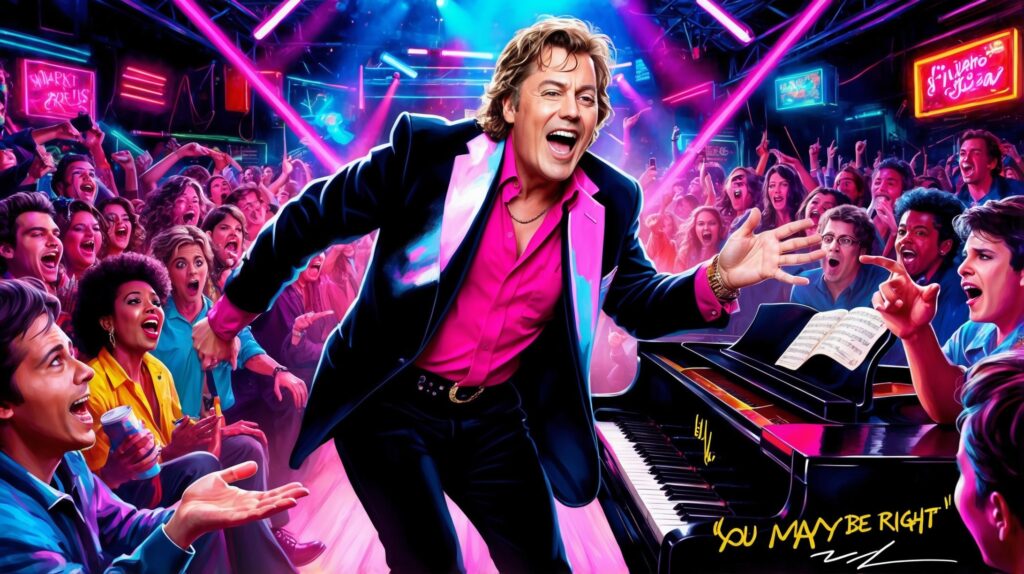
“Made his knees so weak he had to spread mine,” she sings, and the crowd is already losing it. “He’s drinking my bath water like it’s red wine.” If you know, you know, her boyfriend Barry Keoghan is in the pit, filming on his phone, and she’s just referenced the most notorious scene from his film Saltburn, the one where his character drinks Jacob Elordi’s bathwater from a tub. It’s a love letter, a relationship hard-launch, and a joke that only someone with her particular brain would attempt in front of tens of thousands of people.
Then comes the kicker: “Coachella, see you back here when I headline.”
The crowd screams. It’s a great line. Bold, funny, the kind of festival banter that usually evaporates the moment the set ends and the next act loads in. Nobody writes it down. Nobody holds you to it.
Except Sabrina Carpenter meant it.
Flash forward to September 2025. Coachella announces its 2026 lineup, the festival’s 25th edition. Carpenter is Friday’s headliner, above Disclosure, above Wet Leg, above Little Simz. She reposts the clip from Weekend 2 with a three-word caption: “Woman of my word.”
Here’s the thing about Coachella 2026 that makes this story land differently than some tidy comeback arc: the festival needed Carpenter as much as she needed the slot. Frank Ocean’s polarizing 2023 performance had left a sour taste. Ticket sales had been declining. For years, GA passes lingered well past the on-sale date. The 2026 lineup, Carpenter on Friday, Justin Bieber on Saturday, Karol G making history as the first Latina headliner on Sunday, sold out in a week.
What follows is the story of how we got from that mid-afternoon set to the top of the poster. But I want to be clear about something upfront: this isn’t just a “she made it” narrative. This is what happens when a decade of grinding meets a ruthlessly smart team and a 2:55 pop song, all of it arriving at exactly the right moment. Carpenter didn’t stumble into this. Every piece was deliberate.
The Long Road to ‘Overnight’
Before Espresso, Carpenter spent a decade grinding through Disney, lawsuits, tabloid drama, and four albums that barely dented the charts. Nothing about her breakout was overnight.
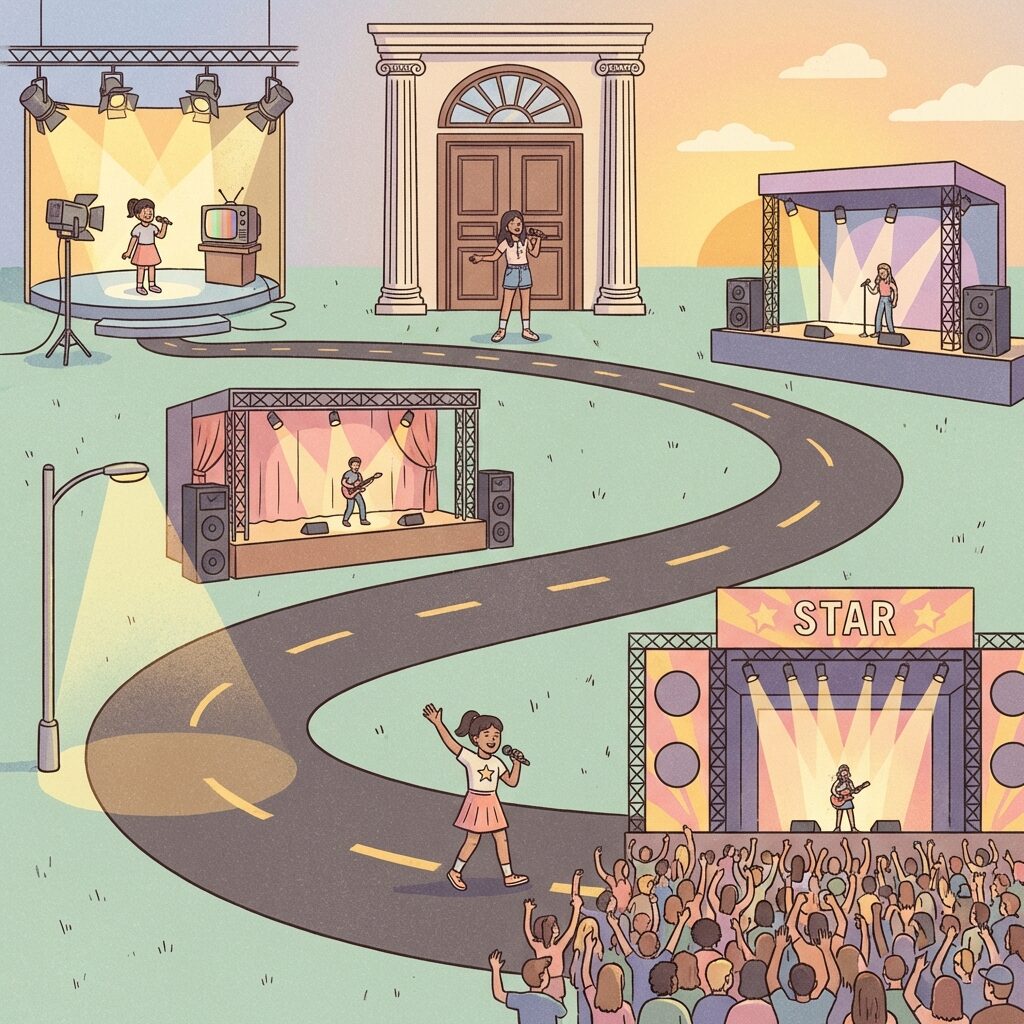
Sabrina Carpenter got a job when she was twelve. She’d like you to stop holding it against her.
Born May 11, 1999, in Pennsylvania’s Lehigh Valley, Carpenter landed the role of Maya Hart on Disney Channel’s Girl Meets World at fourteen and rode it from 2014 to 2017. By the time the show ended, she’d already released her debut album Eyes Wide Open (2015, peaked at No. 43 on the Billboard 200) and its follow-up Evolution (2016, No. 28). Respectable numbers for a Disney kid. Not exactly numbers that make anyone rethink the pop landscape.
Two more albums followed. None cracked the top 20. She was talented, clearly, but she was also stuck in a lane that pop doesn’t reward: the former child star who wants to be taken seriously. “It’s not my fault I got a job when I was 12 and you won’t let me evolve,” she said in an interview, and you can hear a decade of frustration compressed into that sentence.
In 2017, her former managers Stan Rogow and Elliot Lurie sued her, claiming they’d been “treated like trash” and were owed commissions. Carpenter won the case and channeled the experience into “Sue Me,” a diss track that most people outside her fanbase never heard. But it tells you something about her wiring: even early on, Carpenter had the instinct to turn personal friction into content. Remember that.
Then came the Olivia Rodrigo situation. I’m not going to relitigate the love triangle because the internet has done that to death, but the short version: Carpenter and Rodrigo share an ex, the drama fed tabloid cycles for months, and it could have easily become the only thing anyone knew about her. She’s the “other woman” in a pop narrative where Rodrigo had already cast herself as the sympathetic protagonist with “drivers license.”
What Carpenter did instead was smarter than engaging. She took the attention, the name recognition, the mild notoriety, and converted it into something tangible: she became one of Taylor Swift’s opening acts on the Eras Tour.
Twenty-five shows. Thirteen in Latin America, six in Australia, six in Singapore, stretching from August 2023 through March 2024. Her viagogo page views spiked 16,000%. That is not a typo. But she was still “Taylor’s opener.” The Eras Tour was the first concert tour in history to gross over a billion dollars, $1,039,263,762 from just 60 shows in 2023, per Pollstar, and opening for it was the most coveted slot in live music. An opening slot is still an opening slot, though. The audience is there for someone else.
Here’s a statistic that doesn’t get enough attention: 25% of Best New Artist nominees in Grammy cycles coinciding with the Eras Tour were Swift openers. Carpenter, Raye, Gracie Abrams, Benson Boone, all of them got the boost. But Carpenter did more with it than any of them. Not just by performing well (she did), but by using those 25 shows as a testing ground for something that would become her real edge.
Every night, she changed the outro to “Nonsense.”
Every night, fans tuned in specifically to hear what she’d say.
And that tradition, born from opening-act status, born from trying to leave a dent in someone else’s show, would eventually produce the single most talked-about piece of festival banter in recent memory.
A Little Song Before Coachella
Every step of the “Espresso” rollout looked casual and off-the-cuff, the cryptic newsletter, the Instagram vacation post, the I-10 billboard, the “little song before Coachella” framing. None of it was. The whole campaign was choreographed from a French countryside writing session to a Coachella Weekend 2 outro that broke the internet.
July 2023. Chailland, France. Carpenter is fresh off a tour leg and writing songs with Amy Allen, Steph Jones, and producer Julian Bunetta. She’s between relationships. She’s between albums. And she writes “Espresso” as what she later calls a “manifestation tactic”, a song about being irresistible at a moment when, by her own account, “no one” liked her “romantically.”
“I decided to put that burden on other people,” she told The Guardian. Which is a genuinely funny way to describe writing a pop song, and also a pretty accurate description of what “Espresso” would end up doing to everyone’s brain for the next six months.
The writing process was quick. The rollout was not. And nothing about what happened next was accidental, even though all of it was designed to look like it was.
First: the newsletter. Team Carpenter sent fans a photo of Sabrina drinking an espresso martini with a note to “stay hydrated/caffeinated.” Cute. Cryptic. Just enough chatter without giving anything away. Then Spotify created a playlist titled “Espresso Martini” with Carpenter’s photo as the cover, a collab that told you the streaming platform was going to push this one hard.
Then came the Instagram move. “Sabrina’s on vacation until April 11.” That was it. A date. No context. The kind of post that makes fans set calendar reminders.
On April 8, three days before the release and four days before Coachella Weekend 1, Carpenter dropped the casual bomb: “Just wanted to put out a little song before Coachella.” I want to linger on this for a second because the framing matters. “A little song.” Nothing happening behind the scenes was little. There was a provocative billboard on the I-10 freeway, the main artery into the festival from Los Angeles, reading: “She’s gonna make you c me… to her Coachella set. See you Friday!” Rolling Stone reposted it, which is exactly the kind of supposedly-organic viral moment that a good campaign engineers on purpose.
April 11: “Espresso” drops. April 12: Coachella Weekend 1.
The set ran about an hour, 13-plus songs, opening with “Fast Times” and building toward the new single that nobody in the crowd had heard 48 hours earlier. Emma Chamberlain, the YouTuber turned cultural connector, helped introduce “Espresso” on stage, and the TikTok clip went immediately viral. “We hope you love it, Coachella” became a sound. #sabchella started trending.
But it was Weekend 2, a week later, where the real thing happened. Before the “Nonsense” closer, Carpenter did a bit where she pretended to go to bed, then came back wearing a “Jesus was a Carpenter” t-shirt, the kind of corny-but-committed gag her fans live for. And then came the outro.
The bathwater line. The headline promise. Keoghan in the crowd.
I keep coming back to the audacity of using your boyfriend’s most memed movie scene as a relationship announcement in front of a festival crowd. That move could easily read as desperate or tryhard, but Carpenter pulled it off because the whole Nonsense tradition had trained her audience to expect something unhinged. She’d been building to this for months, every Eras Tour outro was practice, and when it landed, it landed as the most talked-about moment of Coachella 2024.
And “Espresso”? It debuted at No. 7 on the Hot 100 the following week. Not bad for a little song.
Why 2:55 Was Enough
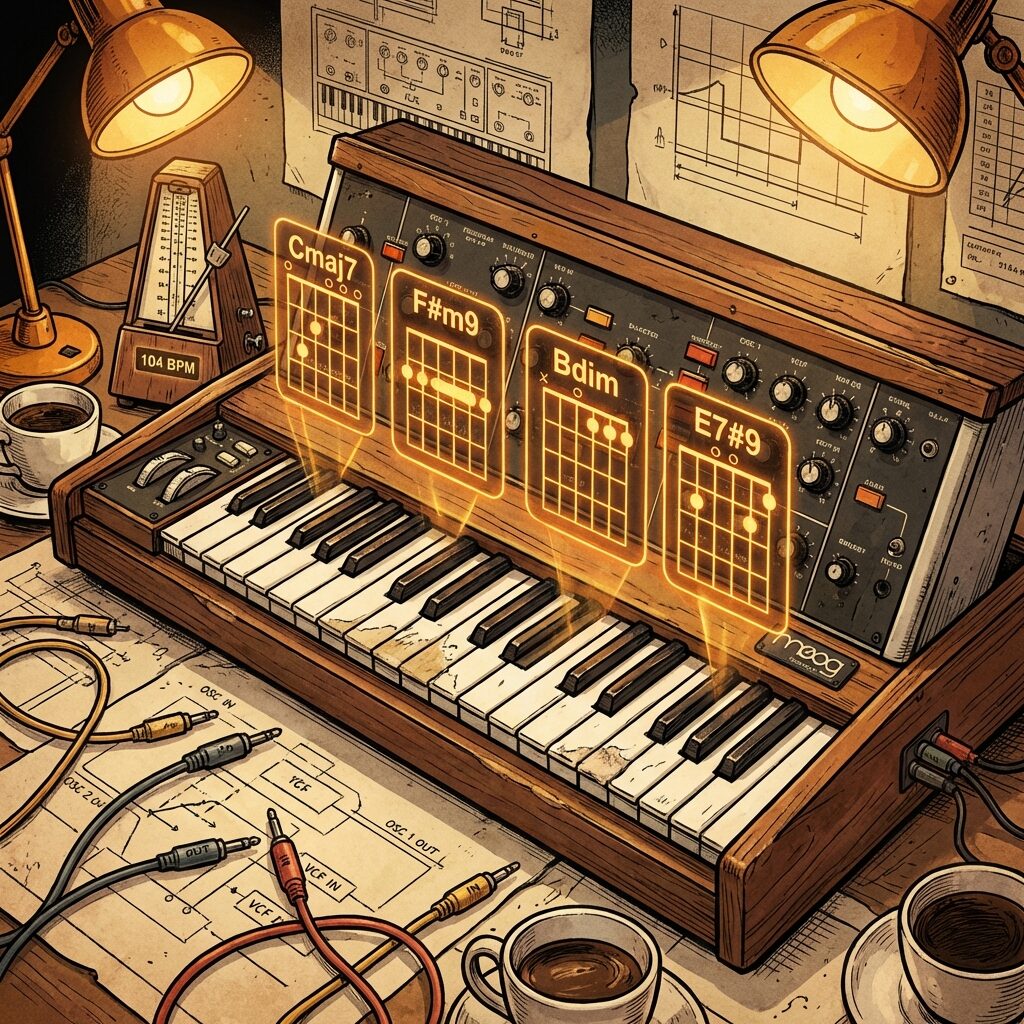
At just 76 measures, “Espresso” runs on three minor chords that never resolve, a half-time groove at 104 BPM, and a runtime so short your brain barely processes it before the song ends. That’s why you keep hitting replay. Meanwhile, “Please Please Please” shows Carpenter isn’t repeating herself: an unexpected A-to-C key change and a LinnDrum programmed on the grid to make the human players sound warmer by contrast.
Let’s talk about what’s actually happening inside “Espresso,” because I think the song’s success gets attributed too heavily to marketing and not enough to craft.
Start with the basics: C Major. Or is it A minor? Even music theory forums can’t agree, and that ambiguity is a feature, not a bug. The chord progression, Dm9 to Em7 to Am9, uses the three most important minor chords in the key of C (built off the 1st, 4th, and 5th scale degrees of A minor, or the 2nd, 3rd, and 6th of C major), and it creates this floating quality where your ear can’t quite decide where home is. You’re reaching for resolution that never quite arrives.
That’s what makes the melody stick. Sure, it’s catchy on the surface, built on stepwise motion and simple intervals, the kind of thing you can sing after one listen. But the reason you keep coming back isn’t the melody itself. It’s that the harmonic foundation keeps your brain slightly off-balance. “Espresso plays with language in a way that takes your brain a moment to process,” Nate Sloan and Charlie Harding noted on their podcast Switched on Pop, and I’d argue the music pulls the same move. There’s a gap between what you expect to hear and what you get, and your brain wants to close that gap, so you press play again.
The tempo sits at 104 BPM, right in the pocket between chill and danceable, with a driving beat that Julian Bunetta places in a half-time feel. It sounds like it’s moving slower than it is. Synth-pop with funk and disco-pop DNA, the production is spare enough that every element earns its place. No filler. No bridge shoehorned in because pop songs are supposed to have bridges.
And at 2:55, the whole thing is almost comically short. Barely 76 measures. About 19 four-measure phrases. In an era where streaming incentivizes longer songs (more plays, more royalties per listen), Carpenter and Bunetta went the opposite direction and made something that’s over before you’ve fully processed it. That brevity is the point. The song never overstays. It never resolves the harmonic tension. It just stops. So you hit replay. Then you hit replay again. Fourteen streams later, Spotify’s algorithm has decided you’re obsessed, and honestly, it’s not wrong.
Trent Reznor called “Espresso” his favorite song of 2024. The Nine Inch Nails guy. The man who scored The Social Network and makes music that sounds like machines having anxiety attacks. When an industrial rock lifer is obsessed with your synth-pop single, something interesting is going on under the hood. I think what Reznor heard, and what a lot of casual listeners feel without being able to name it, is that “Espresso” is doing something clever with very simple materials. Three chords. A melody you could hum after one pass. No resolution. And somehow you can’t stop listening.
The contrast with “Please Please Please” is worth looking at, because it shows Carpenter and her collaborators aren’t running the same play twice. That song, co-written with Amy Allen and produced by Jack Antonoff, pulls a key change from A to C between the first and second verse. “It’s A to C, it’s not a typical place you would lift to, and we were just all like ‘whoa,'” Antonoff told MusicRadar. Most pop modulations go up by a half step or a whole step to juice energy. A to C is a minor third. It’s unexpected, slightly disorienting, and it gives the second verse a completely different emotional color without the listener necessarily understanding why they suddenly feel different.
The production approach is different too. Where “Espresso” is all synth sheen and groove, “Please Please Please” started as a gentle country ballad, acoustic guitar and a tight LinnDrum beat, before evolving into something Antonoff described through the lens of ELO and ABBA: “There wasn’t the technology to make things too great and so people are expressing themselves on synthetic instruments and it gave this song an incredible character.” The vocal arrangement uses four stacked takes spread spatially rather than drenched in reverb, which gives Carpenter’s voice a physical presence that most pop production sacrifices for polish.
The LinnDrum is worth noting specifically because Antonoff programmed it “on the grid,” perfectly quantized, to emphasize the tiny timing drifts in the human-played instruments around it. The machine precision makes the human imperfections more audible, more warm. It’s a production choice that 90% of listeners will never consciously notice, but it’s why the song feels different from a straight-ahead pop track, even if you can’t pinpoint why. Chamber flutes, ornate strings, glittering synths: the arrangement kept expanding from that country-ballad skeleton into something Antonoff probably couldn’t have predicted when they sat down at Electric Lady Studios in New York on a snowy day.
“The fearlessness of modulating in that song and then the lyric content of ‘don’t embarrass me, motherfucker,’ it was just such a joy to help craft that one,” Allen recalled. That combination, musical sophistication paired with blunt emotional directness, is Carpenter’s formula when it’s firing on all cylinders.
The Outro That Became the Event
What started as improvised dirty jokes during Eras Tour warmup sets turned into Carpenter’s sharpest content play, a nightly viral moment that made every show feel like must-see live TV.
“Nonsense” is not, on its own, a remarkable song. It’s a cute, bouncy track from Emails I Can’t Send (2022) with an original outro that goes: “This song catchier than chickenpox is / I bet your house is where my other sock is / Woke up this morning, thought I’d write a pop hit / How quickly can you take your clothes off? / Pop quiz.” Fun. Flirty. Forgettable in a vacuum.
What changed everything was the decision to swap the outro every single night.
It started during the Eras Tour opening slots. Carpenter would drop in city-specific lines, usually sexually suggestive, occasionally filthy, always committed to the bit. Manila got: “His ex is a motel, I’m a villa. He said I taste better than vanilla. What’s your favorite city? Mine’s Manila.” Singapore got a reference to the Jewel Changi waterfall. The BBC banned her Radio 1 Live Lounge performance after she made an innuendo on the corporation’s name.
And then something weird happened: fans started tuning in specifically for the outros. Not for the song, for the twenty seconds at the end. TikTok livestreams of Carpenter shows pulled thousands of viewers who were there for one reason: what’s she going to say tonight? Each outro spun off its own micro news cycle. Each one got clipped, shared, debated, ranked. “Nonsense” stopped being a song and became a delivery vehicle for viral moments.
Most artists try to make their setlist the draw. Carpenter turned a single recurring bit, maybe thirty seconds long, into the reason people talk about the show the next day. Every performance became a unique, unrepeatable thing. You weren’t just at a concert; you were catching that night’s episode of an ongoing series. It’s content strategy wearing the costume of stage banter, and I’m not sure she even planned it that way at the start.
Coachella Weekend 2 was the peak. The bathwater line wasn’t just another city pun, it took Keoghan’s most notorious film scene and repurposed it as a love letter, effectively hard-launching a relationship through a festival outro. And then: “Coachella, see you back here when I headline.” That’s not banter. That’s a promise with a two-year timer on it.
Most artists’ between-song chatter is disposable. “How’s everybody doing tonight” energy. Carpenter figured out how to make hers the main attraction, and at Coachella, she used that leverage to plant a flag she’d eventually come back to claim. The iHeartRadio Music Awards in 2025 gave her Favorite Tour Tradition for the Nonsense outros, the kind of award that only exists because someone invented a new category of thing worth rewarding.
Numbers That Don’t Make Sense
“Espresso” broke chart records that had stood since the Beatles, and the numbers only got more absurd from there, her career Spotify streams quintupled in two years.
I’m going to throw a lot of statistics at you in this section. I apologize in advance. But the scale of what happened after Coachella 2024 is hard to convey without the numbers, and some of these numbers are hard to believe even when you’re staring at them.
“Espresso” debuted at No. 7 on the Hot 100 for the chart dated April 27, 2024. It peaked at No. 3 by June. It went No. 1 on the Billboard Global 200. In the UK, it climbed from No. 6 to No. 1 in its third week, held that position for five consecutive weeks, got briefly bumped by Eminem’s “Houdini,” then came back for two more weeks at the top. Seven total. It was the biggest single of 2024 by a female artist in the UK, and apparently the highest-charting song about caffeine in 24 years, since All Saints’ “Black Coffee” in 2000. (I love that someone tracked this.)
On Spotify: 200 million streams in its first month. It surpassed one billion streams by August 7, Carpenter’s first song to hit that threshold. By the end of 2024, it had accumulated 1,774,525,704 streams, making it the second most-streamed song of the year, trailing Billie Eilish’s “Birds of a Feather” by about 647,000 streams. By the end of 2025, it was at 2.72 billion.
But here’s where it gets weird. “Please Please Please” dropped June 6, 2024, and debuted at No. 2 on the Hot 100 with 50.3 million streams and 533,000 airplay impressions in its first week. It eventually reached No. 1, Carpenter’s first chart-topper. And for a brief, surreal window, she had two simultaneous top-three hits on the Hot 100.
The last solo act to do that? Nobody. The last act of any kind? The Beatles. February 1964. Sixty years earlier.
Think about that. The company Carpenter was keeping on the Hot 100 in the summer of 2024 was literally the Beatles.
The records just kept coming. First female artist to hold UK No. 1 and No. 2 for three consecutive weeks. Second female artist to replace herself at No. 1 on the UK Singles Chart (after Ariana Grande). When “Taste” arrived and charted at No. 2 alongside “Please Please Please” at No. 3 and “Espresso” at No. 4, Carpenter became the first soloist ever to chart their first three top-five Hot 100 hits simultaneously, and only the second act after the Beatles to do it at all. She held three simultaneous top-10 Hot 100 songs for eight consecutive weeks from September through October 2024, the first artist of the 2020s to manage that.
She also became the first female artist to surpass 100 million monthly Spotify listeners. Her peak hit 81.1 million in June 2024, passing Ariana Grande’s previous record of 80.3 million.
Then the album. Short n’ Sweet debuted at No. 1 on the Billboard 200 with 362,000 first-week units: 184,000 in pure album sales, 176,000 in streaming equivalent units (representing 233 million on-demand streams), plus 2,000 TEA units. It moved 105,000 vinyl copies in its first week, the second-largest vinyl sales week of 2024. It spent its first three weeks at No. 1, something only Taylor Swift’s The Tortured Poets Department also managed that year. It’s been certified 4x Platinum by the RIAA. In the UK, it’s logged 43-plus unbroken weeks in the Top 5, the longest consecutive Top 5 streak in Official Albums Chart history, surpassing Ed Sheeran’s =.
Here’s the career stat that puts the whole trajectory in perspective: at the start of 2024, Sabrina Carpenter had 4.5 billion career Spotify streams. By early 2026, she was past 20 billion. That’s not growth. That’s a different person’s career.
Espresso Martinis and Fortnite Skins
Carpenter didn’t just score a hit, she turned a vibe into espresso martini kits, Dunkin’ drinks, a Fortnite skin, and the most repeated lyric of 2024. Then she sold out Madison Square Garden four times over.
You know the difference between a hit song and whatever “Espresso” became? A hit gets streamed. Whatever this was got turned into cocktail kits by liquor companies.
“Espresso” stopped being a song and started being a product line. Absolut Vodka and Kahlúa released a “Short n’ Sweet Espresso Martini Kit” in November 2024, 375ml bottles, Owen’s Espresso Martini Mix, a coupe glass with a red ribbon, and an edible cocktail topper shaped like a kiss mark. Dunkin’ Donuts launched “Sabrina’s Brown Sugar Shakin’ Espresso” in December. By April 2025, Carpenter had a titular skin in Fortnite Festival Season 8. At some point she stopped monetizing a song and started monetizing a vibe, which is a different thing entirely.
The reach went beyond brand deals, though. Amelia Dimoldenberg’s Chicken Shop Date with Carpenter spawned the “This is Espresso” meme, Dimoldenberg’s TikTok clip pulled 31 million-plus views and 4 million likes. Adele publicly admitted the song was stuck in her head, which is the sort of thing publicists would sell organs for and can never actually arrange. “That’s that me espresso” turned into something people just… said. As a caption, a reply, a general-purpose declaration of self-satisfaction that had nothing to do with the song anymore.
The Switched on Pop analysis got at why the phrase lodges in your brain: it “takes your brain a moment to process.” The slightly off grammar, “that’s that me espresso” instead of “that’s my espresso”, forces a tiny cognitive hiccup. Your brain has to engage with it rather than just let it wash past. Same trick as “Who let the dogs out” or “Hit me baby one more time.” Mild grammatical wrongness makes a phrase stickier. Songwriters have known this forever.
On the live side, the jump from Eras Tour opener to headliner happened absurdly fast. When tickets went on sale for Carpenter’s own Short n’ Sweet Tour on June 28, 2024, more than 80,000 people queued for Madison Square Garden alone, a venue that holds 19,000. The tour ran 72 shows, from Columbus on September 23, 2024, to the Crypto.com Arena in LA on November 23, 2025. The European leg sold out entirely; dates were added in Zurich, Oslo, Copenhagen, and Stockholm to meet demand.
And then the SNL moment. On October 18, 2025, Carpenter hosted Saturday Night Live and served as the musical guest, performing “Manchild” and “Nobody’s Son.” Hosting and performing is the move that says you’re not just a musician anymore. The show trusts you to carry sketches, not just songs. It’s a different tier.
Through all of this, I keep coming back to that Eras Tour pipeline statistic: 25% of Best New Artist nominees in coinciding Grammy cycles were Swift openers. The exposure was available to all of them. Carpenter used it better than anyone because she understood something the others didn’t, or at least couldn’t execute as well. She didn’t just perform at those shows. She built repeatable viral moments inside them. The Nonsense outros weren’t just fun crowd work; they were a content strategy that turned someone else’s tour into a launchpad for her own.
Not Slowing Down
One year after Short n’ Sweet, Carpenter came back with Man’s Best Friend, her first time producing, a genre-sprawling record pulling from ABBA and Fleetwood Mac that outsold her debut and killed any notion she was a one-album story.
The follow-up album is where breakout artists go to die. After Short n’ Sweet, No. 1 debut, 4x Platinum, chart records untouched since the Beatles, the safe move was to disappear for two years, let the anticipation build, make people miss you.
Carpenter didn’t do that. Man’s Best Friend dropped August 29, 2025, almost exactly one year later. She cited Dolly Parton and Linda Ronstadt as the reason. “I was inspired by their consistent release schedules,” she explained, pointing to an era when artists put out albums annually because the work was the point, not the marketing cycle around it.
This time Carpenter took a producer credit, working alongside Antonoff and John Ryan. The sessions “felt like a band,” she said, she and Amy Allen (who co-wrote every track on both Short n’ Sweet and Man’s Best Friend) would take long walks, singing melodies and lyrics, while Antonoff and Ryan built “cinematic gorgeous arrangements” around them. Carpenter played banjo, percussion, and handled vocal programming across multiple tracks. Antonoff’s instrument list reads like a gear museum: Mellotron, glockenspiel, Roland Juno-60, Prophet-5, Korg M1, Moog, 12-string acoustic, the man does not believe in restraint, and it works.
The sound went everywhere. Short n’ Sweet was mostly synth-pop with disco and country mixed in. Man’s Best Friend tore through ABBA, Fleetwood Mac’s Tusk, Paula Abdul’s “Opposites Attract” (the LA Times made that comparison for “House Tour”, thwacking drums and rubbery funk bass), disco, country pop, folk ballads, and synth-rock across 38 minutes and 12 tracks. “Tears” channels Donna Summer. “Manchild” blends country-influenced pop with bubblegum and synth. “Go Go Juice” is Carpenter on banjo, which is not a sentence I expected to write.
The numbers kept pace. “Manchild” debuted at No. 1 on the Hot 100, her first song to enter in the top slot. The album hit No. 1 on the Billboard 200 with 366,000 first-week units, beating Short n’ Sweet‘s debut and logging the highest first-week for a female artist in 2025. All 12 tracks charted in the top 40 of the Hot 100. It was the biggest streaming debut for an album by a woman in 2025 (until Taylor Swift’s The Life of a Showgirl showed up). Six Grammy nominations for the 2026 ceremony followed: Record of the Year, Song of the Year, Album of the Year, Best Pop Solo Performance, Best Pop Vocal Album, and Best Music Video, all for “Manchild” or the album itself.
The album art did cause a stir, critics argued the imagery was “leaning on tired tropes that reduce women to pets.” Carpenter’s response, delivered to Zane Lowe: “I can not give a fuck about it.” She called the controversy “an accident” and moved on. An alternative black-and-white cover was released, featuring model Xavier Gutierrez, and the news cycle evaporated.
But the controversy faded fast because the album spoke for itself. Carpenter had followed a blockbuster with a record that was weirder, more genre-scattered, and sold just as well. She wasn’t cooling off. If anything, she was picking up speed.
Friday Night, Top of the Poster
Coachella’s 25th edition sold out in a week with Carpenter headlining Friday, a payoff two years in the making for both the artist and a festival that needed her.
Coachella’s 25th edition needed a story. Not just a lineup, a narrative.
The festival had been coasting on reputation for a few years, and the cracks were showing. Frank Ocean’s 2023 headlining set was divisive at best, a stripped-down performance that left a good chunk of the crowd confused and disappointed. Ticket sales had softened in subsequent years. Rising prices, competition from other festivals, and a growing sense that Coachella’s cultural monopoly was slipping meant GA passes were still available well past the on-sale dates. For a festival that once owned the spring music calendar, that’s a problem.
The 2026 lineup was the answer. Sabrina Carpenter on Friday. Justin Bieber on Saturday. Karol G on Sunday, the first Latina to headline the festival. It was announced September 15-16, 2025. Tickets went on sale September 19 at 11 AM.
It sold out in a week.
After years of lingering inventory, a week. That’s what the right headliners do.
And Carpenter’s story was the best of the three, because she’d been writing it in public for two years. The moment the headline was confirmed, she posted the move everyone was waiting for: the clip from Weekend 2, 2024. The bathwater line. The promise. And the caption: “Woman of my word.”
It closed a loop her fans had been actively tracking. This wasn’t a surprise, it was a payoff. The internet had been willing this into existence since the outro went viral, and Carpenter had let the anticipation build by neither confirming nor denying anything for over a year. When it finally happened, it felt earned in a way that most festival bookings don’t. You’re not just going to see Sabrina Carpenter play Coachella. You’re going to watch her cash a check she wrote from the middle of the lineup card.
As I write this in late March 2026, Weekend 1 is less than two weeks away. We don’t know the setlist. We don’t know the production design, though Reddit is buzzing with speculation that she’ll debut an entirely new show for the festival and her subsequent South American dates. We don’t know if there will be surprise guests, though the internet has opinions about that too.
What we do know is the symmetry. In 2024, Carpenter dropped “Espresso” hours before her mid-afternoon set, turning a single release into a festival moment. She has a pattern now. A playbook. The question everyone keeps asking: will she drop something new for 2026? Given how Team Carpenter operates, the careful planning disguised as spontaneity, the Instagram posts that look casual but definitely aren’t, it would be more surprising if she didn’t have something ready.
The festival runs April 10-12 and 17-19 at the Empire Polo Club in Indio. Eight stages, including a new one called the Bunker. First-time performers include Katseye and Bini, the first Filipino group to play Coachella. Disclosure, Wet Leg, Little Simz, and FKA Twigs round out a stacked undercard.
But Friday night belongs to Carpenter. Top of the poster. Just like she said it would.
The Prophecy Fulfilled
Carpenter’s Coachella arc is the payoff of a two-year bet, proof that you can still build pop stardom through craft, nerve, and knowing when to turn a throwaway joke into a binding promise.
Most festival banter disappears the moment it leaves the PA system. “How’s everyone doing tonight” dissolves into the desert air. “You guys are the best crowd ever” is a lie told in every city. The space between songs is filler, pleasant, functional, forgettable.
Sabrina Carpenter turned hers into a two-year narrative arc with a payoff.
That’s the thing I keep coming back to as Coachella 2026 approaches. Not the chart numbers, impressive as they are. Not the brand deals or the Fortnite skin or the Dunkin’ collaboration. The thing that makes this story worth telling is the intentionality behind all of it. Carpenter’s ascent wasn’t an algorithmic accident. It wasn’t a TikTok fluke that she rode until the wave broke. It was a decade of grinding through Disney credits, manager lawsuits, tabloid love triangles, and albums that nobody outside her core fanbase noticed, followed by the instinct to drop a 2:55 pop song at exactly the right moment, with exactly the right rollout, in front of exactly the right audience.
She had a ruthlessly smart team. She had collaborators, Amy Allen, Julian Bunetta, Jack Antonoff, who understood that pop music works best when the sophistication is invisible, when the chord changes feel effortless even when they’re doing something genuinely unusual. She had the Eras Tour exposure, which opened doors but didn’t walk through them for her. And she had something harder to quantify: the ability to turn small moments into career-defining inflection points.
A 2:55 song. A dirty joke about bathwater. A casual Instagram caption. A billboard on the I-10 with a missing letter. None of these things should be load-bearing career moves. All of them were.
So what does Coachella 2026 actually mean? Partly it’s just a headlining slot, and headlining slots matter on their own terms. But it also feels like the capstone of an argument Carpenter has been making since “Espresso” broke: that pop stardom doesn’t have to be an algorithmic lottery or a major-label carpet-bombing campaign. You can still build it. You just have to know who you are, read the moment right, and be willing to bet on yourself when nobody else would.
And then there’s the part that gets me. Carpenter wrote “Espresso” in a French farmhouse as a “manifestation tactic” at a time when, by her own admission, nobody liked her romantically. She was projecting a confidence she didn’t entirely feel, writing a song about being irresistible as an act of self-willed fiction.
Two years and 20 billion streams later, 100 million monthly Spotify listeners can’t get her out of their heads. She manifested the hell out of it.
See you at Coachella, Sabrina. You earned it.
Did you know? Trent Reznor of Nine Inch Nails called “Espresso” his favorite song of 2024. A 2:55 pop song won over industrial rock’s dark lord ☕🎵 #SabrinaCarpenter #Espresso #Coachella https://bit.ly/3PHYogU

Click to Tweet