Stephen Sanchez | Until I Found You
A Song Out of Time
A song that sounds like 1958 has two billion streams in 2024. It’s not retro cosplay. Stephen Sanchez grew up digging through his grandfather’s discarded vinyl in a barn in San Jose, and the fifties got into his bones before he knew what decade he was living in.
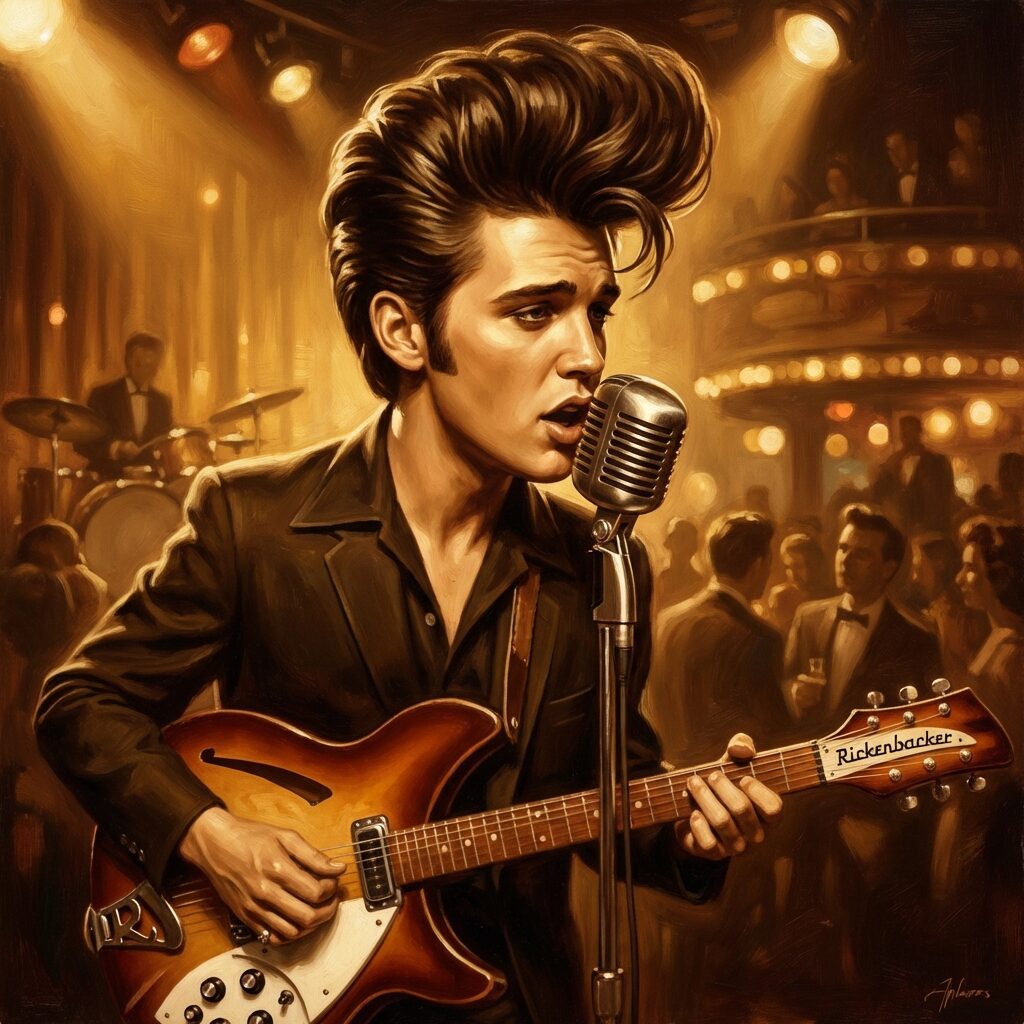
The first time you hear “Until I Found You,” you check what year it came out. You have to. The reverb is too warm, the croon too sincere. It rides a 12/8 triplet feel that doo-wop and fifties ballads own, a rhythmic pocket almost nobody in modern pop touches because it doesn’t sit neatly on a four-on-the-floor grid. The whole thing sounds like it’s drifting out of a transistor radio in 1958, a little distant, a little crackly, like it’s reaching you through several walls and about six decades of dead air.
It came out in September 2021. The kid singing it was eighteen when he wrote it.
And the numbers don’t make sense: this reverb-drenched, deliberately old-fashioned, could-have-been-a-B-side-for-The-Platters love ballad has over two billion streams. Two billion. That puts it in the same streaming tier as Drake, The Weeknd, artists backed by millions in production and marketing budgets and viral campaigns. Stephen Sanchez wrote his in under fifteen minutes on a guitar he’d just bought from a vintage shop in Nashville. It sounds like it was recorded in somebody’s living room during the Eisenhower administration.
What’s worth paying attention to is that this isn’t a costume. It’s not an ironic throwback, not a Gen Z kid playing dress-up with grandpa’s records. It’s a real love song, written to a real girl named Georgia, by a kid who grew up spending his mornings picking through thousands of discarded vinyl records in his grandfather’s barn in San Jose. The fifties didn’t influence him. They raised him. The label that eventually put the song out was Mercury Records, the same Mercury Records that released The Platters seventy years earlier.
That coincidence is almost too neat. But the actual story behind it is messier and weirder than any of that suggests.
Breakfast, Then the Barn
Sanchez’s musical education happened in a San Jose barn full of radio DJs’ discarded records, The Platters, Ink Spots, Paul Anka, before a TikTok cover launched him from bedroom to record deal in fourteen months.

Stephen Sanchez’s grandfather had a property on a hill in San Jose, California. Two barns flanking the house, the whole thing perched high enough to see across the city. Nice setting, sure, but what matters here is what was inside those barns: thousands upon thousands of vinyl records. The grandfather, eighty-five years old by the time Sanchez was telling this story to Billboard, had spent years collecting records that radio DJs had simply thrown away after they’d gotten their airplay out of them. One spin on the station, into the discard pile, and eventually into a barn on a hill in San Jose.
“In the mornings, they would make me breakfast, and then they would tell me to go out in the barn and pick through vinyl,” Sanchez told Billboard. Think about that for a second. You’re a kid, and your morning routine after eggs and toast is to go sit in a barn and rifle through crates of records that professional DJs deemed disposable decades before you were born. The Platters. Paul Anka. The Ink Spots. Nat King Cole. The Penguins. The Duprees. Nobody curated this for him. No algorithm fed him “artists similar to” whatever he listened to last. It was the whole undifferentiated pile of a radio station’s castoffs from the fifties and sixties, and Sanchez absorbed it without any filter or context for what was cool and what wasn’t. He still picks through those crates every time he visits.
Music was coming at him from the other direction too. His other grandfather, up in Oregon, played guitar and sang. The family drove up twice a year to visit, and the kid soaked that in alongside the vinyl. Two grandfathers, two different ways into music, both of them pointing backward in time. By the time his mother bought him his first guitar, a Gibson J-45, which is a serious instrument for a fourteen-year-old, he wasn’t learning to play modern pop. He was learning to play what was already in his ears. Sinatra. Orbison. Buddy Holly. Elvis. Dean Martin. He’s described Sinatra as “the blueprint on how to ask a girl out, how to talk to a girl, how to care about a girl.” That’s not the way most kids born in 2002 talk about Frank Sinatra. Then again, most kids born in 2002 didn’t spend their mornings in a barn full of his contemporaries’ records.
The jump from bedroom musician to professional happened fast, almost comically fast, the way a lot of pandemic-era breakthroughs did. In June 2020, Sanchez posted a cover of Cage the Elephant’s “Cigarette Daydreams” on TikTok. It went viral. Singer-songwriter Jeremy Zucker heard a snippet of an original called “Lady by the Sea,” liked it enough to offer to produce the official version, and it was out by July 2020. By August 2021, Sanchez had a deal with Republic Records. His debut EP, What Was, Not Now, came out in October 2021.
That timeline, TikTok cover to record deal in roughly fourteen months, is genuinely nuts, but it also makes the story look simpler than it is. Sanchez didn’t come out of nowhere. He came out of that barn. The musical vocabulary that made people stop mid-scroll on a sixty-second TikTok clip took years to build, one morning at a time, pulling records out of crates that DJs had tossed in the trash. The viral moment got him noticed. Everything that made him worth noticing had been there since he was old enough to hold a piece of vinyl.
Georgia on His Mind
Georgia Webster found Sanchez on TikTok during the pandemic, and after a breakup and reconciliation, the song poured out in fifteen minutes in Nashville, only for the relationship to end just as the song took off.
The girl’s name was Georgia. Georgia Webster. And the way they met is so perfectly of its moment: she found him on TikTok.
During the pandemic, both of them stuck at home with their families, Georgia came across Sanchez’s videos and was struck enough by his talent to reach out, asking if he was planning to release music. That first message turned into a long-distance friendship, which turned into something more. By August 2020, they were together, she in Virginia, he in California, trying to hold a relationship together across three time zones. Anyone who’s done that knows what it costs.
But Sanchez was carrying weight that had nothing to do with distance. His family situation at the time was, in his words, “very complicated and unhealthy.” He felt like he was dragging that into the relationship, felt he wasn’t good enough for what Georgia was offering him. So he did what people do when they’re scared of something good: he pushed her away. They separated. She was in Virginia, probably at VCU in Richmond. He was in California, probably regretting everything.
“When I met my girlfriend Georgia, I was in the worst place ever,” Sanchez told PLNK WIFI in 2021. “She was so loving and great to me though. I didn’t feel good enough for that, so I pushed her away.”
Then came the reconnection. About a month before Sanchez was set to move to Nashville, they got on the phone. Something clicked back into place. He drove to Virginia, took her on a date, and the way he described it, the evening felt “just like old times.” You’d expect this to be the climax, the couple reunites and the love song writes itself in a burst of joy. But that’s not quite how it happened. The song came from a more complicated place. Not from the reunion, but from the fear that preceded it. From the stretch when he’d lost her and was sitting with the knowledge that it was his own fault.
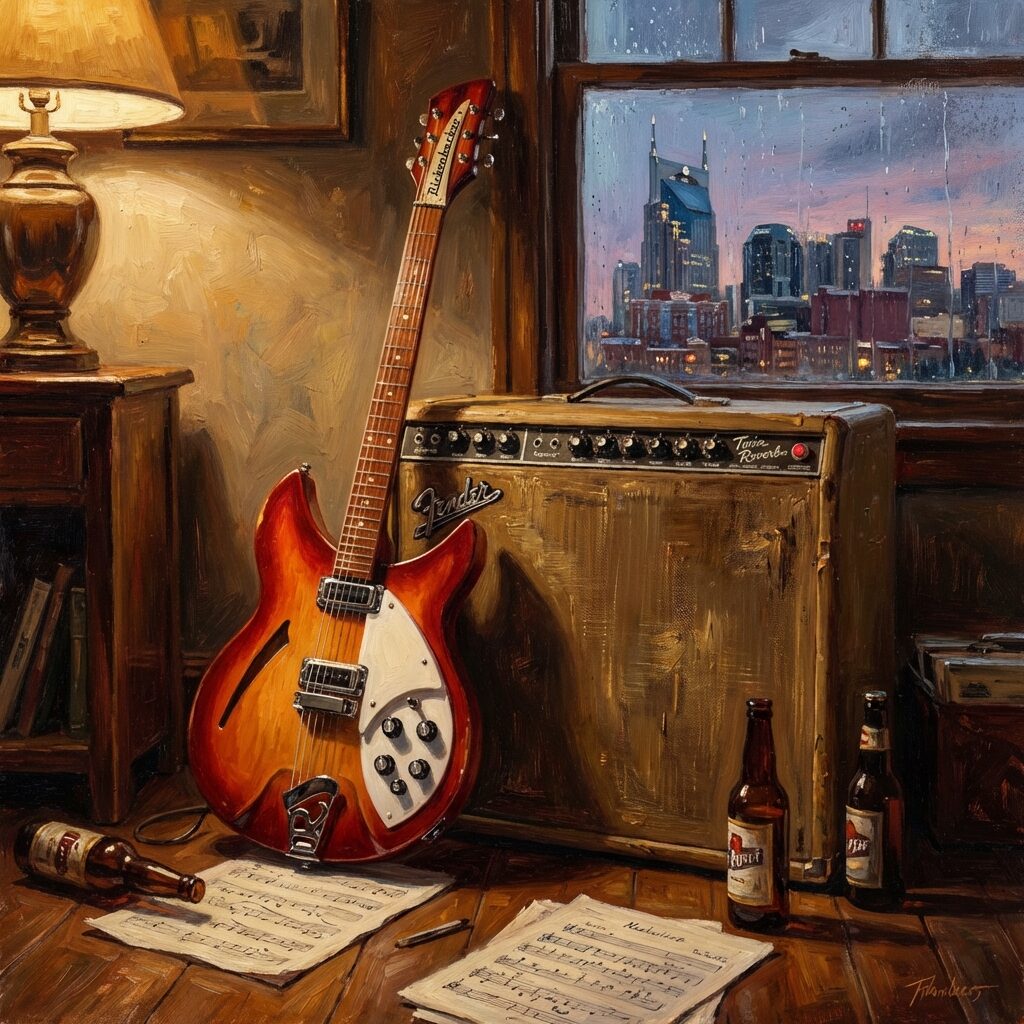
May 2021, Nashville. Sanchez had been in town for about six months, settling into the city that every aspiring musician eventually orbits. He walked into Carter Vintage Guitars, one of those shops where the instruments on the wall have stories older than most of the customers, and bought himself a Rickenbacker and an old amp. Back home, or wherever home was at that point, he started noodling around. Playing fifties covers. Paul Anka. The Penguins. Songs his hands already knew from years in the barn.
And then, as he put it, the song just “popped out.”
“That’s what gave it that ’50s and ’60s sound,” Sanchez told Songfacts. “I was playing around with other ’50s covers, like Paul Anka and The Penguins, and then that song popped out. It felt like it was pulling from my roots in a very huge way.” Under fifteen minutes, start to finish. Sometimes the songs that take the longest to build take the shortest to write, because the building happened across all those years in the barn, and the writing is just the moment it finally spills over.
He’d already had the first part before buying the Rickenbacker. He finished the rest on the new guitar. Georgia herself sang harmony vocals on the original recording, which means the girl the song is about is literally singing on it. The song was released on September 1, 2021, through Republic Records and Mercury Records. Producers Ian Fitchuk, the Nashville musician best known for co-producing Kacey Musgraves’ Golden Hour, and Konrad Snyder helped shape the final sound.
And then the part of the story that nobody tells you about love songs: the relationship ended.
Sanchez and Georgia broke up. He got sick afterward, genuinely, physically sick, sick enough that he couldn’t sing. And now here was the cruelest irony: he had to promote a love song to the girl he’d just lost while going through medical treatment to get his voice back. Imagine standing in front of a camera or a microphone, night after night, singing “I would never fall in love again until I found her” to audiences who are swooning, while the person the song is about is no longer answering your calls.
“I wish her the best, and I think she wishes me the best too,” Sanchez said later. “We’re both living our lives. I feel like it’s about the people’s stories this record is soundtracking, and I think that that’s more important than what it was about originally.” He let the song go. He had to. It wasn’t his anymore.
Why This Song Works on You
A 12/8 time signature, one devastating minor-IV chord, Sinatra-style back-phrasing, and reverb that Sanchez fought to keep in the mix, below-average complexity scores that turn out to be the song’s real advantage.
Let’s get into why this thing hits the way it does, because there’s actual craft hiding underneath all that reverb.
Start with the time signature. “Until I Found You” is in 12/8, which, if you’re not a music theory person, means every beat subdivides into three instead of two. The triplet feel. The rhythmic engine underneath virtually every doo-wop ballad and fifties slow dance you’ve ever heard. When The Penguins sang “Earth Angel” or The Platters sang “Only You,” they were riding that same 12/8 sway. It creates a gentle, rolling momentum that feels fundamentally different from the rigid grid of modern 4/4 pop. Your body responds differently. You don’t nod to it. You sway. There’s a reason slow dances feel natural to songs in this meter. The rhythm itself is a kind of embrace.
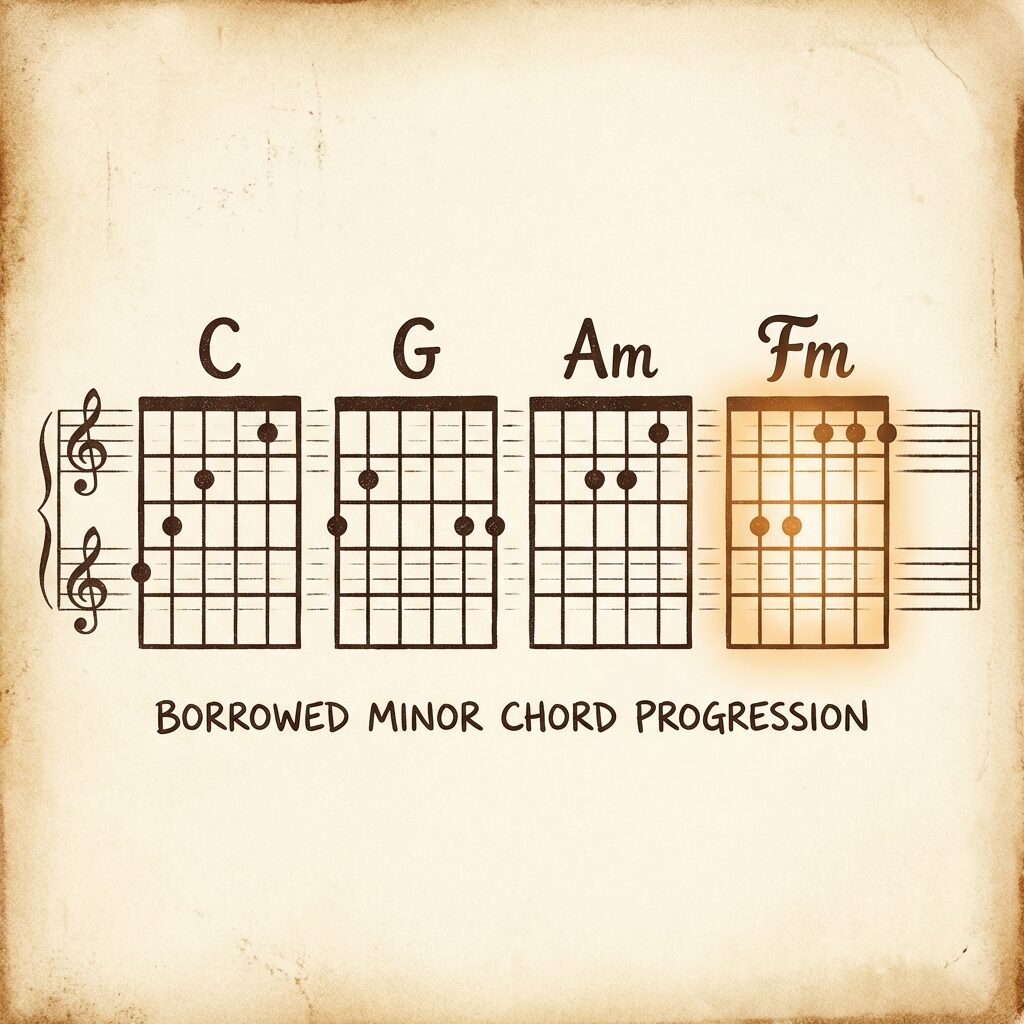
The song sits in B-flat major, and the chord progression is about as simple as it gets: mostly I, IV, and V, B-flat major, E-flat major, F major. Your basic three-chord vocabulary. On paper, it’s the kind of thing that makes music theory students yawn. But there’s one chord that changes everything.
In the verse and at a crucial moment in the chorus, Sanchez drops in an E-flat minor. If you’re playing it with a capo on the third fret, that’s a C minor where you’d expect a C major. A chromatic shift, the IV chord suddenly going minor, and it completely recolors the emotional temperature. Major IV says “I love you and everything’s fine.” Minor IV says “I love you and I’m terrified I’m going to lose you.” That single chord is where devotion meets vulnerability in this song. It’s the sound of someone offering everything they have while suspecting it might not be enough. Technically, it’s just flatting one note, the G-natural in E-flat major becomes a G-flat in E-flat minor. Emotionally, it’s the whole song.
Then there’s the turnaround. Between chorus repetitions, a B-flat-seven chord (or G7 in the capo position) shows up to create tension that pulls you back into the next repetition. A dominant seventh acting as a bridge, a simple but effective bit of connective tissue that keeps the chorus from feeling like it’s just looping. Like taking a breath before saying “I love you” again.
Now let’s talk about the reverb, because Sanchez went to war for it. During recording sessions with producers Ian Fitchuk and Konrad Snyder, Sanchez pushed to keep the reverb heavy in the mix. This was a deliberate aesthetic choice, not a production accident. That reverb is what makes the song sound like it’s coming from somewhere else, like you’re overhearing it through time, catching it drifting from a radio two rooms over. It creates distance, and that distance creates longing. You’re not just hearing the song. You’re reaching for it. The slightly tinny, close-miked quality of the vocal combined with all that space around it puts Sanchez’s voice in a strange position: close to you and far away at the same time. A useful contradiction for a song about trying not to lose someone.
The vocal technique itself is worth pausing on. Sanchez employs back-phrasing, singing slightly behind the beat, throughout the track. Sinatra practically invented this as a pop vocal approach, and it does something very specific to a listener: it creates the feeling of intimacy and restraint. When a singer lands right on the beat, it’s declarative, confident. When they land just behind it, it sounds like they’re choosing their words carefully, like what they’re saying costs them something. Sanchez has cited Sinatra as his primary vocal model, and this is where that influence is most audible. The vocal slides between notes, never rushing, always arriving a fraction late, and the effect is a kind of vulnerable confidence. He means every word. He’s just taking his time with them.
Here’s something that might surprise you: by the numbers, this is not a complex song. Hooktheory’s complexity ratings put it below average in chord complexity, melodic complexity, and chord-melody tension. Chord progression novelty: below average. And that’s actually the whole point. The production’s restraint is doing the emotional work. There’s no vocal acrobatics. No key change for the sake of drama. The arrangement, vintage piano, soft drums, warm bass, subtle strings, that clean Rickenbacker playing arpeggiated riffs, never once tries to impress you. It just sits there, being honest, and lets the emotion breathe.
Most pop songs stack production elements like they’re building a skyscraper. “Until I Found You” is a one-story house with really good bones. The simplicity isn’t a limitation. It’s the whole point.
Named After the Girl
Opening with a real girl’s actual name turns a pop song into a private conversation you’ve stumbled into, and the chorus keeps circling the same idea not out of laziness but because the man singing it is trying to talk himself into believing he won’t lose her again.
Georgia, wrap me up in all your
I want ya in my arms
Oh, let me hold ya
I’ll never let you go again like I did
Oh, I used to say
[Chorus: Stephen Sanchez & Georgia Brown]
I would never fall in love again until I found her
I said I would never fall, unless it’s you I fall into
I was lost within the darkness, but then I found her
I found you
[Verse 2: Stephen Sanchez & Georgia Brown]
Georgia pulled me in
I asked to love her once again
You fell, I caught ya
I’ll never let you go again like I did
Oh, I used to say
[Chorus: Stephen Sanchez & Georgia Brown]
I would never fall in love again until I found her
I said I would never fall unless it’s you I fall into
I was lost within the darkness, but then I found her
I found you
[Guitar Solo]
[Chorus: Stephen Sanchez & Georgia Brown]
I would never fall in love again until I found her
I said I would never fall unless it’s you I fall into
I was lost within the darkness, but then I found her
I found you

Pop songs almost never open with someone’s actual name. Think about it. You get pronouns, “you,” “she,” “baby”, or you get metaphors. You get distance. What you don’t get is a singer looking straight at one specific person and calling them by the name their parents gave them.
“Georgia, wrap me up in all your / I want ya in my arms / Oh, let me hold ya / I’ll never let you go again like I did.”
That first word rewires the whole song. The moment Sanchez sings “Georgia,” this stops being universal pop and becomes a private conversation you walked in on. A specific person, a specific room. You’re not the one being serenaded. You’re eavesdropping on someone else getting serenaded, and weirdly, that’s more affecting than if he were singing to you. The distance makes you lean in closer.
There’s a paradox in the title, too. “Until I Found You” sounds like an arrival story, I was lost, then I found you, cue the credits. But Sanchez wrote it from inside the fear of losing her. He’d already pushed Georgia away once. The song came from that awful in-between where he knew exactly what he’d thrown away and had no guarantee he could get it back. “I wrote ‘Until I Found You’ to let her know how much I love her,” he said. “And to let her know I knew how much of an idiot I was when I let her go the first time.” So the title isn’t looking backward. It’s making a promise to a future he wasn’t sure he’d earned.
The chorus works through repetition, and that repetition is carrying more weight than it might seem. “I would never fall in love again until I found her / I said, I would never fall unless it’s you I fall into / I was lost within the darkness, but then I found her / I found you.” That’s not poetry. It’s a mantra. The same idea turning over and over, like someone trying to convince the other person and themselves at the same time. People dismiss repetition in pop lyrics as laziness, but here it reads as emotional stubbornness. The words keep coming back because the feeling won’t quit, not because the writer ran dry.
Sanchez’s admiration for Sinatra shows up most in how plain the language is. There’s no clever wordplay, no extended metaphor, no ironic deflection. A man telling a woman he loves her and he was wrong to let her go. “I think it’s a lost art to tell somebody that you’d pull the moon down for them,” Sanchez told Billboard. Most pop lyrics now lean toward the oblique, the guarded, the plausibly deniable. This kind of bare sincerity almost feels confrontational by comparison. He’s not trying to be cool. He’s trying to be honest. Sinatra would have approved.
The duet version with Em Beihold, released in April 2022, adds a new angle without messing with the foundation. Beihold, a Los Angeles-based musician who shares Republic Records with Sanchez, wrote her own verse from what amounts to Georgia’s perspective, reworking some of Sanchez’s lines to reflect her own experience of meeting someone during the pandemic. Her most interesting move is literary: “Juliet to your Romeo”, a line that leans into the romantic intensity while quietly acknowledging that Romeo and Juliet end up dead. Whether that’s intentional subtext or just a pretty reference, it puts a small crack in a song that’s otherwise wide open and unprotected. “The first time I heard ‘Until I Found You’ I literally did a double take,” Beihold said. “Stephen’s voice is insane.” The duet kept the song’s bones intact while turning a monologue into a conversation. Now it’s not just a declaration. It’s a back-and-forth.
The Troubadour’s Second Life
After the breakup, Sanchez buried his real love story inside a fictional 1958 concept album, and the song landed on Mercury Records, the same label that released The Platters seventy years earlier.
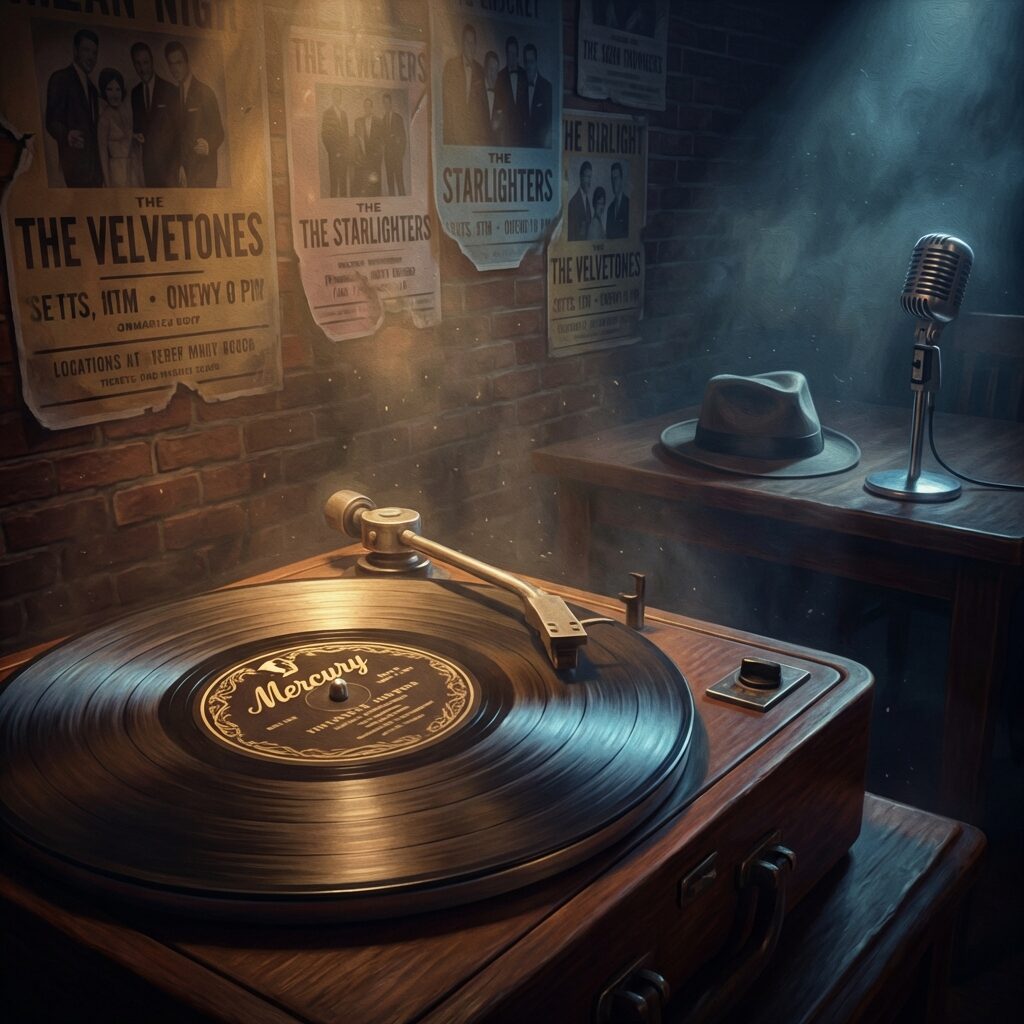
Here’s where it gets strange. The most personal song Stephen Sanchez had ever written, a real love letter to a real girl, using her real name, got swallowed by a fiction.
When Angel Face dropped on September 22, 2023, “Until I Found You” was track six on what was now a full concept album. The conceit: it’s 1958, and the record is by “Stephen Sanchez & The Moon Crests,” a band that never existed, playing music from an era that ended before Sanchez’s parents were born. The album follows a character called “The Troubadour Sanchez” who falls in love with a woman named Evangeline, who happens to be the girlfriend of a mob boss named Hunter. Hunter puts a bullet in the Troubadour’s chest by the end. Love story, mob story, murder ballad, played completely straight.
So why bury a genuine confession inside an elaborate fictional universe? Because the confession got too public. After the breakup with Georgia, Sanchez was stuck: the most intimate thing he’d ever written was becoming a global hit, and every interview meant reopening the wound. The fiction gave him a way to keep performing the song without performing his own heartbreak every night. The Moon Crests were a shield. The concept album was a wall between his real story and the world’s appetite for it.
The band name started almost as a joke during sessions with co-producers Fitchuk and Snyder. But it stuck because it sounded right, like something you’d see on a faded poster stapled to a telephone pole in 1958.
And then there’s the coincidence that makes the whole thing feel like it was planned by someone with a flair for narrative symmetry. The Platters, one of the core artists in that San Jose barn, one of the sounds Sanchez grew up absorbing before he understood what he was hearing, were a Mercury Records act in the 1950s. Mercury was their label. Seventy years later, Mercury Records released “Until I Found You.” A 1950s-style love song, shaped by 1950s artists, put out on the same label that originally carried those artists. Sanchez noticed the connection as the song approached gold certification.
“It’s even more wild that The Platters were on the label Mercury back in the ’50s,” he told ABC Audio. “And this record is signed through Mercury, and it’s Gold under Mercury. And it’s a 1950s-style love song. Like, that’s just unreal and such a full circle thing.”
He’s not wrong. The records that DJs threw away ended up in a barn. A kid found them. The kid made his own record that sounded like the ones in the barn. And it came out on the same label. You can’t write that. Or rather, nobody needed to.
The Longest Slow Dance
A 51-week climb to #1 on Hot Rock & Alternative Songs, 2 billion total streams, and 4x Platinum certification. The anti-viral hit that went viral slowly, one week at a time.

Most songs that become massive hits do it fast. They debut high, spike on playlists, burn through their cultural moment, and fade. “Until I Found You” did none of that. It crept upward for almost a year, and the sheer stubbornness of its chart run is what makes the numbers worth looking at.
The song took 51 weeks to reach #1 on Billboard’s Hot Rock & Alternative Songs chart, finally getting there around March 4, 2023. That’s the second-longest climb to #1 in the chart’s history, behind only Glass Animals’ “Heat Waves” at 60 weeks. For nearly a year, this thing was gaining listeners week after week, never exploding but never fading either, building the way songs used to build before streaming compressed every hit cycle into a two-week sugar rush.
On the Billboard Hot 100, it debuted at #100, literally the last slot on the chart, and climbed to a peak of #23 over 23 weeks. That’s not a viral spike. That’s a grinding ascent, the kind of chart run that looks more like word-of-mouth than algorithmic injection. People heard it, liked it, told someone else.
The TikTok-to-radio pipeline played a role, but the song moved through platforms in an unusually organic way. It started on TikTok, migrated to streaming, then hit radio, climbing to #10 on Pop Airplay, #4 on Adult Alternative Airplay, #6 on Adult Pop Airplay, and #14 on Adult Contemporary. That spread across demographic lines matters. When you’re charting on both Pop Airplay and Adult Contemporary at the same time, you’ve written something that works for the college kid and their parents.
January 2023 brought an accelerant: the song landed in the second season of Netflix’s Ginny & Georgia, playing during the finale’s wedding scene. That sync topped Billboard’s Top TV Songs chart for the month. In the same week, the song pulled 43.7 million official U.S. on-demand streams and 10,000 downloads. The Netflix placement didn’t create the success. The song was already climbing. But it poured fuel on a fire that was already going.
The total numbers, accumulated over years rather than weeks, got big. Over two billion streams across platforms. Sanchez’s monthly Spotify listenership surged to 33 million, putting him in the top 100 most-listened-to artists on the platform. The YouTube music video hit 105 million views. On TikTok, the song spawned millions of videos with over a billion collective views.
The RIAA certified it 3x Platinum in August 2023, then bumped that to 4x Platinum by April 2024. The song appeared on sixteen international charts for a combined 421 weeks. It hit #8 in Australia, #14 in the UK (re-entering after Glastonbury, having previously peaked at #16), and #2 in Belgium. It placed #39 on the UK’s year-end chart for 2023.
None of those numbers on their own are the story. The story is the shape of the run. This wasn’t a song that got lucky with one viral moment. It just kept showing up, week after week, because people kept playing it. The streaming era is supposed to have killed that kind of slow build. Apparently nobody told this song.
Glastonbury, Sofia, and Olive Garden
From Elton John’s final UK show to Sofia Richie’s wedding to Rosé’s birthday cover to Olive Garden, the song kept turning up in places that had nothing in common, because a generation hungry for sincerity latched onto it and wouldn’t let go.

There’s a version of this section where I just list all the places “Until I Found You” has shown up and let the range speak for itself. But the specific stories are too good to summarize, so let’s take the three that matter most.
Glastonbury, June 25, 2023. The Pyramid Stage. Elton John is playing what’s billed as his final show in the UK, ever. The biggest stage at the biggest festival in the world, and Elton has turned it into a celebration, bringing out guest after guest, Jacob Lusk from Gabriels, Rina Sawayama, Brandon Flowers of The Killers. And then he brings out Stephen Sanchez, a twenty-year-old kid who, days earlier, had played an intimate show to 320 people at Omeara, a venue in London roughly the size of a large living room.
Elton changed his planned setlist to make room for Sanchez to sing his own song. At rehearsals, he pulled the kid aside and said something Sanchez has been carrying around since: “I don’t want you to waste this, this is the biggest moment so far in your career. It’s the biggest moment in my career as well.” Think about that for a second. Elton John, a man who has played every stage on the planet, telling a twenty-year-old that this moment is as big for him as it is for the kid. And Sanchez responded by going out there and delivering. “I could’ve split the sky in half I was so fearless,” he said afterward. The song re-entered the UK chart at #14 the following week.
A couple of months earlier, April 22, 2023: the wedding of Sofia Richie and Elliot Grainge at the Hotel du Cap-Eden-Roc in Antibes, France. Elliot Grainge, whose father, Lucian Grainge, happens to be the chairman and CEO of Universal Music Group, had secretly arranged to fly Sanchez to France for the ceremony. Sanchez changed the lyrics from “Georgia” to “Sofia.” The walk down the aisle lasted over seven minutes. They had to keep singing the chorus over and over because Sofia was crying too hard to proceed.
“We kept having to sing the chorus over and over again, cause she was crying,” Sanchez told People. “She was having to get ready and had a wardrobe malfunction cause she was crying over that moment.” Sofia didn’t even realize it was actually Sanchez singing until she got close to the altar. Lionel Richie walked his daughter down the aisle; after the ceremony, guests partied with Sanchez until three in the morning. A love song written to a girl named Georgia, performed at a French Riviera wedding with “Sofia” dropped in where “Georgia” used to be, sung on repeat while the bride cried her way down the aisle. You couldn’t make that up.
Then there’s the Rosé cover. On February 10, 2023, the day before her twenty-sixth birthday, Rosé of Blackpink released a stripped-back acoustic version of “Until I Found You.” The previous year, she’d released covers of Coldplay, Neck Deep, and Oasis for her birthday. This year, she chose Sanchez. The cover hit #1 on Billboard’s Hot Trending Songs chart, and the original saw a concurrent 8% spike in U.S. streams, with 9.4 million plays in the week of February 10-16 alone. When one of the biggest names in K-pop picks your song as her birthday release, that opens a door to an audience that might never have stumbled onto a doo-wop-influenced indie pop song otherwise.
What makes these moments worth telling together is how little they have in common besides the song. The Pyramid Stage. A billionaire wedding on the French Riviera. A K-pop star’s birthday video. The song also showed up in Superman & Lois on The CW, scoring a scene between Clark Kent and Lois Lane. It appeared in the trailer for Lola, directed by Nicola Peltz Beckham. It dominated TRL, or the 2020s equivalent, which is TikTok, where it racked up millions of videos.
And it played at Olive Garden.
I’m including that because a Reddit commenter called it “the best song they’ve played at Olive Garden after all the years I’ve been there,” and honestly, if that doesn’t capture where this song ended up, nothing does. Elton John’s final UK show and unlimited breadsticks. The French Riviera and your nearest strip mall. This isn’t a song that found a niche. It just kept going.
There’s a generational thing happening here, too. Gen Z’s well-documented love of vinyl records and pre-digital aesthetics had already cleared a path. TikTok data shows that older music, tracks five or more years old, accounted for 19 out of 50 top songs on British TikTok in 2024, up from just 8 of 50 in 2021. A generation raised on irony and algorithms was reaching backward for something that didn’t feel mediated by twelve layers of self-awareness. “Until I Found You” split the difference, it sounded like the fifties but it hit like something written yesterday. As UMusic NZ put it, the audience was “a youth culture living in nostalgia, obsessed with vinyl records, nineties fashion and now, rock and roll romance.” Sanchez just happened to be someone who’d been speaking that language his whole life.
Still Finding Her
The records DJs threw away shaped a billion-stream hit decades later, and sincerity, the least common sound in modern pop, turned out to be exactly what two billion listeners were waiting for.

Go back to the barn on the hill in San Jose. The records in those crates, The Platters, Paul Anka, The Penguins, all the rest, were thrown away by DJs who’d gotten their use out of them. One spin on the radio, then into a pile, then into a barn, then into the hands of a kid who didn’t know they were supposed to be disposable. He listened to them like they were new. He absorbed the chord progressions, the vocal approach, the reverb, the 12/8 sway, the directness of a man telling a woman he loved her without hedging or irony. And decades later, that absorbed vocabulary came pouring out in under fifteen minutes in a Nashville apartment, addressed to a real girl by her real name.
Here’s the thing nobody talks about with this song. Sanchez wrote “Until I Found You” from fear, fear of losing Georgia, fear that he wasn’t good enough, fear that he’d already ruined the best thing that had happened to him. But the world heard it as pure devotion. Two billion streams’ worth of people used it for first dances, for TikTok declarations, for crying at weddings, for swaying in their bedrooms to something that felt like it had always existed. They heard the love. He wrote the loss. The song outgrew both readings a long time ago.
Sanchez seems at peace with that now. “I feel like it’s about the people’s stories this record is soundtracking,” he said, “and I think that that’s more important than what it was about originally.” That’s a strange thing for a twenty-something to say about the most personal song he’s ever written. Most people would hold on tighter. But he handed his own heartbreak to strangers and let them turn it into something happy. The song doesn’t belong to Georgia anymore, or even to Sanchez. It belongs to whoever is listening to it right now, projecting their own story onto its three minutes of reverb and devotion.
Here’s what I keep coming back to: in a pop world run by production maximalism, stacked vocals, 808 patterns, and hooks designed by committee, the thing that cut through all of it was a guy with a Rickenbacker, too much reverb, and a I-IV-V chord progression singing a girl’s actual name. No gimmicks. No ironic distance. No algorithmic optimization. Just sincerity, which, if you think about it, might be the least common sound in modern pop.
Two billion people showed up for it. The audience for honesty was always there. Someone just had to actually try.
Did you know? Stephen Sanchez wrote “Until I Found You” in under 15 minutes after messing around with 1950s covers — and it dropped on Mercury Records, the same label that released The Platters 70 years earlier 🎶💿 #StephenSanchez #UntilIFoundYou #DooWop https://bit.ly/4cagMGX

Click to Tweet