Horses, Lasers, and Trumpets
Knights of Cydonia opens with horse whinnies and laser blasts, then delivers the most absurdly ambitious six minutes in 2000s rock. It works because Muse committed fully to being both deeply personal and completely ridiculous, and refused to hedge on either.
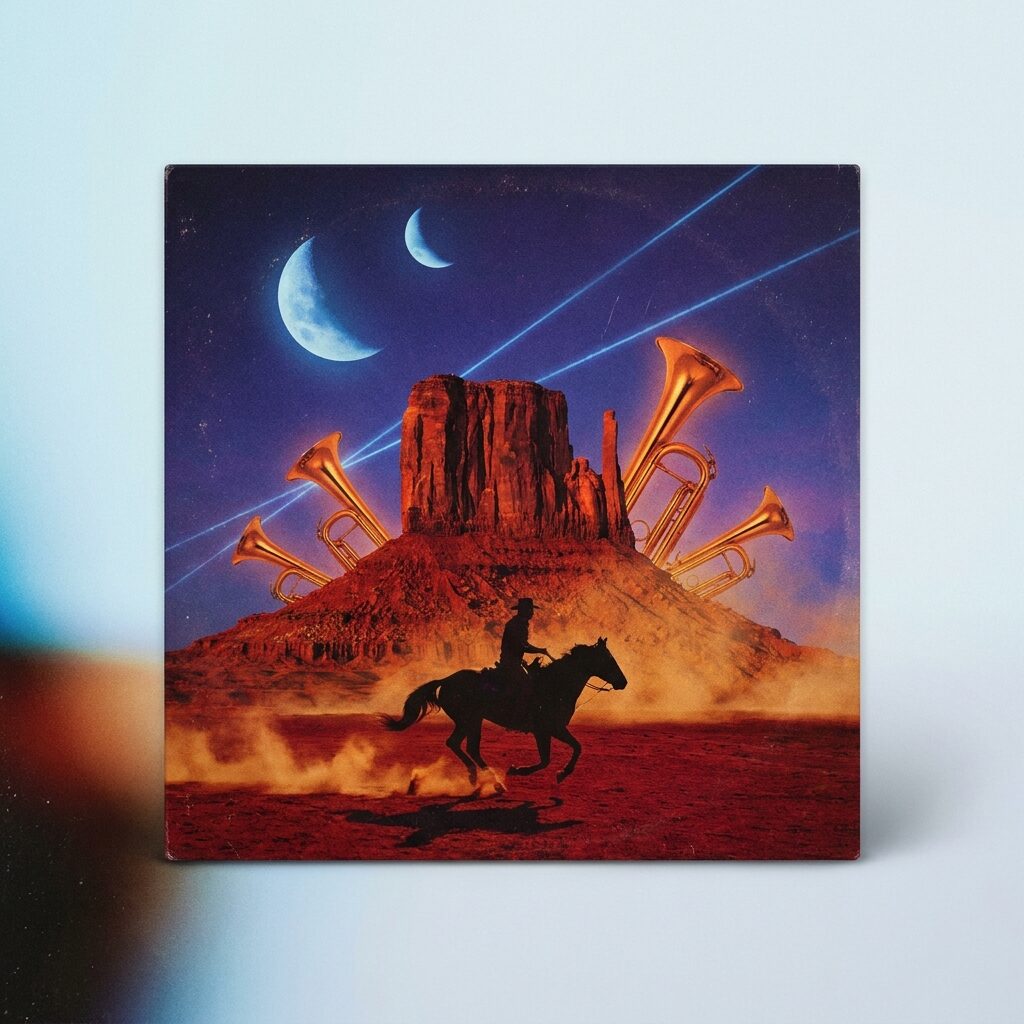
Imagine you’ve never heard this song. You press play and the first thing you hear is a horse. Not a metaphorical horse, not a guitar effect that kind of sounds like a horse. An actual horse whinny. Then laser blasts. Then, before your brain can even figure out what genre it’s supposed to be, mariachi trumpets come swaggering in like they own the place. You’re maybe thirty seconds in and you already have no idea what’s happening.
Good. That’s exactly where Muse wants you.
What follows is six minutes and change of the most unhinged rock music the mid-2000s ever produced. “Knights of Cydonia” shouldn’t work. It’s too long for radio. It has no chorus in any conventional sense. It stitches together at least three different songs across genres that have no business sharing a tracklist, let alone a single composition. It has horse noises. On paper, it reads like a joke, or at best, a prog-rock indulgence destined to be a deep cut for the diehards.
Instead, it became one of the defining rock tracks of its decade.
Chris Wolstenholme, the band’s bassist, once described it as “40 years of rock history in six minutes.” That’s not hyperbole. It’s barely even an exaggeration. The song pulls from spaghetti westerns, surf rock, Queen, Iron Maiden, 1960s British instrumental pop, and dystopian science fiction, runs all of it through a distortion pedal, and somehow comes out the other side sounding not like a mess but like an anthem.
I keep coming back to why it actually lands, and I think it’s this: the song is simultaneously deeply personal and completely ridiculous, and Muse committed fully to both. There’s a real emotional core here, a son paying tribute to his father’s musical legacy, channeling decades of rock lineage into something new. But there’s also a band that decided the best way to honor that legacy was to cram it all into one song, add lasers and horses, aim the whole thing at Mars, and dare anyone to call it too much. The sincerity makes the absurdity land. The absurdity makes the sincerity hit harder. And the fact that they pulled it off, that it became a career-defining moment rather than a spectacular misfire, is maybe the best argument I know for what happens when a band just refuses to hedge.
A Riff Born in the Desert
Matt Bellamy wrote the core riff on a tour bus rolling through Arizona in 2004, deliberately shaping it to echo his father’s 1962 hit “Telstar”, the first British #1 in America.
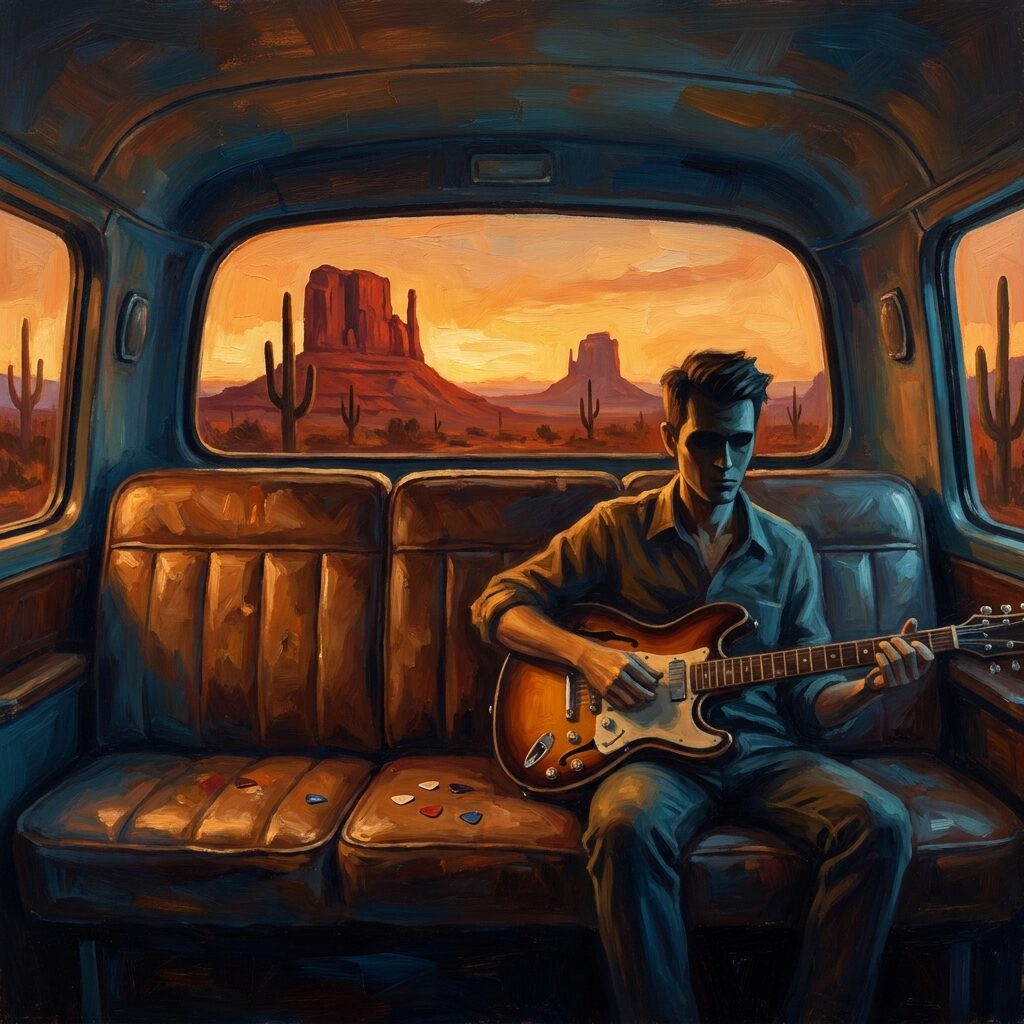
The year is 2004. Muse is on the Absolution tour, rolling through the American Southwest. Matt Bellamy is at the back of the bus, doing what guitar players do when they’re bored and inspired at the same time, playing the same riff over and over until it either turns into something or drives everyone else insane.
Dominic Howard, the band’s drummer, remembered the scene vividly: “Matt was at the back of the bus in Arizona, repeating the jerky riff to death, outside we could see the desert rolling…all that went very well together. Galloping horses, Texas, trumpets etc.” The landscape was doing half the writing. Red rock, open sky, the kind of vast emptiness that makes you think about cowboys and space and whether there’s really much difference between the two.
But that riff wasn’t coming from nowhere. Bellamy was thinking about his father.
George Bellamy was the rhythm guitarist in The Tornados, a British instrumental group whose 1962 single “Telstar” hit #1 on the American pop charts, the first time any British band had managed that. This was before the Beatles crossed the Atlantic, before the British Invasion was even a concept. The Tornados got there first, with a track named after the Telstar communications satellite, driven by the eerie wail of a Clavioline, a primitive electronic keyboard that sounded like the future showing up a few years early.
Matt grew up hearing that song. And when he started shaping the opening guitar part of what would become “Knights of Cydonia,” he made a deliberate choice. “On the opening part of that song, we made a conscious effort to make the guitar sound like a 1950s synth, one of the first synthesizers around, that they’d used for the sound of the ‘Telstar’ bit,” Bellamy explained. “That was deliberate.” The track also sounds a lot like George Bellamy’s own composition “Ridin’ the Wind,” which probably isn’t a coincidence when you’re a guitarist who grew up in your dad’s record collection.
It didn’t stop there. Wolstenholme recalled: “When we wrote ‘Knights,’ we were listening to a lot of Morricone and stuff like Dick Dale, surf stuff like that.” Bellamy was watching Clint Eastwood films, The Good, the Bad and the Ugly in particular, absorbing the way Ennio Morricone’s scores made the desert feel ten times larger than it actually was. He was listening to The Shadows, the British instrumental group who’d dominated the pre-Beatles era alongside his dad’s band. All of this, the surf guitar, the spaghetti western bombast, the space-age optimism of early 1960s pop, was running through one guitarist’s head while the Arizona desert scrolled past like a movie backdrop.
Originally, Bellamy intended the song as a mostly instrumental prog showcase, with lead guitar serving as the vocal line. He wanted to lean into the band’s progressive side, let the riffs do the talking. The early versions had a retro 1950s sound built around heavy tremolo, fitting, given the Tornados homage, but it didn’t sit right against the rest of the album they were building.
So they went the other direction entirely. Bellamy swapped the vintage tremolo for what he called “the most obscene ridiculous heavy distortion” pedal he had. The song stopped sounding like a loving period piece and started sounding like a loving period piece being fed through a jet engine. That push and pull, treating your influences with total reverence while also blowing them up, is what makes the track work.
The recording sessions for Black Holes and Revelations were split between New York and France, co-produced by Rich Costey, who’d previously worked with Rage Against the Machine and Audioslave. Muse had originally planned a massive production setup. Instead, they ended up in a small studio with vintage equipment and minimal microphones. Sometimes the constraints are the whole point. Howard called the sessions “a real highlight,” noting “some of the most amazing vocals I’ve ever heard Matt do.” Working in a tight room gave a song about galloping across Mars a weird intimacy it probably wouldn’t have had otherwise.
Anatomy of Controlled Chaos
Behind the genre-hopping mayhem, Knights of Cydonia is built on sophisticated harmonic choices, E Dorian mode, a three-act structure, and a galloping rhythm that connects it to rock’s most primal traditions.
Let’s talk about what’s actually happening in this song, because the chaos is more controlled than it sounds.
Knights of Cydonia is essentially three different songs stitched together. The Bohemian Rhapsody comparison gets thrown around a lot, and honestly? It’s earned. You’ve got the instrumental opening, that Morricone-meets-Telstar guitar over galloping drums and mariachi trumpet. Then a vocal-focused middle section where Bellamy drops into lower register verses before climbing into falsetto. And finally, the anthemic guitar-led finale that’s basically designed for 80,000 people to scream along to. Each section has its own feel and its own energy. But they don’t feel like a medley. They feel like a story.
Harmonically, this thing is sneakier than it sounds. The song sits in E Dorian mode, not your standard E minor. The difference? One note. E Dorian has a raised 6th, which means you’re getting a C♯ where standard minor would give you a C natural. It’s a subtle shift, but it’s the reason the song feels different from typical minor-key rock without most listeners being able to explain why. Music theory forums have described the harmonic transitions as “very wild” and “extreme” while somehow sounding “really natural and common to the untrained ear.” That’s a neat trick, writing something harmonically sophisticated enough to interest music nerds while keeping it intuitive enough that a teenager hearing it on Guitar Hero just feels like it goes hard.
The primary chord palette is relatively lean, Em, Bm, A, G, but the song modulates through sections in C minor and G♯ minor, which is where that sense of constant forward motion comes from. It’s running at 137 BPM, firmly in Allegro territory. Fast enough to feel urgent, controlled enough to maintain groove.
And speaking of groove, that galloping bass line. Wolstenholme isn’t being subtle about it. He’s literally evoking horseback riding, his fingers doing what horses’ hooves do on hardpacked desert ground. Howard’s drum pattern, meanwhile, carries a debt to Queen’s “I Want to Break Free,” that same propulsive insistence, that refusal to let the energy dip. NME nailed the lineage: “Its galloping rhythm has the same headlong exhilarating thrills of great metal epics like Led Zeppelin’s ‘Achilles Last Stand’ and Iron Maiden’s ‘Run To The Hills.'” The galloping rhythm might be rock’s most primal tempo. It triggers something almost physical, the feeling of velocity, of a chase, of ground disappearing beneath you. Every generation of rock finds its way back to it.
Then there’s the guitar solo, which NME ranked #5 on their all-time list. What makes it land isn’t just the technical execution, it’s the placement. By the time that solo arrives, you’ve been through the atmospheric intro, through the verses, through the building tension of the middle sections. The solo doesn’t just show off. It releases pressure. It’s the moment the song stops holding anything back, and in the context of that three-act structure, it hits like the climax of a film. Reviewers noted it sounds like a section of “Bohemian Rhapsody,” that same operatic grandeur translated into six strings and a fuzz pedal.
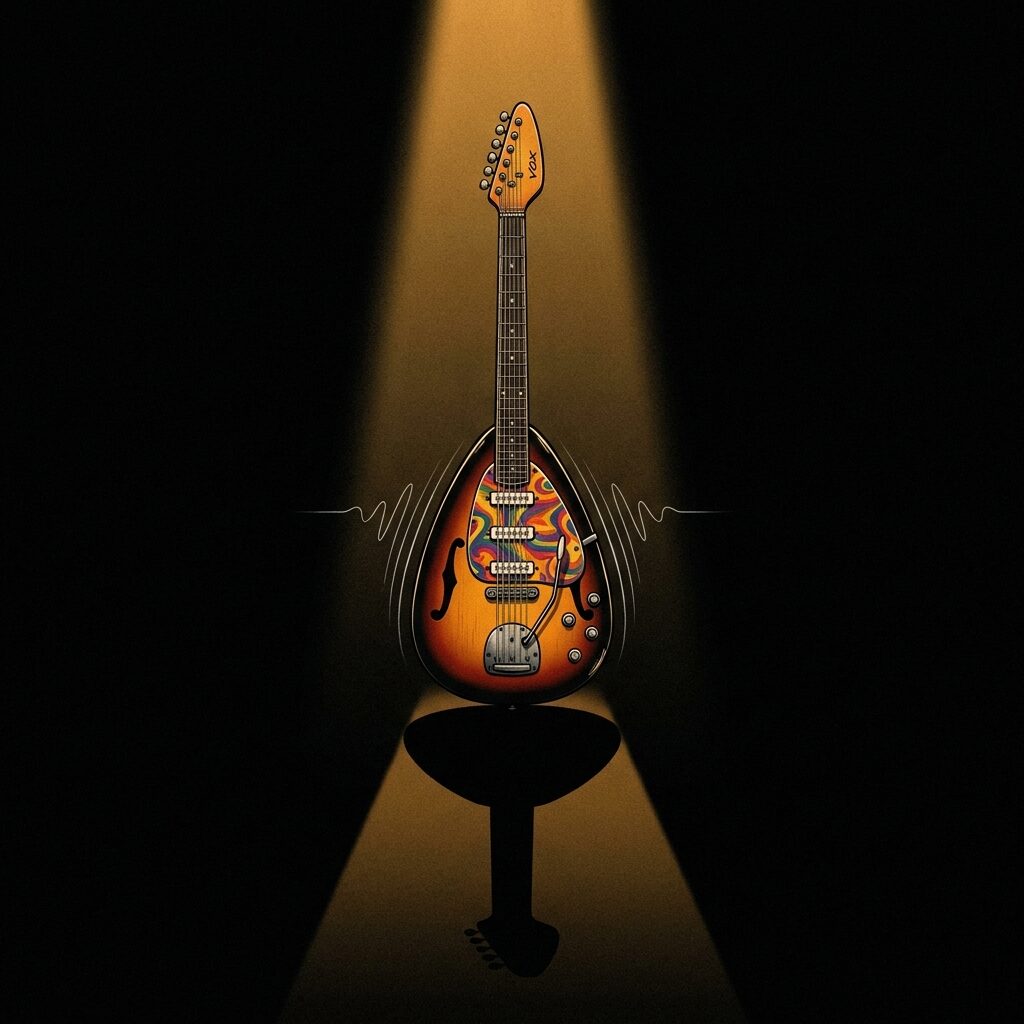
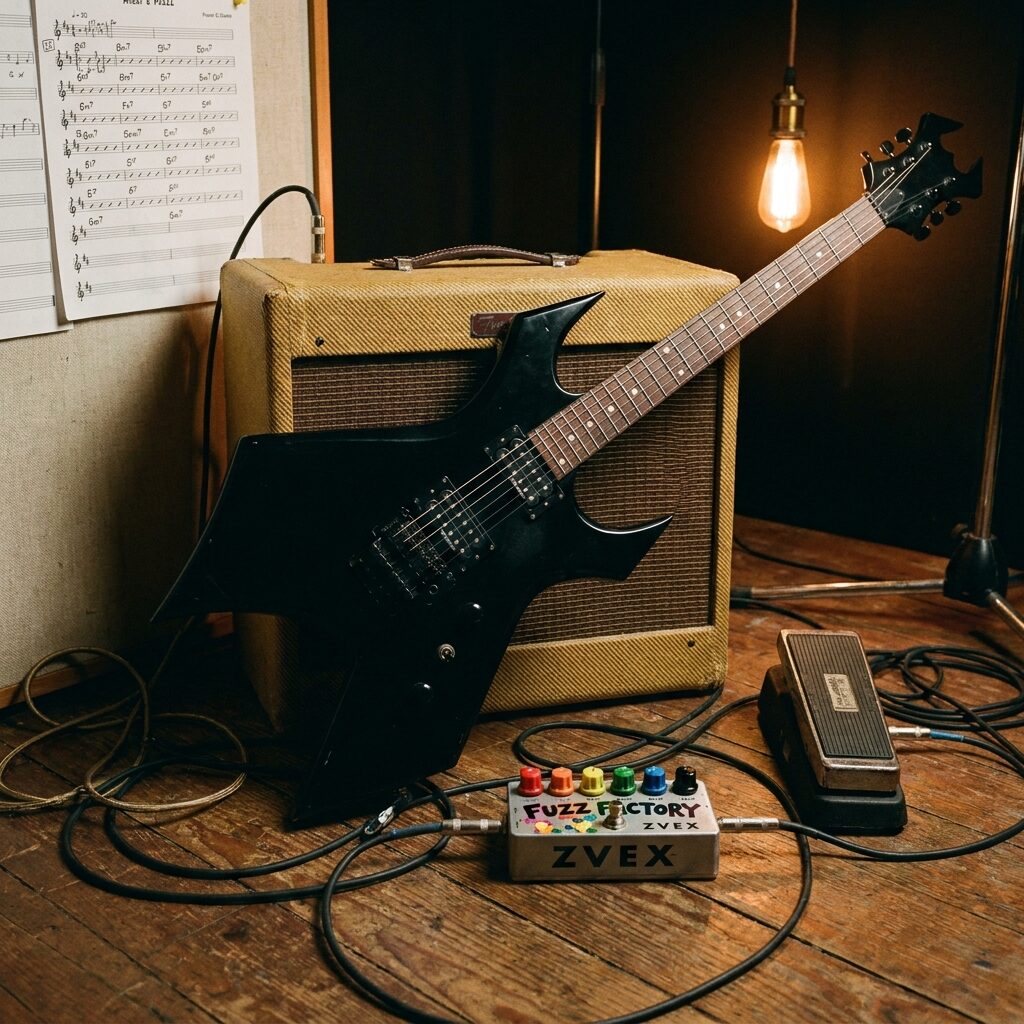
The gear behind the sound is worth getting into. Bellamy played his Manson Bomber, a custom-built guitar from luthier Hugh Manson that would become one of his signature instruments across multiple tours. He ran it through a Diezel VH4 amp for that high-gain punch, with a ZVEX Fuzz Factory for the more unhinged textures. An MXR Phase 90 handled the sweeping modulation on the lead lines, and a Line 6 DL4 Delay Modeller added spatial depth.
There’s also a great story about the Digitech Whammy pedal. Bellamy apparently asked Hugh Manson if they could build one directly into a guitar. Manson’s response was perfect: “Of course we can. Then I looked at the back of a Whammy pedal and realized it draws a lot of power. Unless he wanted a guitar full of batteries that he could only use for 40 seconds, it wasn’t gonna work.” Sometimes the best gear stories are about the ideas that didn’t pan out.
The intro layers in sounds you wouldn’t expect on a rock record. Those horse whinnies and laser blasts aren’t ironic. They’re scene-setting. And the trumpet part, played by a session musician (sources disagree on whether it was Marco Brioschi or a chain-smoking trumpeter known as Franco; the historical record is charmingly vague on this point) adds a genuine Morricone flavor rather than just gesturing at one. Pitchfork described the opening as “stampeding stallions and laser blips before moving into a galloping 6/8 drumbeat slathered in mariachi trumpets.” That’s about right. It’s ridiculous and it’s specific and it works.
Gods Who Fall Asleep on the Job
Bellamy’s lyrics aim wide on purpose, corrupt leaders as sleeping gods, civilizations caught in the same loop, then the finale drops the analysis and turns into a straight-up battle cry. The broadness is the point: it lets anyone plug in their own tyrant.
For a song with horse noises and laser effects, the lyrics are doing more work than you’d expect.
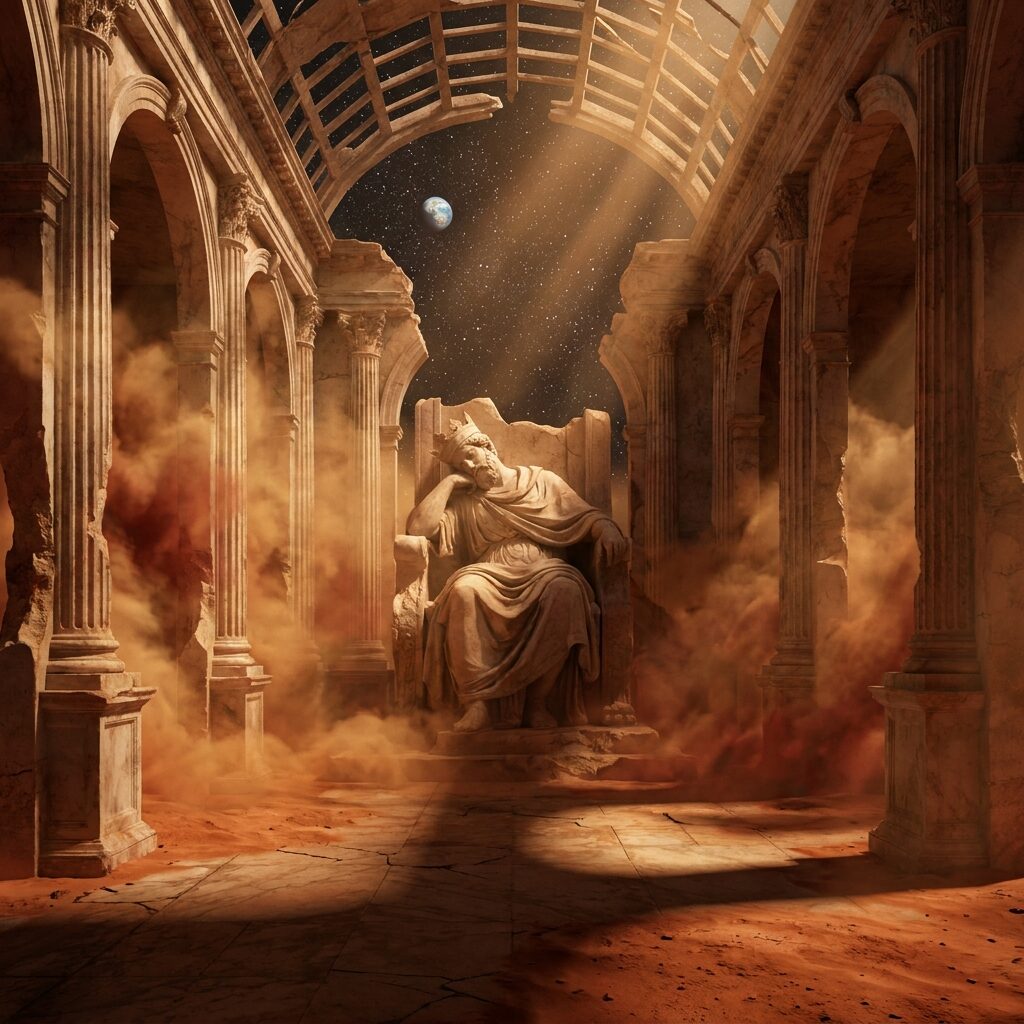
Bellamy’s starting point was broad on purpose. He wasn’t writing about Bush or Blair or any specific leader, he was writing about all of them. Every leader who accumulates power and mistakes it for divinity. “I’ll show you a god who falls asleep on the job” is about politicians and rulers who consider themselves godlike because they have power, then fail the people they’re supposed to serve. It’s a brutal little image. Six syllables, falls asleep on the job, and the whole critique is right there.
The bigger theme, as Bellamy explained in Mark Beaumont’s biography Out Of This World, is the life-cycle of civilizations. How empires rise and fall, how the same patterns repeat, whether it’s even possible to break the cycle. “How can we win, when fools can be kings?” isn’t asking for an answer. It’s asking whether you’re willing to try anyway. “Don’t waste your time or time will waste you” reads like a bumper sticker until you hear it in context, delivered with escalating urgency over that galloping rhythm, it stops being a platitude and turns into a warning.
The structural trick worth noting is the shift from observation to action. The verses diagnose the problem. They’re analytical, almost detached, here’s what’s wrong with the world, here’s the pattern we keep falling into. But the finale abandons analysis entirely. “No one’s gonna take me alive / The time has come to make things right / You and I must fight for our rights / You and I must fight to survive.” That’s not a thesis. That’s a battle cry.
Bellamy was explicit about what he was doing: “When I’ve created a slightly imaginary dystopian nightmare, I’m putting myself in there: what would I feel in that situation? In Knights Of Cydonia, ‘No one’s going to take me alive’, I had that feeling of wanting to fight back against something.” He’s not observing from the outside anymore. He’s inside the story, and he’s dragging you in with him.
The lyrics work despite their broadness, maybe because of it. They’re a feeling more than an argument. Bellamy isn’t making a specific political case. He’s channeling the emotion of political anger into something that feels like pure defiance. Optimism that looks like rebellion, rebellion that looks like optimism, the two stop being distinguishable when you’re screaming along with 80,000 other people. The broadness lets anyone plug in their own tyrant, their own broken system, their own reason to fight back. “There is this feeling of waking up and trying to fight back,” Bellamy said. “I think to me that’s very optimistic, this strength at the end of ‘Knights of Cydonia.'” He’s right. For a song set in a dystopia on Mars, it’s one of the most hopeful things in their catalog.
Cattle Punk Cinema
Director Joseph Kahn turned Knights of Cydonia into a six-minute short film, a post-apocalyptic spaghetti western with kung fu, laser guns, and 15 hidden movie references. Fans on NeoGAF identified 13 of them. The other two remain unknown.
Most bands would have made a performance video. Muse made a movie.
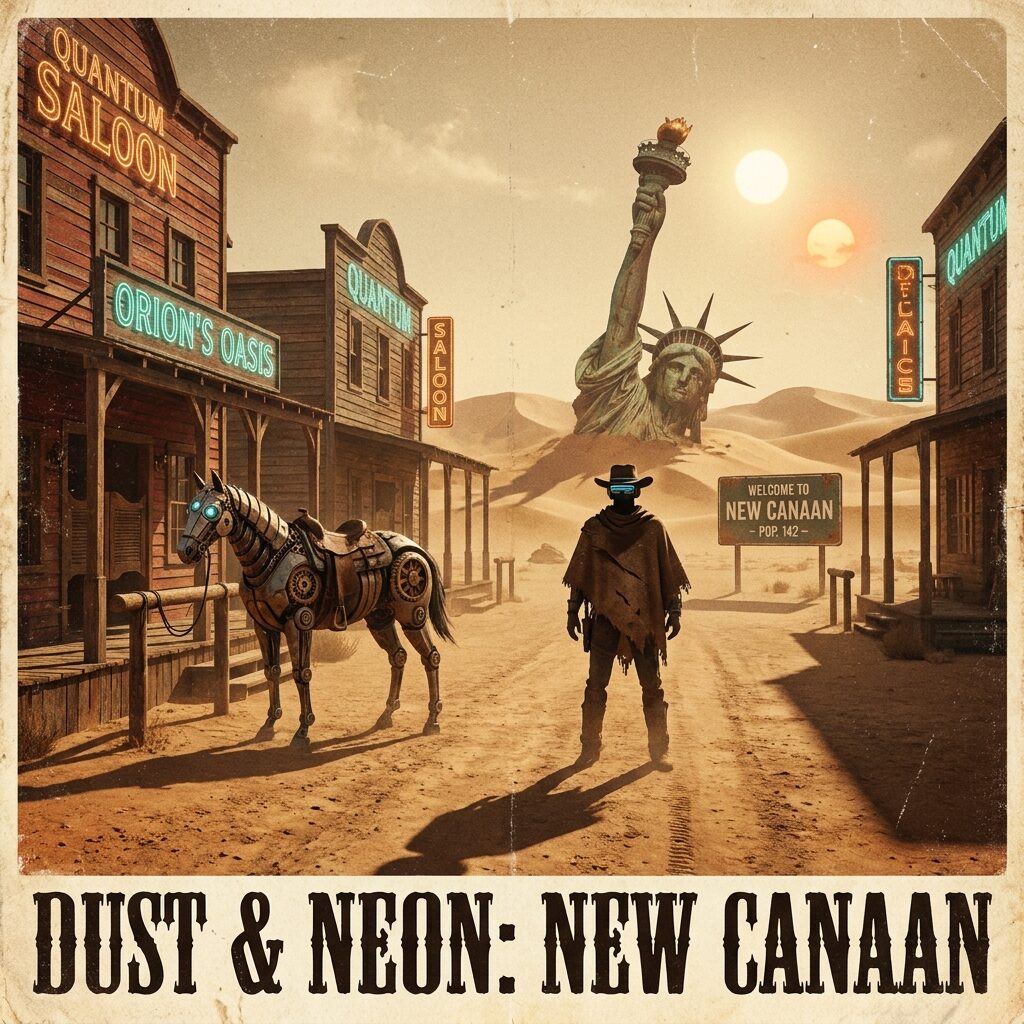
Director Joseph Kahn turned Knights of Cydonia into a six-minute short film, complete with opening and closing credits. The shoot took five days across three locations: Romania (recycling the set from Anthony Minghella’s Cold Mountain), London, and Red Rock, California. What came out is a post-apocalyptic spaghetti western that crashes headlong into kung fu and low-budget sci-fi. Whether it’s genius or insane depends on your tolerance for both, and the correct answer is yes.
The plot, loosely: a lone gunslinger called The Man With No Name (played by Russ Bain) rides into Cydonia, a town ruled by the villainous Sheriff Baron Klaus Rottingham (Richard Brake, chewing every available piece of scenery). Our hero gets defeated, humiliated, sent on a desert spirit journey involving a Valkyrian warrior and a robot, then comes back for revenge. There’s kung fu fighting, a metal-clad maiden on a unicorn, and laser gun duels. It sounds like someone threw a dozen VHS tapes from different sections of the video store into a blender. That’s because someone did.
About the kung fu: Russ Bain had zero martial arts training. Kahn’s response? “He didn’t know any kung fu, but that was exactly the type of kung fu I wanted.” You can see the awkwardness in every fight scene, and it works. The video shares the song’s attitude of maximum ambition, minimum pretension. Nobody’s trying to sell you on realism. The commitment to going all the way is the whole appeal.
The easter eggs run deep. Muse and their label ran a MySpace competition in September 2006, challenging fans to spot 15 hidden movie references for a chance at one of 1,000 movie posters. You’ve got a Statue of Liberty protruding from the ground (Planet of the Apes), Star Wars-style holograms, and a robot walking like C-3PO. The town’s population sign reads 143, which is numerical shorthand for “I love you.” Actors mouth along to the lyrics: Bain mouths “No one’s going to take me alive” while locked in a pillory, Cassandra Bell (as Princess Shane Kuriyami) mouths “You and I must fight for our rights” at the gallows.
Most of those references were, by all accounts, “very cryptic and practically impossible to guess.” Fans on NeoGAF managed to identify 13 of the 15. The other two remain unknown, which feels right for a song named after a region of Mars famous for optical illusions.
Two moments are worth calling out. First: there’s a sex scene where the camera crew is deliberately visible in a mirror. The video knows it’s a video, the same way the song knows it’s too much and leans in anyway. But the self-awareness never tips into irony. It’s not winking at the audience from a safe distance. Every scene still plays straight.
Second: a proper Chekhov’s Gun. Early on, a Muse CD gets loaded into a jukebox, which generates a hologram of the band performing. Seems like a fun cameo, nothing more. Then later, that same hologram deflects the sheriff’s laser blast and saves the hero’s life. A band’s album literally saves the day. It’s absurd. It’s also kind of perfect, if you buy the idea that art can intervene in the world, even in a post-apocalyptic desert town on Mars.
The Closer That Never Gets Old
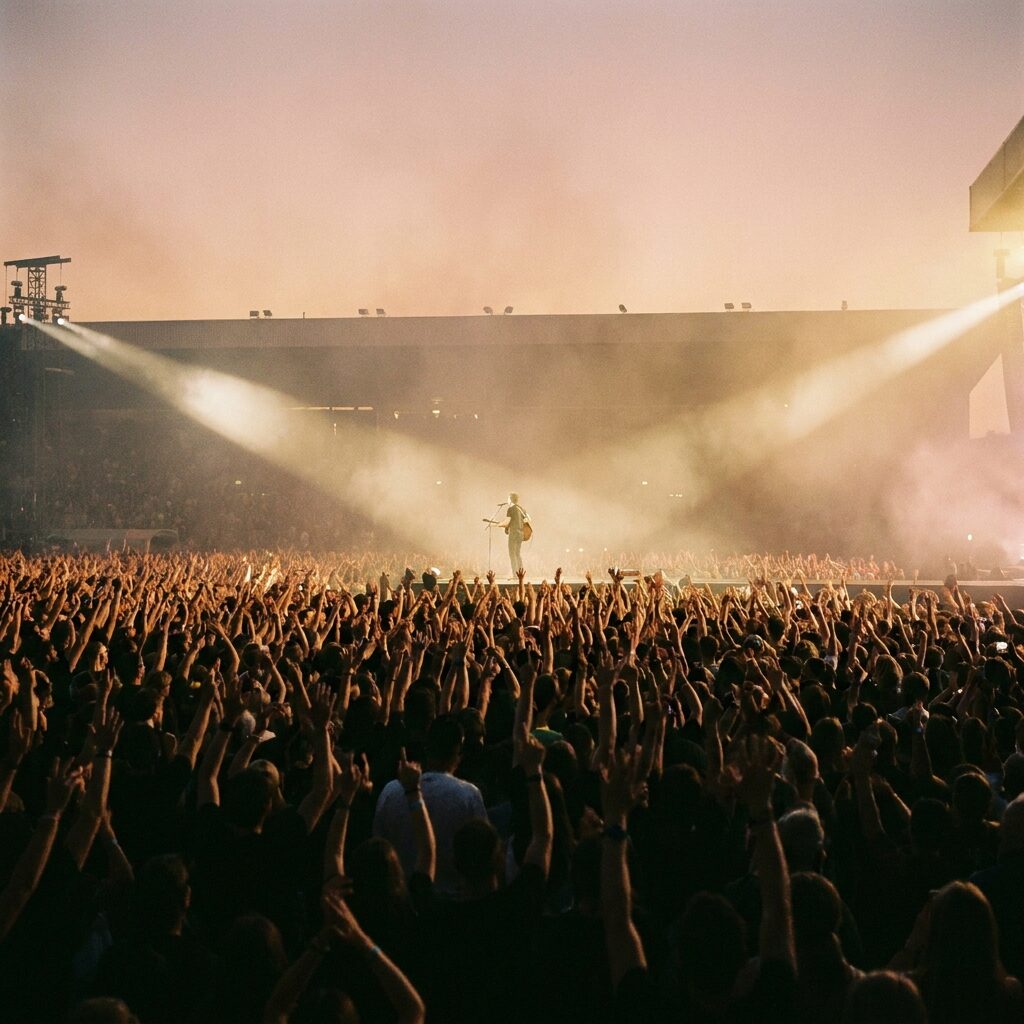
Knights of Cydonia has closed nearly every Muse show for almost 20 years. What started as a risky debut at BBC Radio 1’s Big Weekend in Dundee, where Bellamy half-expected confusion, became a harmonica-led arena ritual that 80,000 people sing back every night, and somehow still hasn’t gotten old.
The first time Muse played Knights of Cydonia live, they genuinely didn’t know if anyone would care.
It was 13 May 2006, BBC Radio 1’s Big Weekend at Camperdown Park in Dundee. The band hadn’t played live in two years, hadn’t done a UK gig since Earls Court in 2004. They were testing three songs from Black Holes and Revelations, which wasn’t even out yet: “Starlight,” “Supermassive Black Hole,” and the six-minute spaghetti-western-prog one that could easily have confused people. Bellamy said afterward: “The crowd seemed to get the new ones straightaway, even ‘Knights Of Cydonia’, which is a bit of a weird one!” You can hear the relief in that. He expected blank stares. He got a crowd that was already with him.
After Dundee, the song locked into the setlist and basically never left. Nearly every Muse gig for close to twenty years. Not rotated out, not rested, not given the “we’ll bring that one back next tour” treatment. The only gaps are promotional appearances where they can’t play a full set.
What keeps it from going stale is that the live arrangement never sits still. Early on, Bellamy tacked a Space Dementia guitar adaptation onto the outro. Later in the Black Holes and Revelations tour, he started opening with the five-note riff from Close Encounters of the Third Kind, which tells you everything about how this band relates to science fiction. Then on 13 August 2008, Wolstenholme did something nobody expected: he pulled out an actual harmonica and played Ennio Morricone’s “Man With a Harmonica” from Once Upon a Time in the West as the song’s intro. He was still doing it in 2023. Fifteen years of a bass player walking to the front of an arena stage with a harmonica, playing a Morricone theme, and the crowd going absolutely feral for it every time. It should feel like a gimmick by now. It doesn’t.
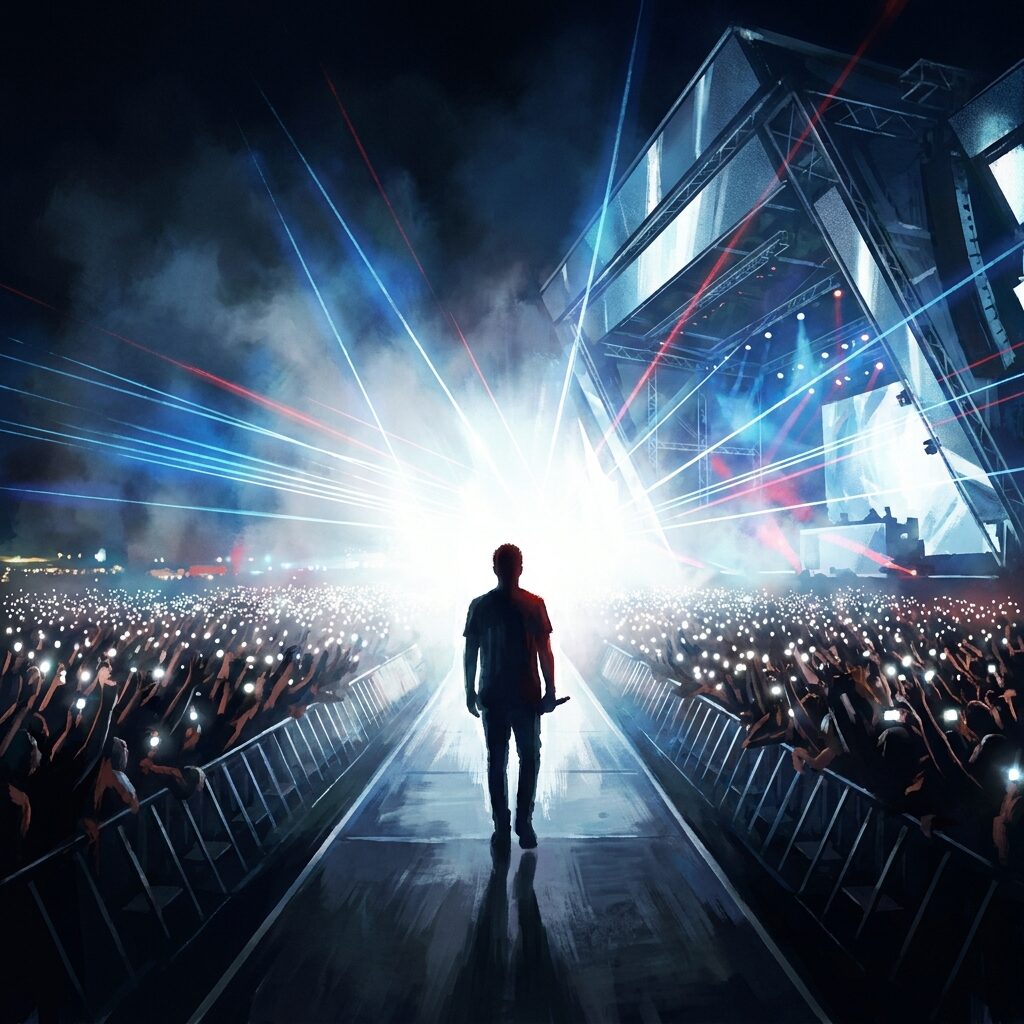
The Wembley Stadium shows in June 2007 were when the song stopped being a great closer and became something people tell stories about. Two nights, 180,000 people total, 150,000 seated, 30,000 standing. The stage was themed around HAARP, the High-frequency Active Auroral Research Program, because Muse are the kind of band who build their set design around an ionospheric research facility that conspiracy theorists won’t shut up about. The whole thing was captured on the HAARP live album, which NME later ranked the 40th greatest live album of all time.
The reason it works as a closer, and keeps working, is structural. Three acts. You start in that sparse Morricone space, build through the verses, and arrive at the finale already knowing what’s coming. Nobody cares that they know. That’s the point. The last section is built for crowds. “No one’s gonna take me alive” is a melody that 80,000 people can sing back without thinking, and when they do, it stops being about whatever dystopian scenario Bellamy originally had in mind. It becomes about the room. The specific room, the specific night, the fact that everyone around you is doing the same thing at the same time. Howard has thrown in drum solos over the years, extra guitar parts have crept into the solo section, codas come and go. But the bones of the ritual don’t change. Harmonica. Build. Release. Roar.
From Guitar Hero to Gold Medals
Guitar Hero III put Knights of Cydonia in front of millions of new players in 2007, and the ripple effects were immediate: the song won Triple J’s Hottest 100 by just 13 votes (prompting a rule change), NBC soundtracked Michael Phelps’s record-breaking eighth gold medal with it, and NME Radio listeners voted it as the station’s very first broadcast. The song kept climbing polls for years after.
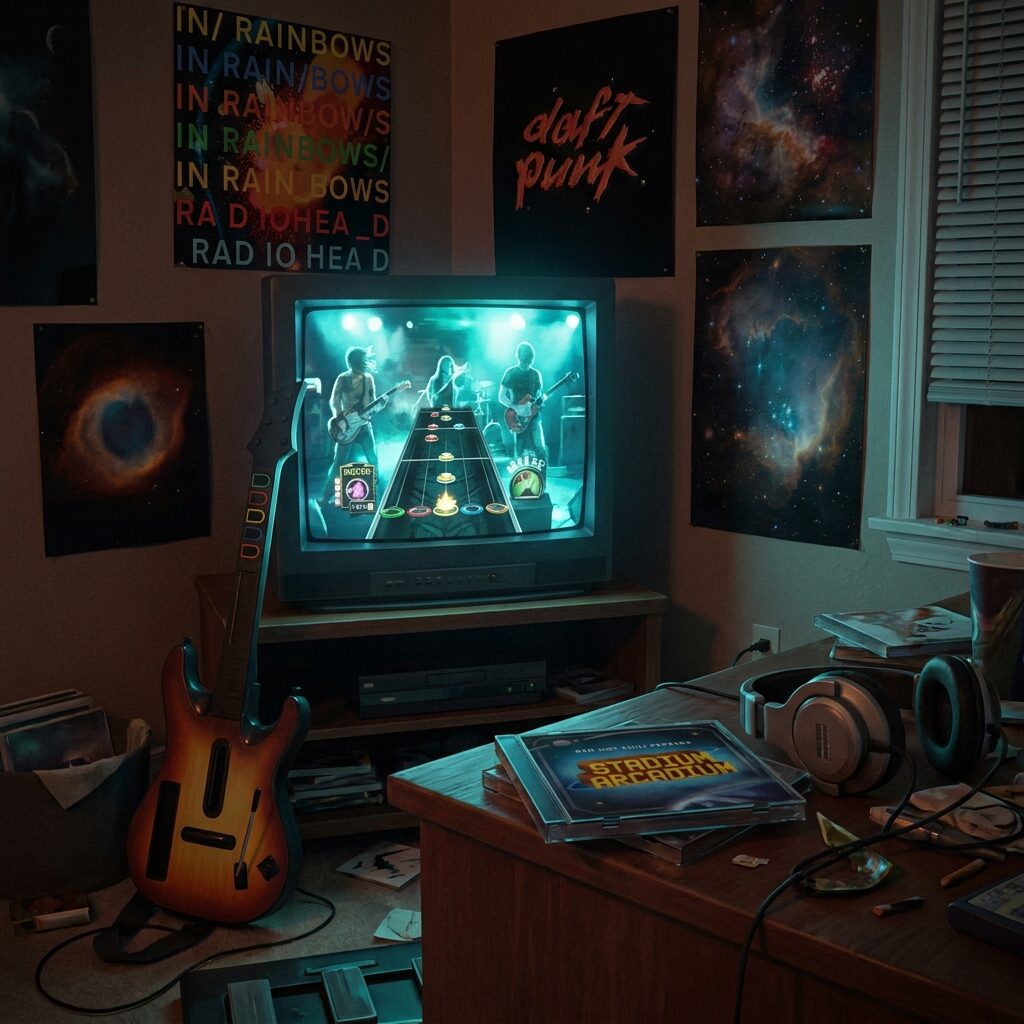
There’s a version of history where Knights of Cydonia stays a beloved Muse deep cut, the sprawling album closer that diehards rave about but casual listeners never discover. Guitar Hero III changed that timeline.
When the song appeared in the 2007 game as a Tier 7 track, one of the hardest in the entire setlist, using the master recording rather than a cover, it put Knights of Cydonia in front of millions of players who might never have clicked on a six-minute prog-rock track by a British band they’d vaguely heard of. The game didn’t just expose the song. It made people experience it. Even through the abstracted medium of plastic buttons and a scrolling note highway, players felt the song’s intensity, its relentless forward momentum, the way the difficulty curve mirrors the musical arc. You failed at Knights of Cydonia a lot before you conquered it, and that made the conquest feel earned.
The Guitar Hero effect cascaded directly into one of the more entertaining controversies in Australian music history. In January 2008, Knights of Cydonia won Triple J’s Hottest 100, the annual listener poll run by Australia’s national youth broadcaster, essentially the country’s most democratic music chart. It won by just 13 votes over Silverchair’s “Straight Lines.” Thirteen votes. Daniel Johns of Silverchair had actually shown up to the broadcast, presumably expecting to celebrate. He didn’t get to.
The controversy wasn’t about the song’s quality. It was about timing. Knights of Cydonia had been released nearly 19 months before the poll, which meant it was competing alongside much newer tracks. The strong suspicion was that Guitar Hero III, released in late 2007, had given the song a massive second-wind boost among voters who’d just discovered it through the game. As Junkee later noted: “If only 13 less people played Guitar Hero that year.” Triple J subsequently tightened their inclusion guidelines, requiring songs to be released within a specific calendar window. Muse broke the format, so they changed the format.
The song kept showing up where you wouldn’t expect it. When Michael Phelps won his record-breaking eighth gold medal at the 2008 Beijing Olympics, breaking Mark Spitz’s record that had stood since 1972, NBC played Knights of Cydonia over the celebration footage. Hard to argue with the choice. The song sounds like what triumph feels like, not modest, dignified triumph, but the kind where you’ve done something so absurdly difficult that the only appropriate response is operatic excess.
That same year, NME launched NME Radio and let readers vote on the very first song to be broadcast. They chose Knights of Cydonia. A song stuffed with 40 years of rock history inaugurating a rock radio station. You couldn’t script it better.
The reach kept expanding. Triple J’s Hottest 100 of All Time poll in 2009 placed it at #18, the second-highest ranked 21st century song on the list. Their Hottest 100 of the Decade poll put it at #2. Each new context, each game, each broadcast, each poll, brought new ears to the song, and the song kept converting them. Six minutes at maximum intensity, it turns out, tends to stick with people.
The Hit That Shouldn’t Have Been
A six-minute song with no real chorus and horse sound effects hit #10 in both the UK and on Billboard’s alternative chart, while its parent album gave Muse their first US top-ten entry.
Let’s put the chart performance in perspective. This is a six-minute song with no conventional structure, no real chorus, horse noises in the intro, and laser sound effects. It peaked at #10 on the UK Singles Chart (debuting the week of 4 December 2006) and #10 on the Billboard Modern Rock Tracks chart, Muse’s third top-ten hit on the US alternative chart. Those are strong numbers for a normal single. For this single, they’re absurd.
The song also charted across Europe, #2 in both Flemish and Walloon Belgium, #20 in Norway. It was released as the third UK single from Black Holes and Revelations on 27 November 2006, but served as the first US single, hitting radio on 13 June 2006 with the radio edit first airing on KROQ-FM a week earlier. That’s a strange way to introduce yourself to America, lead with your six-minute prog-rock album closer. Either Muse believed this song could convert people, or they figured if America couldn’t handle their weirdest track, there wasn’t much point in pretending to be something else.
The parent album justified the gamble. Black Holes and Revelations hit #1 on the UK Albums Chart and held it for two consecutive weeks, the biggest sales figures Muse had managed to that point. On the Billboard 200, it reached #9, their first US top-ten album entry. The record went on to earn quadruple platinum certification in the UK and platinum in the US. Muse had been building toward a commercial breakthrough for three albums. This was the one that got there, and Knights of Cydonia was the closing argument, the track that made you realize just how far the band was willing to push things.
Annie Mac put it well on BBC Radio 1: “Six minutes and seven seconds of pure genius.” That quote stuck because it matched what people actually felt listening to the thing. Nobody tolerated the length and the weirdness out of politeness. The length and the weirdness were the whole point. Every second pulls its weight in those six minutes. Nothing’s there for show. The charts, improbably, agreed.
The Case for Going Too Far
Knights of Cydonia endures because Muse meant every absurd second of it, a son turning his father’s space-age legacy into arena rock, wrapped in lasers and horse noises, proving that committing fully to the ridiculous is its own kind of honesty.
Here’s what it comes down to: Muse made the most over-the-top track they possibly could, and it connected with people because they meant every second of it.
“We wanted to make a bomb-tastic, silly over the top track,” Bellamy said. “We never thought it would become this huge.” They didn’t set out to make an anthem. They set out to have fun, to be ridiculous on purpose, to cram every influence they loved into one song and see how far they could push it before it collapsed. It didn’t collapse. It flew.
The reason it flew is the thread running underneath all the spectacle. A kid grew up hearing “Telstar”, that primitive, beautiful, space-age sound his dad helped create in 1962. Forty-odd years later, that kid is in a tour bus crossing the Arizona desert, turning his father’s legacy into something new. The opening guitar of Knights of Cydonia is shaped to sound like the Clavioline synth from his dad’s hit. It’s a love letter disguised as a laser battle, a family heirloom rebuilt as a rocket ship. That emotional core, a son reaching back through decades of rock history to connect with his father’s work, then launching it forward into something neither of them could have imagined alone, is what gives the song its weight. Without it, Knights of Cydonia would be a spectacular novelty. With it, it’s something that lasts. You can trace a direct line from Joe Bellamy’s studio in 1962 to his son’s arena show in 2006, and the line runs right through those opening bars.
The absurdity and the sincerity aren’t opposites here. They never were. Committing fully to something ridiculous is sincerity, it’s what happens when you stop worrying about looking cool and just play what you actually want to hear. You can feel it in the horse noises they left in, the mariachi trumpets at full blast, the six-minute runtime that never gets trimmed. Every choice was a refusal to play it safe. And somehow the audience always comes along.
Twenty years later, the song is still closing Muse shows. Wolstenholme still pulls out the harmonica. The crowd still sings every word of a lyric about fighting back against sleeping gods on Mars. New fans keep finding it, through streaming, through playlists, through whatever the next Guitar Hero turns out to be. It still sounds like nothing else, because nothing else has ever tried to be this many things at once and actually pulled it off.
Forty years of rock history. Six minutes. One song that refused to apologize for any of it.
🐴 Did you know? Knights of Cydonia won Triple J’s Hottest 100 by just 13 votes over Silverchair — partly because Guitar Hero III introduced millions to the song months earlier 🎸 #Muse #KnightsOfCydonia #2000sRock https://bit.ly/41M1djV

Click to Tweet