The Song That Refuses Explanation
Bloc Party’s “Helicopter” is built on paradox: a title disconnected from its lyrics, a political anthem that isn’t political, and a riff borrowed from a band they got compared to but never actually listened to.
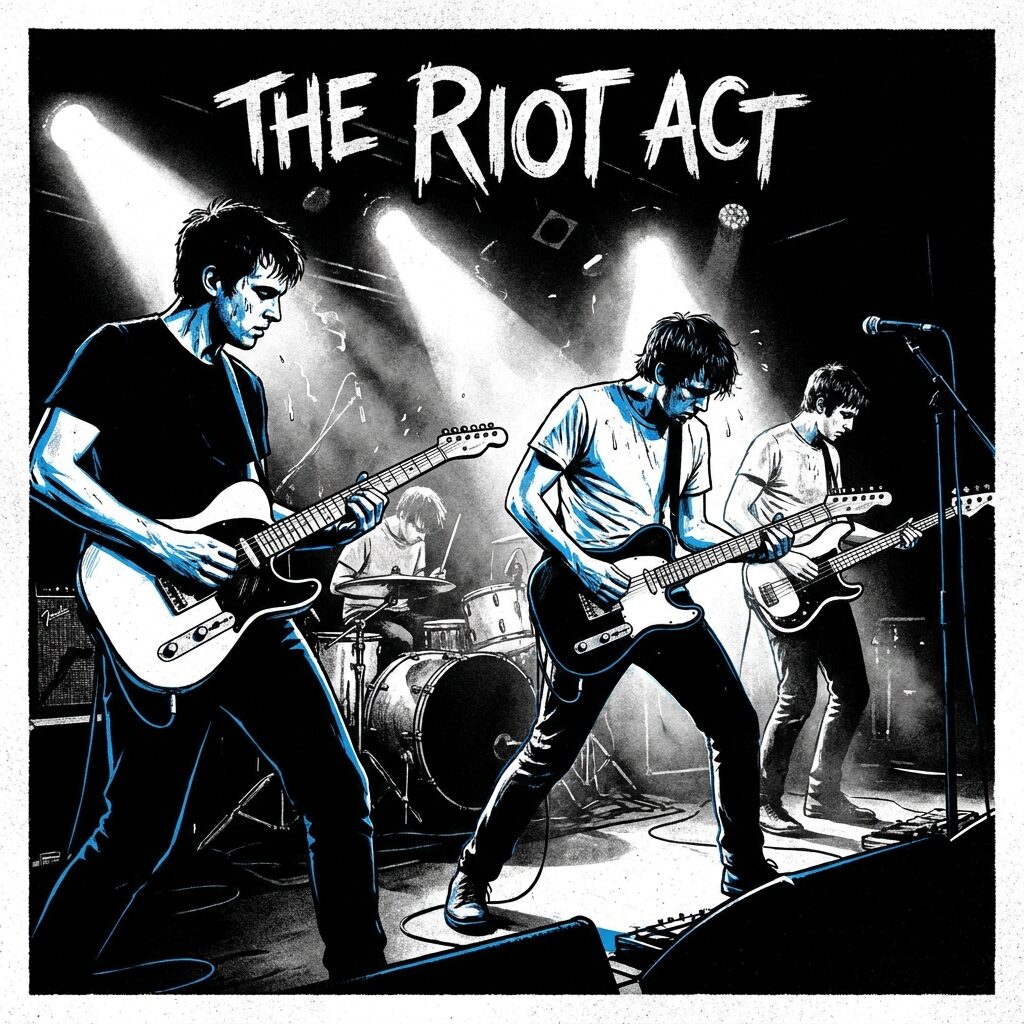
Here’s a song where the title never appears in the lyrics. Not once. Kele Okereke, Bloc Party’s frontman, has said he just liked the sound of the word “helicopter.” That’s it. No metaphor, no hidden meaning in the rotors. Just a word he thought sounded good sitting on top of three minutes and forty seconds of furious indie rock.
And yet. Go read any comment section, any forum thread, any music blog post from 2004 to roughly now, and you’ll find people who are absolutely certain this song is about George W. Bush. They’ll cite the lyrics. They’ll build their case. They’re wrong, Kele has said so, repeatedly, for two decades, but that hasn’t stopped anyone.
That’s the thing about “Helicopter.” It resists every easy reading you try to put on it.
When it landed in autumn 2004, UK indie was in a strange place. The Libertines were imploding. People were, and I need you to sit with this, taking Razorlight seriously. Drowned in Sound captured the mood perfectly: “When Bloc Party arrived in 2004, the UK indie scene was losing the Libertines and people were starting to take Razorlight seriously, bleak times.” Into that vacuum came four guys from London with angular guitars and a song that NME would later call “easily Bloc Party’s defining song.” Ticketmaster went further, calling it “quite possibly the most fun indie rock has ever sounded.”
But here’s what I keep turning over, twenty years on. Every misunderstanding about this song, the Bush reading, the Gang of Four comparisons the band never asked for, the riff everyone thinks is original but was actually adapted from The Jam, even the tempo that databases can’t agree on, all of those wrong readings made the song more powerful. The gap between what people heard and what was intended didn’t weaken “Helicopter.” It fed it. Misreadings became part of the song’s identity, layered on top of whatever Kele actually meant, until the meaning belonged to everyone and no one.
That’s what I find so worth picking apart here. “Helicopter” runs on ambiguity, and I’m not sure any guitar song this century has done it better.
Four Kids, Six Band Names
Bloc Party came together through a Reading Festival meeting, an NME classified ad, and a demo shoved into Franz Ferdinand’s singer’s hands. They cycled through six terrible band names before settling, then spent their whole career fighting a Gang of Four comparison none of them had actually listened to.
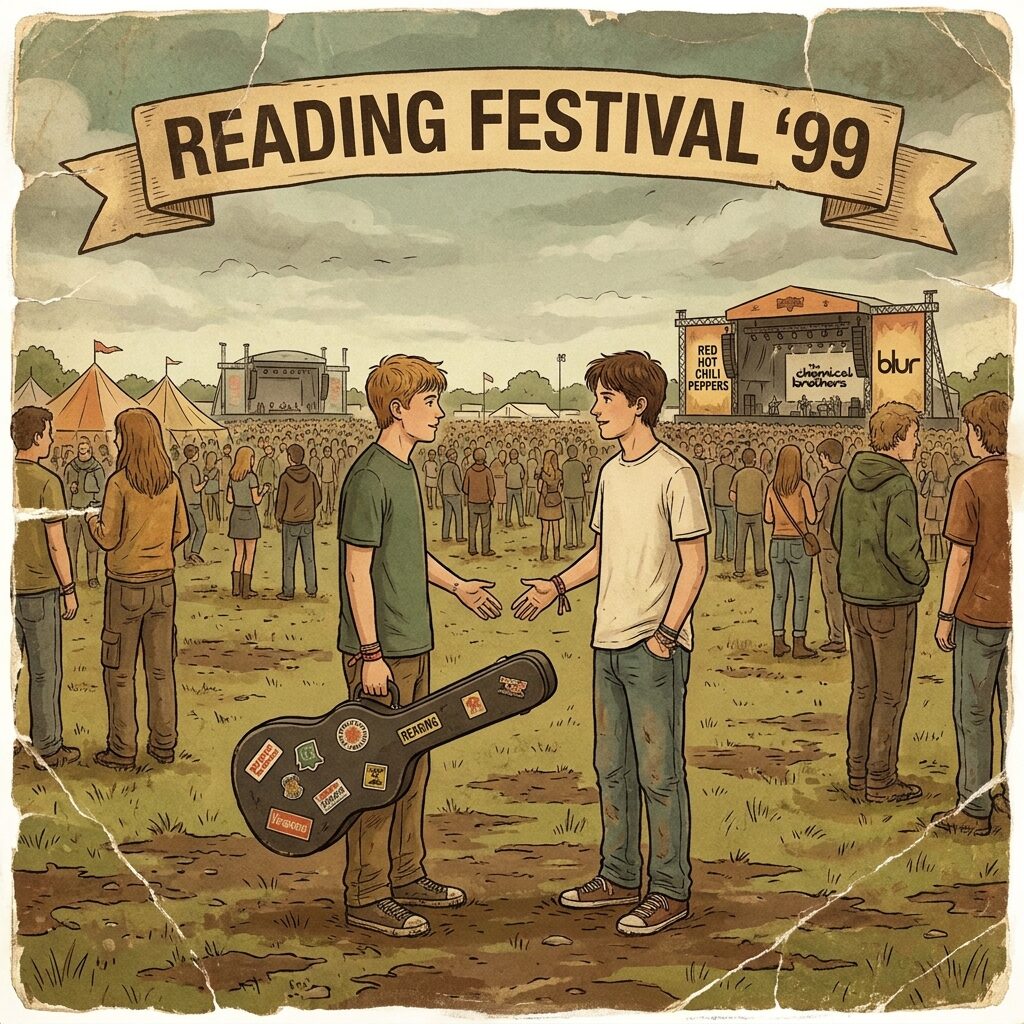
Kele Okereke and Russell Lissack first crossed paths in 1998 in London, but it was the 1999 Reading Festival where things actually clicked. Two kids in a festival crowd who decided to start a band. The way these things happen.
Gordon Moakes came aboard through an ad in NME, the classified section of a music paper, which is such a pre-internet way to recruit a bassist that it almost feels like folklore now. Matt Tong completed the lineup. But before they could make any music that mattered, they had to figure out what to call themselves. And they were spectacularly bad at it.
Superheroes of BMX. Diet. Union. The Angel Range. Each one worse than the last. “Bloc Party” wasn’t exactly a stroke of genius either, but at least it didn’t sound like an energy bar or a housing development. Sometimes the best band names are just the ones that stick.
The hustle to get noticed was exactly what you’d expect from four unknowns in early-2000s London. At a Franz Ferdinand gig in 2003, Kele walked up to Alex Kapranos and handed him a demo. Just like that. He also got one to BBC Radio 1 DJ Steve Lamacq, who played “She’s Hearing Voices” and brought the band in for a live session. Meanwhile, they were sending demos across the Atlantic to Steve Aoki at Dim Mak Records, who signed them for the US. In April 2004, they signed with Wichita Recordings in the UK, an indie label that was building a reputation for knowing what was next.
But the thing that would follow Bloc Party from day one, the misidentification problem, was already setting in. Music journalists heard the angular guitars and immediately started throwing around Gang of Four comparisons. Kele told The Independent in 2014: “When Bloc Party first started, people compared us to Gang of Four. I’d never heard of them so from the start, we were pegged as something that we weren’t. I feel that our whole career has been us moving away from people’s expectations.”
Their actual influences told a completely different story. The Cure. Chemical Brothers. Suede, particularly Dog Man Star. Sonic Youth, Pixies, Radiohead, Weezer. This was a band pulling from post-punk and Britpop and shoegaze and electronic music all at once, and critics kept trying to file them under “post-punk revival” because that was the easy shelf. The misreading was productive, though. It gave them something to push against.
Copenhagen, Cold Studios, and a Stolen Riff
Bloc Party recorded ‘Helicopter’ during three cold weeks at Deltalab Studios in Copenhagen with producer Paul Epworth, who wanted to simplify the song’s difficult pre-chorus rhythms, the band refused, and those awkward passages became part of what makes the track work.
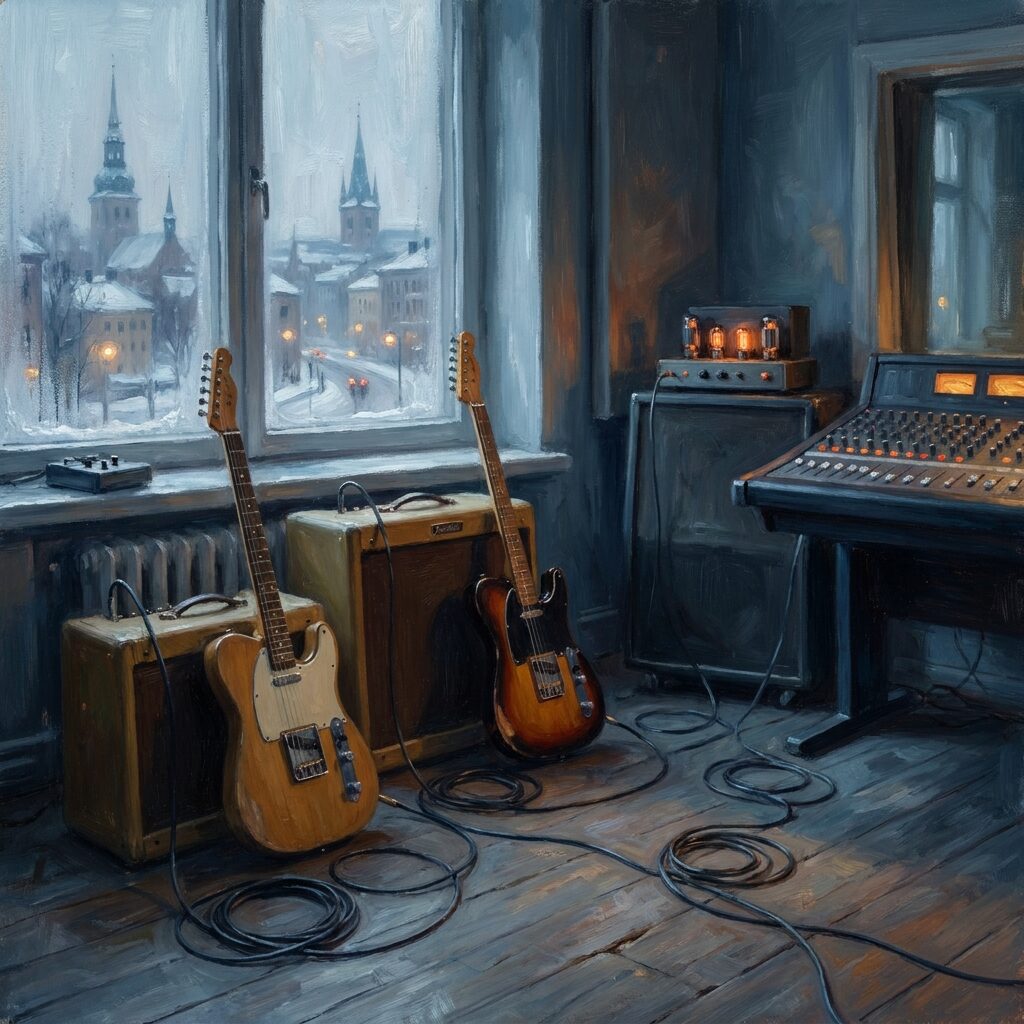
Three weeks in Copenhagen. That’s what Bloc Party gave themselves to record Silent Alarm in June and July of 2004. They chose Deltalab Studios partly for the isolation, get away from London, get away from distractions, lock yourselves in a room and make a record. The romantic version of this story is four young musicians channeling creative intensity in a foreign city. The reality involved cold weather, equipment malfunctions, and the kind of friction that either breaks a band or makes the music better.
In Bloc Party’s case, it made the music better. Considerably better.
The band arrived with demos already prepared, so songs weren’t being written from scratch in the studio. “Helicopter” existed in some form before Copenhagen. But what happened next reshaped it. Paul Epworth, their producer, took what they’d written and, his word, “meticulously dissected and re-imagined” it. Epworth had no interest in capturing a live sound. His approach was almost club-centric, building tracks from the bass and drums up, chasing the kind of punchy, present drum sounds he’d picked up from Rick Rubin records. “That’s something I got from listening to Rick Rubin records, where the drums are always really punchy,” Epworth said in Sound On Sound. “It used to really wind me up hearing drum sounds where every time they hit the snare, all you’d hear was ringing.”
Here’s where things got contentious. Epworth wanted to smooth out some of “Helicopter’s” more challenging rhythmic structures in the pre-chorus, the parts where the song does something unexpected with its timing, where it refuses to settle into a comfortable groove. He thought they were too difficult, too demanding on the listener. The band fought to keep them. The band won. And those awkward, resistant rhythmic moments became part of why the song feels so restless. Another productive disagreement.
Now, about that riff. The main guitar figure in “Helicopter”, the one that grabs you from the first bar, was adapted from The Jam’s “Set The House Ablaze,” a track from their 1980 album Sound Affects. The AV Club described the original Jam riff as “a wiry, stair-skipping guitar riff,” and you can hear the DNA if you listen to both songs back to back. But what Bloc Party did with it is a genuine transformation. They took something wiry and melodic and made it angular and dissonant, full of clashing seconds and nervous energy. It’s like hearing a sentence translated into a different language, the meaning survives but the feeling changes completely.
The irony is almost too perfect: by lifting a Jam riff, Bloc Party accidentally placed themselves in exactly the post-punk lineage that critics were already trying to pin on them through the Gang of Four comparisons. They were being called post-punk revivalists by people who assumed they were listening to Gang of Four, when they were actually, knowingly or not, channeling Paul Weller. The diagnosis was wrong, but the instinct behind it was right. Just not for the reasons anyone thought.
Epworth was generous about the process. “I feel like with Silent Alarm, we caught a band at the right time,” he said. The band let him reshape their material, and he was sharp enough to know when to push and when to back off. Most of the music was tracked in Copenhagen; vocal overdubs happened back in London at Miloco Studios in Hoxton and at The Exchange. Rich Costey mixed the record at Avatar Studios in New York on a 56-input SSL 4000 G+ console, and Howie Weinberg mastered it at Masterdisk, also in New York. London to Copenhagen to New York, a transatlantic production chain for a band who hadn’t even put out their debut album yet. That’s confidence. Or ambition. Probably both.
171 BPM and Duelling Telecasters
Even the tempo of ‘Helicopter’ can’t agree with itself, listed as both 171 and 86 BPM, while two Telecasters panned hard left and right build an interlocking web of dissonant clashes that shouldn’t work but does.
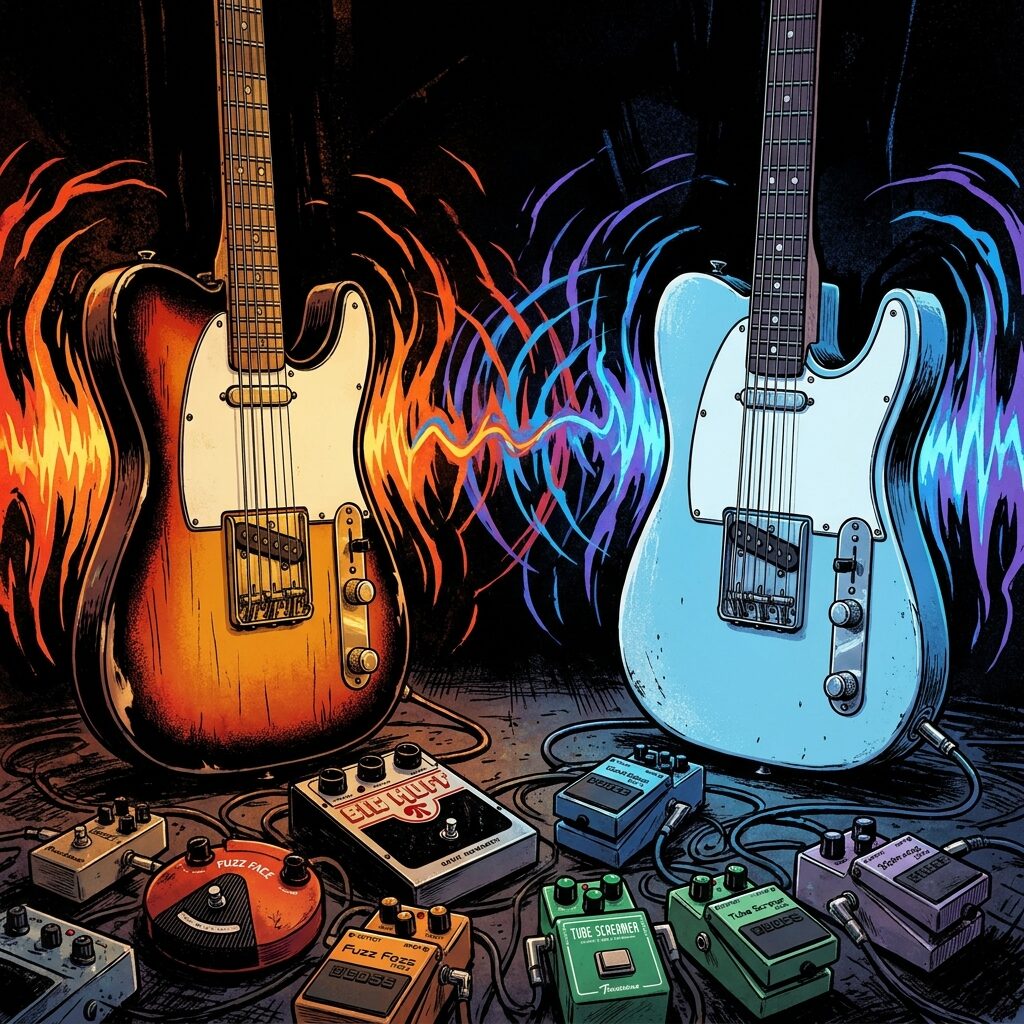
Let’s start with something that says a lot about this song’s refusal to be pinned down: the tempo. “Helicopter” runs at 170-171 BPM in full time. Except some databases list it at 85-86 BPM, because they’re reading it in half-time. Same speed, two different numbers. Even the tempo can’t agree with itself.
In practice, 171 BPM feels relentless. It’s the kind of tempo that makes you move before you’ve decided to move. The song is in B minor, common time, 4/4, with the three most important chords built off the 1st, 4th, and 5th scale degrees all being minor. B minor, E minor, F# minor. That’s a dark harmonic palette for a song that makes you want to jump around. The tension between the darkness of the harmony and the sheer propulsive energy of the rhythm is a big part of why “Helicopter” works the way it does.
But the thing I keep coming back to is the guitars. Two Fender Telecasters, panned hard left and right in the mix, playing two distinct interlocking parts. Kele’s rhythm guitar sits in the right channel; Russell’s lead guitar lives in the left. They’re not playing the same thing. They’re not harmonizing in any traditional sense. What they’re doing is more like having two conversations simultaneously that occasionally collide.
If you want to get specific, and I do, here’s what’s happening in the intro. Kele’s part on the D string runs 9-9-7, slides down to 5-4-4, then climbs to 4-11-11-9-7 before dropping to the E string. Russell’s part mirrors it but offset: 7-7-5-5-4-4-2-2-0-0-2-2-4. Russell does this brilliant thing where he plays an octave off Kele’s riff, hitting 10-10-8 while Kele is doing something different below. The result is these dissonant major second clashes, notes that are just one step apart on the scale rubbing against each other throughout the song. That friction is the nervous energy you feel. It’s not comfortable. It’s not supposed to be.
The chorus opens things up with power chords. Kele slides shapes down the neck, 7/9/9 to 5/7/7 to 3/5/5, which gives the chorus that descending, opening-up quality. But here’s a detail I love: Russell’s second guitar doesn’t enter the chorus right away. He waits. The first “Are you hoping for a miracle?”, just Kele. The second, still just Kele. Russell comes in on the third repetition, adding shapes at 2/4/4, 4/6/6, 5/7/7. It’s a small structural choice that gives the chorus a building intensity most people feel but don’t consciously notice. That kind of restraint is harder than it looks.
Russell Lissack has been characteristically direct about what drives Bloc Party’s sound: “The effects pedals are the defining part of our sound more than guitars and amps.” His main Telecaster is a US-made model with a Seymour Duncan single-coil in the bridge position, bought in 2003 with his cut of the Wichita advance, covered in cartoon stickers in a way that reminds me of Jonny Greenwood’s instruments. He also tours with a black ’72 Custom Telecaster, humbucker in the neck, single-coil in the bridge. Delay and reverb are the primary effects. The band uses Boss echo pedals. None of this is exotic gear. Two Telecasters and some pedals. The architecture of the parts is doing the heavy lifting.
Kele has been disarmingly honest about his own guitar playing in relation to Russell’s: “I’d stopped pushing myself as a guitar player because I knew Russell was there.” That division of labor, Kele providing the rhythmic engine, Russell adding the textural and melodic complications, is how “Helicopter” holds together. Take either part away and the song collapses. Together, they create something that neither player could produce alone.
Even on a song where Gordon Moakes’ bass takes more of a supporting role, Epworth’s mix philosophy keeps the low end planted firmly and distinctly. Bass and drums first, everything else built on top. Matt Tong’s drumming intro, which closely resembles the intro of “Banquet,” funnily enough, drives the whole thing forward with the kind of locked-in timekeeping that made the Jools Holland performance so memorable. There’s a reason Sportskeeda listed “Helicopter” among the greatest FIFA soundtracks, noting “the song’s selling point was its quick tempo of 171 beats per minute.” It was built to move.
The Bush Song That Isn’t About Bush
For twenty years, listeners have insisted “Helicopter” is about George W. Bush. Kele Okereke keeps saying no, calling the interpretation “kinda patronizing.” The song, he says, is self-deprecation about his own life growing up in Western society. Both readings fit the lyrics, but only one of them still works outside of 2004.
North to south, empty
Running on, bravado
As if to say, as if to say
As if to say, he doesn’t like chocolate
He’s born a liar, he’ll die a liar
Some things will never be different
[Pre-Chorus]
Stop being
So American
There’s a time and there’s a place
So James Dean
So blue jeans
Gonna save the world, he’s gonna
[Chorus]
Are you hoping for a miracle?
Are you hoping for a miracle?
Are you hoping for a miracle?
Are you hoping for a miracle?
[Verse 2]
Three out of five, three out of five (It’s not enough)
Six out of ten, better luck next time
Just like his dad, just like his dad (The same mistakes)
Some things will never be different
Hungry and dumb, hungry and dumb (So wait in line)
Queuing up for some more junk food
It’s not my fault, it’s not my fault (Just this once)
They’re getting so much younger
[Pre-Chorus]
Why can’t you be
More European?
Bastard child of guilt and shame
Bury your head
In the sand
I’m thinking six, six, six, I’m thinking six
[Chorus]
Are you hoping for a miracle?
Are you hoping for a miracle?
Are you hoping for a miracle?
Are you hoping for a miracle?
[Guitar Solo]
[Chorus]
Are you hoping for a miracle? (It’s not enough, it’s not enough)
Are you hoping for a miracle? (It’s not enough, it’s not enough)
Are you hoping for a miracle? (It’s not enough, it’s not enough)
Are you hoping for a miracle? (It’s not enough, it’s not enough)
Okay. Let’s talk about what everyone thinks this song is about, and then what it’s actually about. Because this is where “Helicopter” gets interesting.
The case for the Bush reading is, I’ll admit, pretty compelling on the surface. It’s autumn 2004. The Iraq War is a year and a half old. George W. Bush is running for re-election. And here comes Kele Okereke singing: “Stop being so American / There’s a time and there’s a place / So James Dean, so blue jeans / Gonna save the world, he’s gonna.” You can see why people connected the dots.
Then the second verse makes it worse: “Just like his dad, just like his dad, same mistakes.” A second Bush in the White House, following his father into military conflict in the Middle East. Scene Point Blank heard it that way: “The lyrics appear to target Bush, but they also address the frustration of inaction and over-reliance on faith.” Most listeners didn’t bother with the second half of that sentence. Bush. Obviously Bush. Case closed.
Except Kele has spent twenty years saying no.
“It’s frustrating that people attribute something to certain songs and that’s not what they’re about at all,” he told Pitchfork in August 2005. “It’s a common misconception that ‘Helicopter’ is about President Bush. It’s kinda patronizing.” Pay attention to that word choice. Patronizing. He’s not doing the songwriter thing where you say “oh, it means whatever you want it to mean” while winking. He’s genuinely annoyed. He finds it reductive.
His actual explanation is both simpler and harder to sit with than the Bush theory. “‘Helicopter’ isn’t about Bush; it’s a song about waking up and realising certain things. I hope what people got from that song wasn’t a critique of American life.” He’s described the lyrics as self-deprecation, directed at himself, about his own experiences growing up in Western society. He was born in England. This is his own reckoning, not a broadside aimed at a foreign president.
Look at the lyrics again with that frame. “Three out of five, it’s not enough / Six out of ten, better luck next time.” Those aren’t about a president’s approval ratings. They’re about mediocrity. About never quite measuring up. About cycles of failure that feel inherited (“just like his dad, same mistakes”) but might just be your own. “Stop being so American” reads differently if the speaker is talking to himself, if “American” is shorthand for a brash overconfidence he recognizes in the mirror.
“Why can’t you be more European / Bastard child of guilt and shame / Bury your face in the sand.” The second pre-chorus explicitly offers the alternative to being “so American,” and it’s not flattering either. European here means guilt, shame, burying your head. Neither option is good. This isn’t a song picking a side. It’s a song about feeling stuck between two modes of being, and both of them are broken.
There’s a detail about how deep the misunderstanding runs that I keep thinking about. Even within the band, the lyrics may not have been fully understood. Kele has suggested that his own bandmate Gordon Moakes might not have known what the songs were really about: “Yes, but they’re still wrong. I think maybe Gordon listened to the songs and didn’t ask me what they were.” If your own bassist doesn’t know what you’re singing about, maybe that tells you something about how the songs work.
Kele’s songwriting philosophy makes this explicit. “I think that’s right,” he said, talking about leaving meaning open. “It has to be more than just telling people ‘Don’t vote for Bush.’ Leave people space to make their own conclusions.” He consciously builds ambiguity into his work. He trusts his audience to bring their own meaning. And then he gets frustrated when that openness collapses into the most literal available reading.
The personal reading is more powerful, though, and I think Kele knows it. A song about George Bush is a song about 2004. It’s locked to that moment. A song about inherited failure, about cycles of mediocrity, about recognizing your own worst patterns and watching yourself repeat them anyway, that’s just a song about being alive. Both readings coexist, and they probably always will. Listeners brought their political moment to a personal song and found it fit perfectly. That’s not a misreading, exactly. It’s just not the whole story.
Two Videos, Two Nightmares
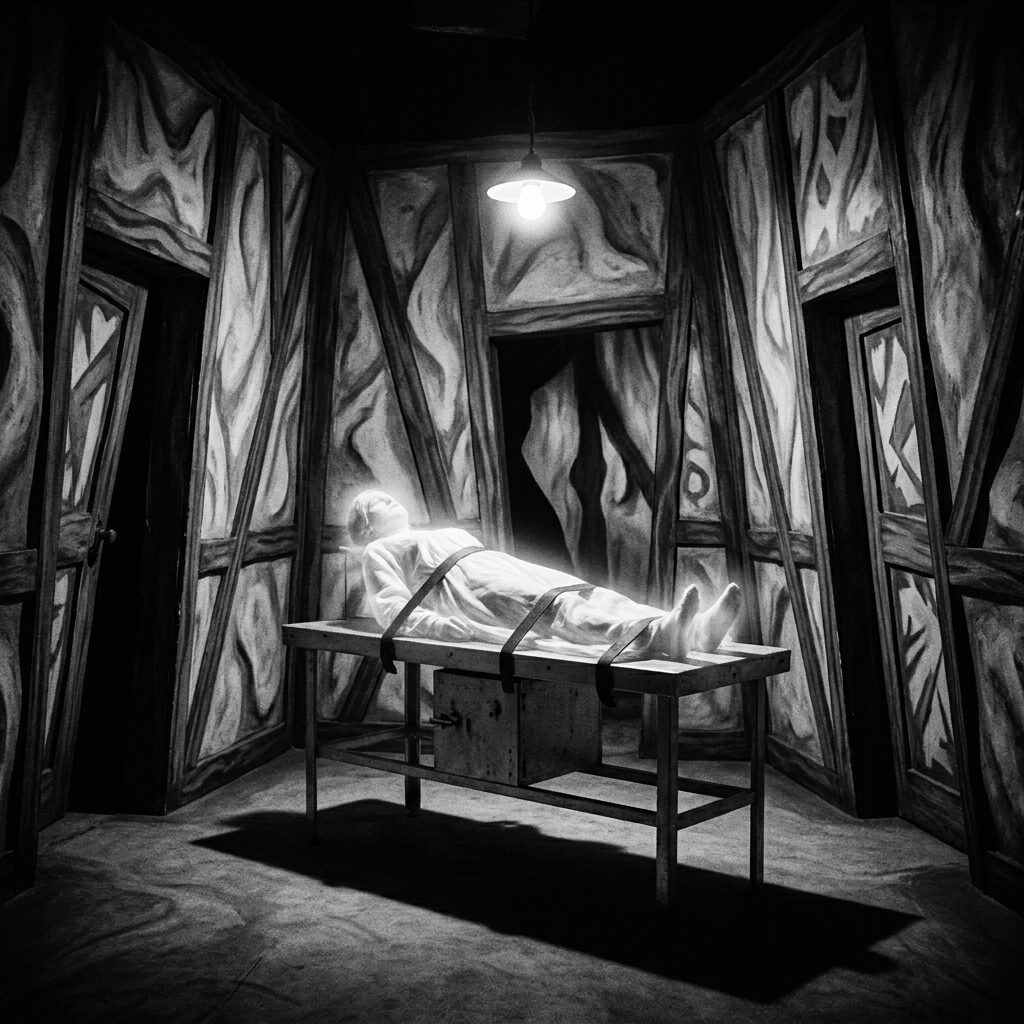
Two separate music videos were produced for “Helicopter” in 2004, one drawing on Hitchcock and German Expressionism, the other built around melting celluloid, and both chose to amplify the song’s unease rather than illustrate its lyrics.
Most songs get one music video. “Helicopter” got two, and neither one tries to explain what the song is about. Probably wise.
The black-and-white version, directed by Type2error, is the one most people know. It’s racked up over 30 million views on YouTube, which makes sense once you’ve seen it. The band performs inside a claustrophobic old house while the camera intercuts genuinely creepy surreal imagery, a glowing creature buckled to a lab table being the image you won’t shake. Videoteque described the approach precisely: “Directors type2error borrow elements from Hitchcock and German Expressionism, using rapidfire editing and a claustrophobic, seemingly impossibly-structured set to create tension within the frame and a generally ominous unsettling feeling in the viewer.” The rapid editing locks to the song’s 171 BPM pulse, and shooting in black-and-white strips away any warmth the visuals might have otherwise carried. It feels like the song sounds, restless and wrong in ways you can’t quite articulate.
The second version, directed by Minivegas, who’d previously made videos for Keane and Dogs Die in Hot Cars, went somewhere else entirely. This one used melting celluloid effects, and the production was its own kind of ordeal. “We had two crews, one shooting melting film, and the other shooting the main action,” the director told Dazed. “So it was tight but we got just about everything. The difficulties expanded in post-production as each melting effect had to be pieced together using different techniques.” What you end up with is a video where the image itself seems to be coming apart, the visual equivalent of a song that won’t hold still long enough to be pinned down.
The interesting thing about both videos is what they refuse to do. No helicopters. Kele never stands in front of an American flag. Nobody references George Bush. There’s no attempt to illustrate the lyrics literally. Both lean into atmosphere instead, that sense of something being deeply off without anyone naming exactly what. HIP Video Promo wasn’t wrong when they said: “A song with imagery this intense required an uncommon clip.” The videos got something about “Helicopter” that a lot of listeners missed: the song isn’t really about what it says. It’s about how it sits in your body. Both clips chase that feeling without ever trying to decode the words.
Gold Twenty Years Late
‘Helicopter’ peaked at #26 in the UK, not the top 20 some sources claim, but took twenty years to earn BPI Gold certification, outlasting singles that charted far higher.
Let’s correct the record on the record’s chart position. You’ll find sources claiming “Helicopter” reached the UK top 20. It didn’t. It peaked at number 26 on the UK Singles Chart, debuting in the week of 6 November 2004 and spending two weeks in the top 200. Number 26 is fine for an indie single on an independent label, but it’s not the top 20, and rounding up does the song a disservice. The actual story is better.
“Helicopter” just refused to go away. It kept accumulating plays, streams, purchases, year after year, until the BPI certified it Gold in 2024, twenty years after release. That’s 400,000-plus combined units. For context, Bloc Party’s highest-charting single was “The Prayer” at number 4. On US alternative radio, the songs that broke through were “Banquet” and “I Still Remember.” “Helicopter” didn’t crack the Billboard Hot 100 at all. And yet NME calls it their defining song. It lost every sprint and kept running anyway.
The parent album tells a similar story at a bigger scale. Silent Alarm hit number 3 in the UK and went platinum. It was certified gold in Europe within 24 hours of release. It sold over 350,000 copies in North America and more than a million worldwide. Pitchfork gave it a 9.0. NME gave it 9 out of 10 and voted it Album of the Year. It was nominated for the Mercury Prize. However you want to slice it, that’s one of the strongest debut albums of the 2000s.
But “Helicopter” specifically owes a lot of its staying power to video games. The song appeared in Guitar Hero III: Legends of Rock, FIFA 06, FIFA 23, Burnout Revenge, Project Gotham Racing 3, and Colin McRae DiRT 2, among others. Think about that pipeline for a second. A kid who was ten years old when FIFA 06 came out would have been twenty-seven when it showed up again in FIFA 23. The song kept reaching people who weren’t born when it was released, through a medium that nobody in the 2004 music press was thinking about. Sportskeeda listed it among the ten greatest FIFA soundtracks, noting the 171 BPM tempo was “just what you need before going into a match.” Not a bad second life for a song about, well, whatever it’s about.
Rockets in Our Pockets
From a breakout Jools Holland performance in 2004 to a triumphant Glastonbury return in 2024, “Helicopter” has closed Bloc Party’s sets for twenty years, and it still hits like the first time.

The Jools Holland performance is where it starts. Series 24, Episode 7 of Later… with Jools Holland, BBC Two, 2004. Interpol was on the same episode. And what people remember about that night, what has since become a viral TikTok moment with 31,300 likes, is how fast and tight Bloc Party played “Helicopter.” The speed. The precision. Four guys who look like they’re barely holding on but are actually locked in. It’s the fan-favorite version of the song for a reason. That performance put Bloc Party on a different level overnight.
But if any venue owns “Helicopter,” it’s Glastonbury. The song keeps coming back to that festival, and every time it lands differently. First time: 24 June 2005, their Glastonbury debut, John Peel Stage. It rained. There was lightning. Giant inflatable props were bouncing around the crowd. They played “Helicopter” and something locked into place between the song and that setting that hasn’t come loose since.
Second time worth noting: 22 June 2007, “Helicopter” set-listed as the closer. The last thing the crowd hears. That’s the position of maximum trust in a setlist, and by 2007 nobody was arguing about which song belonged there.
Then: 29 June 2024, the Other Stage, billed as “20 Years of Bloc Party.” The band debuted a new single, “Flirting Again.” Kele wore a Bad Brains T-shirt. He restarted “Mercury” because “the people of Glastonbury deserve a song that’s played properly.” But when they got to “Helicopter,” Kele introduced it by saying “We’ve got a few more rockets in our pockets,” and it pulled the biggest crowd response of the entire set. Twenty years on. Still the one. A Louder review called it “a reminder of just how fantastic and influential a band they are and proof that Bloc Party can still compete with any cutting edge guitar music in the modern era.”
Between Glastonburys, there was Crystal Palace Park on 7 July 2024, 25,000 people, their biggest headline show ever, Silent Alarm performed in full plus a greatest hits set across two hours. Friendly Fires and The Hives supported. And now, in 2025, the Silent Alarm 20th Anniversary world tour is rolling through the UK, North America (co-headlining with Metric, who are performing Fantasies in full), and Australia. The song is still closing sets. It still works. Most songs from 2005 have settled into nostalgia by now. “Helicopter” just keeps detonating.
Indie Sleaze and the Algorithm
A new generation found “Helicopter” through TikTok’s indie sleaze revival rather than music press or radio, while remixes by Diplo, Steve Aoki, and Peaches pushed it into dance music territory. In 2025, Bloc Party’s Ivor Novello nomination for Outstanding Song Collection confirmed what the algorithm already knew.

Nobody in 2004 would have guessed that “Helicopter” would find its biggest second life through an app that wouldn’t exist for another twelve years. TikTok’s indie sleaze revival lumped Bloc Party in with The Strokes, Foals, The Libertines, and the TV show Skins, less a genre classification than an aesthetic mood board. A new generation found the song not through NME or radio but through thirty-second clips set to grainy footage of house parties and festival mud. The Jools Holland clip alone pulled 31,300 likes on TikTok. All the context fell away. The 2004 political reading, the post-punk revival debates, the Gang of Four comparisons, none of that baggage traveled. What traveled was the riff and the urgency behind it.
The remix ecosystem pushed “Helicopter” even further from its indie rock origins. Diplo did a remix. Steve Aoki and Blake Miller of Moving Units, working as the duo Weird Science, produced a version featuring Peaches that ended up on Aoki’s dance mix CD Pillowface and His Airplane Chronicles. Whitey delivered a minimalist rework that stripped the song bare, then added wolf howls and xylophone staccato, honestly pretty unhinged, and it appeared on Silent Alarm Remixed in August 2005. All three remixes got a vinyl release through Dim Mak. A song that was already hard to categorize got harder still once it existed in dance, electronic, and art-noise versions at the same time.
Institutional recognition took a while to catch up. In 2025, the original four members of Bloc Party were announced for an Ivor Novello Award nomination for Outstanding Song Collection. That kind of honor acknowledges a body of work rather than a single moment, but “Helicopter” is almost certainly doing a lot of the heavy lifting in that catalog.
And there’s an irony I keep circling back to. A song that nobody can correctly explain, not the critics who thought it was about Bush, not the databases that can’t agree on the tempo, not even the band’s own bassist, turned out to be the most enduring thing Bloc Party ever made. The confusion didn’t sink it. If anything, the confusion kept it alive. Every misreading handed the song a new audience and a new reason to stick around. “Helicopter” doesn’t resolve into a single meaning, and at this point, that seems like the whole reason it’s still here.
The Miracle of Not Knowing
After twenty years, the chorus question “Are you hoping for a miracle?” still lands because it never answers itself, and the song’s long history of gaps between intention and interpretation turned out to be what holds the whole thing together.

“Are you hoping for a miracle?”
After everything, the Copenhagen sessions, the stolen Jam riff, the Bush readings Kele has spent half his life denying, the two nightmarish music videos, the chart positions that don’t match the mythology, the TikTok clips and FIFA soundtracks and Glastonbury rain, after all of that, come back to the chorus. Four words and a question mark. Are you hoping for a miracle?
I think the reason that question still works, twenty years on, is that it never tells you what the miracle would be. A political change? A personal transformation? Just getting through the day with a passing grade instead of three out of five? The question stays open the same way the entire song stays open, it makes space for you to fill in your own answer, and it doesn’t much care which one you pick.
Kele has always insisted on this. “Leave people space to make their own conclusions.” He wasn’t being coy or evasive. He was doing something harder than writing a protest song, writing one that could hold multiple meanings without collapsing under any of them. The title means nothing. The lyrics get misread constantly. The riff came from a tradition the band didn’t know they belonged to. The producer who tried to simplify the structure got overruled. You could map the whole history of “Helicopter” as a series of gaps between intention and interpretation, and somehow none of those gaps broke the song. They’re what holds it together.
In September 2025, the Silent Alarm 20th Anniversary Deluxe Box Set ships. Among the demos is an early version of “Helicopter”, a chance to hear what the song was before Epworth and the band wrestled it into shape. Maybe the demo will clarify something. Maybe it’ll just pile on another layer of confusion. Knowing this song’s track record, I’d bet on confusion.
A title that means nothing turned out to be the perfect title for a song that means whatever its listeners need it to mean. Nobody knows what “Helicopter” is about, and at this point I’m fairly sure that’s the whole point.
🚁 Did you know? The word “helicopter” never appears in the lyrics of Bloc Party’s “Helicopter.” Kele Okereke just liked how the word sounded. The song took 20 years to go Gold. #BlocParty #IndieRock #SilentAlarm 🎸 https://bit.ly/3Qr69s3

Click to Tweet