A Letter and a Phone Book
Jon M. Chu wrote a careful letter asking Coldplay to license ‘Yellow.’ Chris Martin got the title off a phone book. The tension between those two truths defines the song.
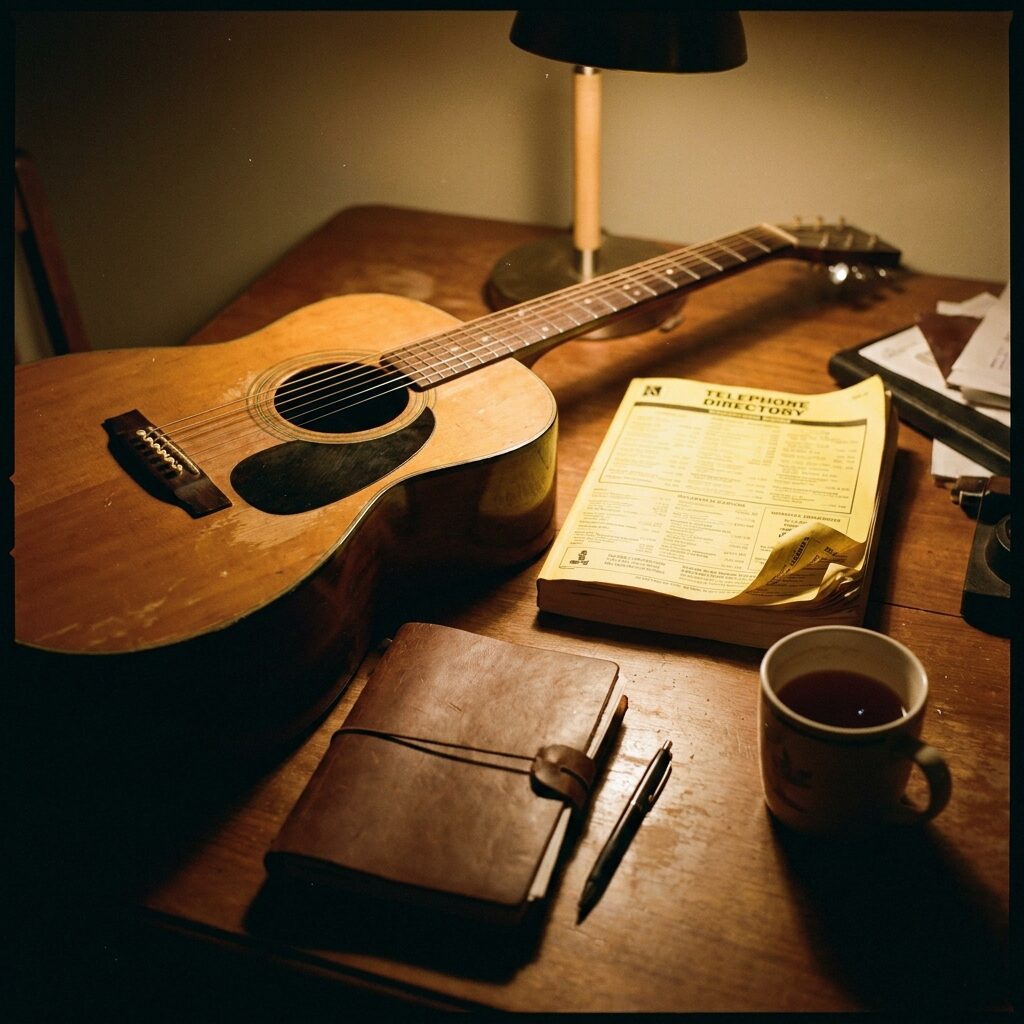
On December 8, 2017, a filmmaker sat down at a typewriter and wrote a love letter to a rock band. Jon M. Chu was trying to license a song for the closing scene of Crazy Rich Asians. He’d been called the word yellow as a slur all through grade school. He wanted to take it back.
“For the first time in my life,” he wrote to Coldplay, “it described the color in the most beautiful, magical ways I had ever heard: the color of the stars, her skin, the love.”
Here’s the thing about the song he was writing about. Chris Martin got the title off a Yellow Pages directory.
It was sitting on a table. He was stuck on a word. He looked around. There was the phone book. Done.
That’s the tension every conversation about “Yellow” keeps circling back to. A filmmaker agonizes over a word that has followed him his whole life. The guy who chose that word shrugs and says it has, and I’m quoting him directly, “absolutely no meaning whatsoever.”
Both things are true. The song came together in ten minutes as a bad Neil Young impression with a random title yanked from a directory. And it has become one of the most ceremonial pop records of the 21st century. Played at Steve Jobs’s memorial. At Shane Warne’s funeral. At thousands of weddings. At the climax of a Hollywood blockbuster trying to reclaim a slur.
This is the story of how a song that means nothing ended up meaning everything.
Rockfield After Dark
A Welsh studio at night, a sky full of stars, a bad Neil Young impression, and a Yellow Pages within arm’s reach, how Coldplay accidentally wrote their defining song in ten minutes.

To understand how “Yellow” happened, you have to picture Rockfield in November 1999.
Rockfield Studios sits on a farm near Monmouth in Wales. Queen recorded “Bohemian Rhapsody” there in 1975. Oasis tracked (What’s the Story) Morning Glory? there. The Quadrangle Studio, where Coldplay would set up, sits on one side of an open courtyard, roughly fifty yards square. It’s the kind of place you go when you need to disappear from London and actually make a record.
Coldplay needed to disappear. Their first crack at the debut album had collapsed. They’d started at Orinoco Studios in London with producer Chris Allison, who’d done their Blue Room EP. Rehearsals went badly. Allison bailed. Only one track, “High Speed,” survived those sessions. Parlophone brought in Ken Nelson, who’d produced Gomez’s Mercury-winning Bring It On. Chris Martin later called Rockfield “kind of a make-or-break session.” The band was barely out of university and running out of chances.
One night, after tracking “Shiver,” they stepped outside. This is farmland Wales. No ambient light to speak of. The sky above the Quadrangle courtyard was a full spread of stars.
Someone said, “Look at the stars.”
Wikipedia credits Guy Berryman with that line. Ken Nelson remembers it differently. “One of us — Guy reckons it was me — just said: ‘Look at the stars, it’s amazing!’” Whoever said it, Martin caught it mid-air. “We’d been in London for five years,” he said later, “so we hadn’t really seen anything beyond smog.”
Back inside, Martin started fooling around. He was doing a Neil Young impression to make the band laugh. “The song had the word ‘stars,’” he told VH1, “and that seemed like a word you should sing in a Neil Young voice.” Will Champion remembers it starting slower, hanging closer to that Neil Young country drawl. Then Jonny Buckland plugged in and started sketching a riff over it. It got heavier. It stopped sounding like a joke.
Martin had the music. He had the first line. He had a chorus shape. He had a hole. There was a “key word” he couldn’t find. The way he tells it, he looked around the room. The nearest book was a Yellow Pages directory.
Yellow. Fine.
“In an alternate universe,” Martin joked on VH1 Storytellers in 2005, “this song would be called ‘Playboy.’”
The song was written in roughly ten minutes. Songfacts cites that figure, and nothing in the history of this recording contradicts it. Martin showed it to Buckland while Buckland was playing darts. They tracked it that same night.
Now — take a beat. The song that would become one of the defining British pop records of the 21st century. The song Noel Gallagher would later say he wished he’d written. The song Jon Chu would type a letter about. That song got born in an evening as a Neil Young goof with a title swiped from a phone book.
And this is the part that kills me. Martin has since admitted he’ll sometimes make up song-origin stories “to move on to the next question.” So even the Yellow Pages story — the one everyone repeats, including this article — arrives with a small shrug attached. It might be true. It might be the third version he landed on because the first two got boring to tell.
What we know for sure is this: a make-or-break session, a stand-outside moment, a bad Neil Young impression, a rural Welsh sky. That’s the core. Everything after is Martin telling and retelling a story that keeps getting looser the further he gets from it.
Which is, I’ll argue in a minute, the whole point.
Three Chords, One Fight
Three chords, 173 BPM, a Telecaster Thinline through a Vox AC30, and a tempo fight that nearly killed the song. Simple on paper, spacious on tape.
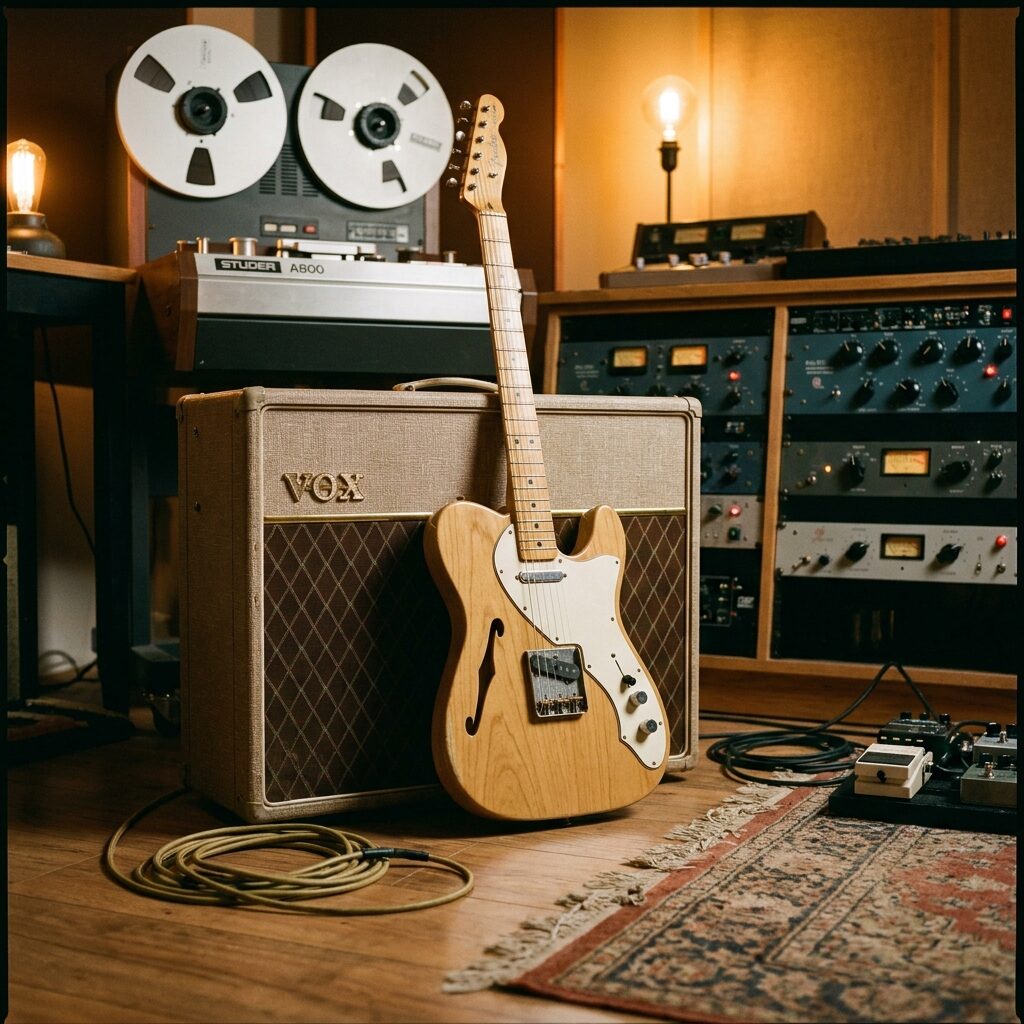
Let’s get into the mechanics. “Yellow” is in B Major. It moves at 173 BPM, in 4/4. The verse uses three chords: B, F♯, E. That’s I, V, IV in B Major. The plainest rock progression in the book. Your cousin can learn it this weekend.
The chorus shifts. Some analysts hear it modulating to E major, some hear it staying in B with an E–G♯m–F♯ figure repeating. Either way, you’re still living inside the same three chord centers. Hooktheory, measuring against a database of over 73,000 songs, rates the song’s chord complexity as near-average and its melodic complexity as below-average. Translation: there is nothing clever going on here.
So why does it land?
A few things. Start with voicings. Jonny Buckland plays his part on a Fender Classic Series ’72 Telecaster Thinline through a Vox AC30. That specific combination, semi-hollow Tele into chimey British amp, is where the song’s signature tone lives. Billboard nailed it: “every time that electric-guitar riff barges in, you’re hooked all over again.” That word, barges. It doesn’t glide in. It doesn’t fade up. It arrives.
Ken Nelson’s production philosophy was analogue-to-tape, clean as possible, short signal path. He bypassed the desk’s mic amps in favor of stand-alone preamps. “I like bands who can play live,” he told Sound on Sound. “That’s what I’ve done more or less all my recording life: I try to get bands to play together.” The basic track of “Yellow” was cut live in the Quadrangle, all four of them in a room. The backing vocals got tracked in the control room of that same studio. Buckland’s electric riff came later, overdubbed on top of the live take.
Now the problem that almost killed the song. Tempo.
“A beat either side of the tempo we picked didn’t have the same groove,” Nelson said. “It lost the feel of it.” The band tried it slower. Faster. Nothing sat right. They recorded “Yellow” two or three full times before anyone was happy. Nelson, again: “It all sounds very easy, but it was quite intense because we recorded it two or three times until we were happy with what we got.”
This is where “Yellow” went partly digital. The song was “particularly problematic to capture using a purely analogue set-up,” which pushed the sessions up to Parr Street Studios in Liverpool with the then-new Pro Tools. They tracked into the computer, then, as Nelson put it, “we then put it down to the 2-inch, which I found was a great way to do it.” So the myth of this as a pure tape recording isn’t quite right. The bones are tape. The rescue was digital.
A few other things doing the quiet work. Guy Berryman’s bass pounds root notes in constant eighth-notes through the verse. Not flashy. Relentless. That’s the engine underneath the acoustic strum. Martin sings in near-falsetto through most of the song, which puts the vocal up in a register where it sounds fragile even when he’s belting. And there is no guitar solo. Anywhere. Buckland takes a little lead line in the chorus, the riff does its barging-in work, and then it’s back to the voice.
Put it all together and you get a song that’s deliberately simple on paper and deliberately spacious in execution. Three chords. A tempo they had to fight for. A guitar tone chosen with surgical care. A vocal that leaves room above it. This is the architecture of a song built to be filled in later, by listeners, by covers, by video montages, by mourners, by brides.
We’ll come back to that.
The Word That Means Nothing
Chris Martin has given contradictory explanations for 25 years. The real craft is that the word yellow means nothing, which is exactly why it can mean anything.
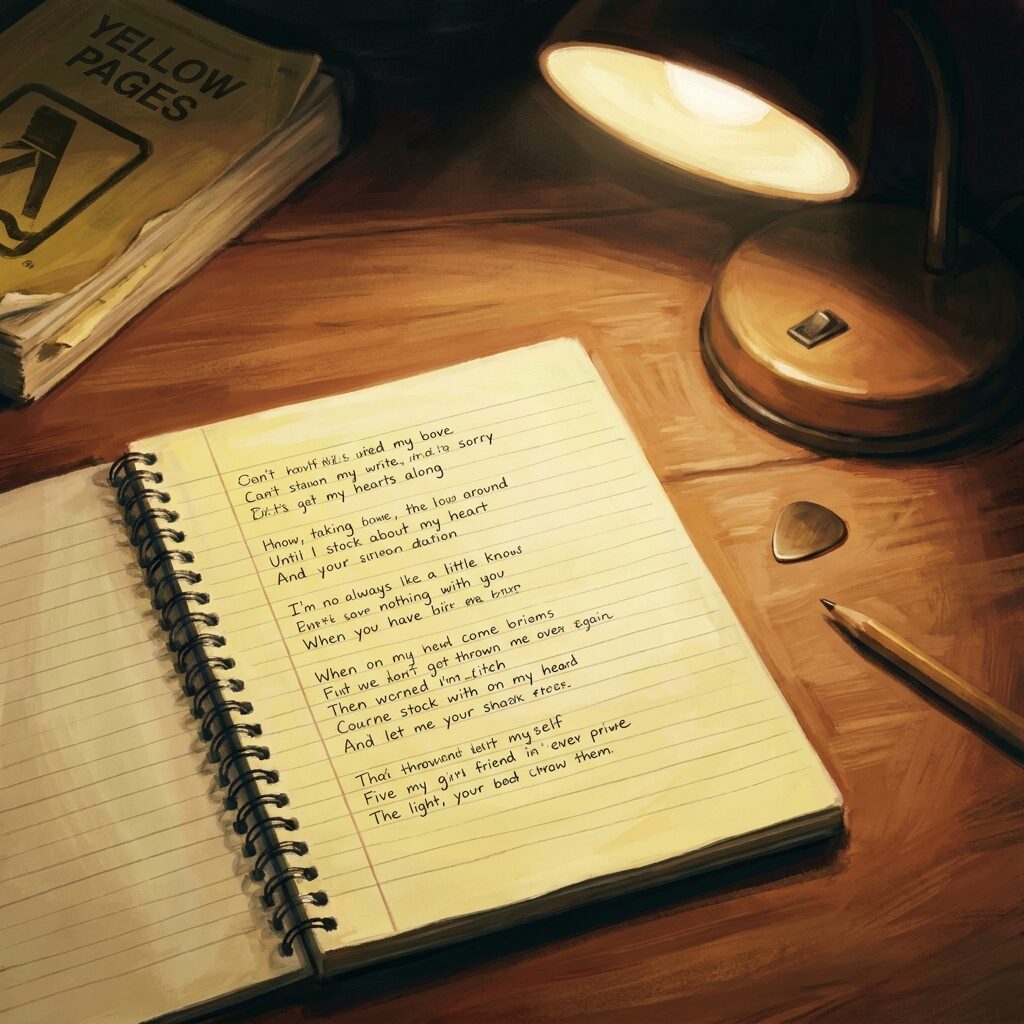
Chris Martin has spent 25 years failing to explain this song. Or refusing to. Depends on how generous you want to be.
On VH1 Storytellers in 2005, he told the Yellow Pages story. The book was on the table. He needed a word. That was the word. In an alternate universe, he said, it’d be called “Playboy.”
Six years later, on The Howard Stern Show in November 2011, he claimed the Neil Young angle was the actual truth. “I like you, Howard, so that’s the first time I’ve ever told anyone the truth behind ‘Yellow.’” Asked if the song was about a particular girl, he answered, “It’s about all girls.” And then: the word yellow has “absolutely no meaning whatsoever.” He tried to change it. It just sounded right.
But here’s the kicker. He’s also described the song’s mood as “brightness and hope and devotion,” which sure sounds like meaning. He’s called it “a feeling more than a meaning.” He’s admitted, separately, that he sometimes invents song-origin stories “to move on to the next question.”
So pick your canon. The phone book. The Neil Young impression. The all-girls answer. The brightness-hope-devotion answer. They contradict each other. That’s not a bug. That’s the guy’s whole stance.
Now look at what the lyric actually does. Count the acts of devotion in the verses:
“I wrote a song for you.”
“I swam across.”
“I jumped across for you.”
“I drew a line, I drew a line for you.”
These are small. A song is small. Drawing a line is nothing. Jumping across, across what? Never specified. Each gesture is a kid’s offer of a crayon drawing. And every single one gets punctured, immediately, by the same deadpan line: and it was all yellow. Like a child who makes you a present and then shrugs when you ask what it is. The song keeps refusing to take itself seriously.
Until, once, it does.
“For you, I’d bleed myself dry.”
That line hits because the rest of the song is so small. If every line were that big, you’d get a Meat Loaf song. What Martin does is set up a room full of shrugs, and then, for a single second, stop shrugging. It’s like someone who jokes through a whole dinner and then, quietly, near the end, tells you they love you. The stakes stay low so that the one moment of real stakes can land.
Will Champion, talking to The i Paper in 2020, put it about as well as anyone’s put it. Chris, he said, has “a thing of finding something interesting in the mundane and abstract objects.” Which is the craft under the whole song. The object was a Yellow Pages. It was mundane. Martin found something interesting in it, not by making it more than it was, but by leaving it exactly what it was.
And this is the part that unlocks everything else. Because yellow means nothing, yellow can mean anything. It’s a blank. That’s why it works at funerals. That’s why Jon Chu could pour the weight of a childhood of slurs into it. That’s why a bride can walk down an aisle to it. That’s why Martin could sing it at the Steve Jobs memorial and mean something totally different than what a couple dancing at their wedding means by it. A specific song closes the door. A blank song leaves the door open.
The most ceremonial pop record of the 21st century is a Yellow Pages ad that happened to rhyme.
The Rain That Saved It
A rained-out shoot, a bandmate’s funeral, and a lone improvised take on a Dorset beach produced the single continuous slow-motion walk that became the iconic video.

The original plan for the music video was, I promise, a beach party.
It was May 23, 2000. The location was Studland Bay in Dorset, a stretch of white-sand coast on England’s south shore. Directors James Frost and Alex Smith — James & Alex — had thirty extras on call. The concept was sunny, communal, full-band. A time-lapse effect would send the stars wheeling across the sky above the party, tying back to the song’s opening line.
None of that happened.
It rained. It rained all day. By four in the afternoon, the thirty extras were sent home. And there was another weight on the shoot that no one outside the band knew about. Will Champion’s mother had died, and her funeral was that same day. Parachutes is dedicated to her. Champion wasn’t on the beach. Jonny Buckland and Guy Berryman aren’t in the final video either. What James and Alex had left was a grey beach, rain on wet sand, and Chris Martin.
So they improvised. Martin put on a black mackintosh — some sources say “waterproofs,” same thing — and walked down the beach. The directors kept one camera running. One take. No cuts.
Here’s the technical trick that makes the video work. To get that dreamy, floating quality where Martin’s walk looks ever-so-slightly too slow for real life, they filmed at 50 frames per second and played it back at 25. Everything drops to half speed. But then Martin’s lips wouldn’t match the audio. So the song got played back at double speed on set, and Martin lip-synced to that. Slow the footage down, and the lip-sync lands on the normal track.
The original idea of moving stars got dropped. The directors decided the stars would pull focus from Martin, and without the band in the frame, focus was already thin. But they kept the “time advancing” concept. In telecine — the film-to-tape transfer process — a colorist pushed the footage from a grainy, cold, monochromatic open through to a warm, saturated dawn. Night bleeds into day across the length of the song. The directors have said the night-swim scenes in Jaws were the visual reference.
What they ended up with is the iconic version. A lone figure, soaked, walking toward the camera in slow motion while the sky warms up behind him. No band. No party. No stars. Just the song’s emptiness with a picture to match.
The video eventually joined YouTube’s Billion Views Club — Coldplay’s fifth to hit that mark, reported January 2024. And per reporting that’s repeated often but worth flagging as one of those widely-cited facts that bears its own weight: when MTV resumed normal programming after the September 11, 2001 attacks, “Yellow” was reportedly the first video they aired.
Think about that for a second. A video born from a rained-out shoot and a funeral and a solo improvisation became the clip MTV reached for when America was trying to feel human again. The video nobody meant to make. Which is, by this point in the story, an almost suspiciously neat rhyme with the song itself.
A plan fell apart. What got made instead is the thing the world kept.
Softness in a Nu-Metal Year
Against a 2000 backdrop of Limp Bizkit and nu-metal aggression, ‘Yellow’ offered open, unmasculine vulnerability, and kicked off a British guitar-band wave in America.
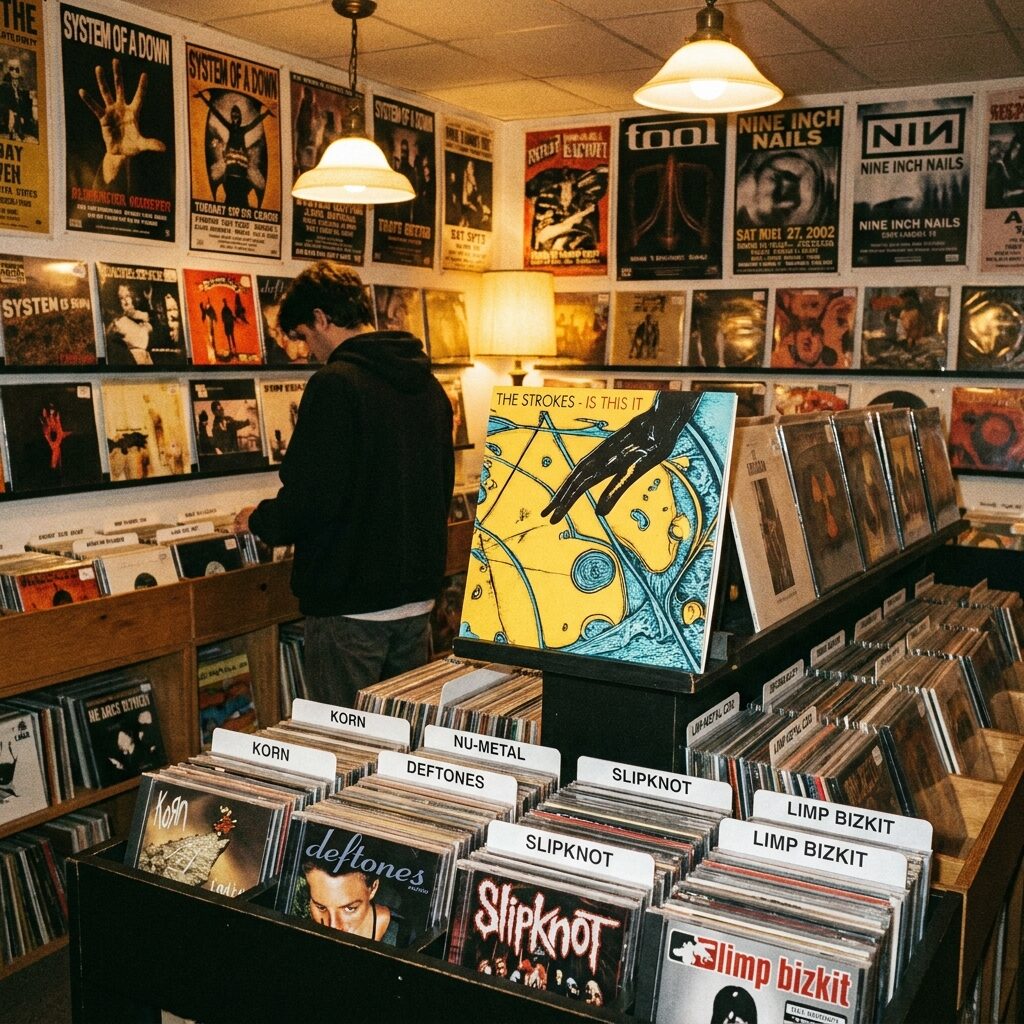
Here’s what was on rock radio when “Yellow” landed.
Limp Bizkit’s Significant Other had gone 7x platinum. Korn was still selling millions. Papa Roach. Staind. Disturbed. Fred Durst in a backwards red cap screaming about nookie. This was the nu-metal moment. Big muscles, big riffs, big resentment.
“There was a lot of that nu-metal, like Limp Bizkit,” Will Champion told The i Paper in 2020, looking back. “It was heavy, very masculine music. I think Yellow represented something that was possibly under-represented.”
Under-represented. That’s a careful phrase. He’s being diplomatic about what was actually a pretty radical move in 2000: a young man in near-falsetto singing about wanting to bleed himself dry for someone. No anger. No armor. No irony. Just open want.
The commercial response was immediate. “Yellow” debuted at #4 on the UK Singles Chart in July 2000, Coldplay’s first top-five hit. Parachutes went to #1 on the UK Albums Chart and moved 1.6 million UK copies by Christmas. In America, where British guitar bands had been dead since Oasis peaked, “Yellow” eventually reached #48 on the Hot 100 and #6 on Alternative Airplay, with a 20-week Hot 100 run that pried the door open for the next wave of British rock coming across the Atlantic.
Noel Gallagher, of all people, had the best quote about it. “When I heard ‘Yellow’ for the first time, I immediately picked up the guitar and went, ‘Fucking bastards, why didn’t I write that?’” You can hear the full Oasis ego in that line. Grudging admiration from a guy whose whole thing was writing songs like that, now beaten on his own turf by a band of university kids.
Not everyone was sold. Alan McGee, the former Creation Records boss who’d signed Oasis, dismissed Coldplay as “bedwetters’ music.” Pitchfork’s Spencer Owen handed Parachutes a 5.3 in November 2000 and called Coldplay “exceedingly generic and immediately forgettable.” On “Yellow” specifically, Owen wrote it was “the most obvious choice for a single” but also “the record’s weakest moment,” with “saccharine lyrics” and “grating, slightly tuneless guitars.” Ouch.
The interesting part is how that split aged. NME, two decades later in 2020, ranked “Yellow” #1 out of all 142 Coldplay songs. Pitchfork’s 5.3 has become one of the most-cited bad scores in the site’s history, the kind critics now quote with a little embarrassment. The Independent in 2020 credited the song with “altering the course of 21st-century rock music.” A song critics split on in real time got reconsidered, then reconsidered again.
The numbers kept piling up. 6x Platinum in the UK. 4x Platinum in the US. Over 3 billion Spotify streams as of May 2025, making “Yellow” Coldplay’s second song past that mark. The music video passed a billion YouTube views in January 2024. And here’s the one that actually matters to me: the song keeps coming back onto charts more than twenty years after it came out. In September 2024, it entered Spotify’s Global Top 20 at #20, with 2.6 million daily streams. The song is older than most of the people streaming it now.
McGee was right about one thing. It was bedwetters’ music. He just didn’t realize the bedwetters were going to win.
When the Song Became Ceremony
How a song written in ten minutes became the soundtrack of Steve Jobs’s memorial, Crazy Rich Asians’ climax, Shane Warne’s funeral, and every Coldplay stadium show.

October 19, 2011. An outdoor amphitheater at Apple’s Cupertino campus. Apple stores around the world were closed that morning, curtains drawn over their windows so retail staff could watch the stream. Steve Jobs had died two weeks earlier. The memorial ran about 80 minutes. Tim Cook, Al Gore, Bill Campbell, and Jony Ive spoke. Norah Jones played piano. Then Coldplay walked out and opened with “Yellow.”
Before the first chord, Martin said this to the crowd: “We played this song for Steve 10 years ago and he said it was sh—. He said we’d never make it.”
Read that again. The opening line of the song that would see Jobs off was a joke about Jobs once telling the band their song was garbage. Martin then told a story about Jobs personally fixing his broken laptop, thanked him for using “Viva la Vida” in an iTunes ad, and played that one too. Four-song set: “Yellow,” “Viva la Vida,” “Fix You,” “Every Teardrop Is a Waterfall.”
Jump forward seven years. August 2018. Crazy Rich Asians opens at #1 at the US box office. The film closes on Rachel Chu (Constance Wu) squaring off against Eleanor Young (Michelle Yeoh) over a mahjong table. And then a Mandarin cover of “Yellow” rises under the scene, sung by a 19-year-old USC student named Katherine Ho.
This didn’t happen by accident. Director Jon Chu had written a typewritten letter to Coldplay on December 8, 2017. “From being called the word in a derogatory way throughout grade school, to watching movies where they called cowardly people yellow, it’s always had a negative connotation in my life. That is, until I heard your song.” Coldplay had been burned before on Asian-culture questions. “Princess of China” with Rihanna in 2012 caught Orientalism criticism. 2016’s “Hymn for the Weekend,” filmed in Mumbai during Holi, got called out by The Guardian for “perpetuating hackneyed fantasies of India as an exotic playground.” They read Chu’s letter and said yes within 24 hours.
Here’s the detail most people miss. Katherine Ho’s version is not a translation. The production first approached Beijing singer Li Wenqi, who’d covered “Yellow” on The Voice of China at age 15. Li declined. Ho got contacted through Ben Bram, had 24 hours to record a partial demo on the USC campus, her father helping her dissect the Chinese lyrics over the phone. The lyrics she sings are from Zheng Jun’s Mandarin song 流星 — “Liu Xing,” Shooting Star — arranged to fit Coldplay’s chord progression. The song becomes something else entirely for that mahjong-table climax. Different language, different lyric, different cultural weight, same bones.
“To me,” Ho said, “the Mandarin lyrics tell a story of taking a leap of faith to pursue a dream or person/thing you love. On a broader level, for me, this song embodies what it means to be Asian American.”
A song with no inherent meaning, now carrying an entire diaspora’s relationship to a slur. You could not script this.
Then March 2022. Shane Warne, the Australian cricket legend, dies of a heart attack at 52. His public memorial service at the Melbourne Cricket Ground pulls tens of thousands. Martin, unable to attend in person, performs a rearranged acoustic version of “Yellow” via video link. Warne had harmonica’d alongside Coldplay on “Don’t Panic” at a 2016 Melbourne show. “Yellow” was one of his favorites. So the song sees that life off too.
Then there’s the stadium ritual that grew up around the song. The first known yellow balloon drop happened at the UIC Pavilion in Chicago on September 24, 2002. Martin looked up with what every concert photo from that night captures — genuine surprise on his face — as several thousand yellow balloons fell from the rafters during the song. That became a fixture of Coldplay live shows. It got upgraded in the 2010s to Xylobands, the LED wristbands every concertgoer wears. When “Yellow” hits, the wristbands go yellow in unison. A stadium of 50,000 people becomes a single yellow field.
So here’s the arc. A song written in ten minutes as a Neil Young joke, titled off a phone book, now does this: sees Steve Jobs off. Reclaims a slur in a Hollywood film. Buries Shane Warne. Turns every arena Coldplay plays into a color you can stand inside.
No wonder critics came back around to it. They had to. The world was doing the work on the song’s behalf.
Why Artists Keep Reaching
IDLES built an AI deepfake of ‘Yellow’ for their own song. Tegan and Sara wrote their own ‘Yellow.’ Katherine Ho sang it in Mandarin. Why artists keep reaching for the song.
February 2024. IDLES, the Bristol post-punk band, release their fifth album Tangk. The second single, “Grace,” drops with a music video that makes you sit up. It’s the “Yellow” video. Same rainy beach. Same slow walk. A 23-year-old Chris Martin in a black mackintosh, walking toward the camera in slow motion, lip-syncing — not to “Yellow,” but to IDLES lyrics.
It’s an AI deepfake. Director Jonathan Irwin and frontman Joe Talbot built it from footage of the real Chris Martin, filmed specifically so IDLES could train the model. Martin approved the final cut. Now and then the director nudged blur over Martin’s movement to offset the uncanny effect, which tells you how close the AI got. IDLES guitarist Mark Bowen put it most cleanly when asked about writing in that tender register: “That stuff is so hard to write without it sounding super cheesy. I have so much deference for your Coldplay, your The National, people that write that kind of music.”
Think about that for a second. IDLES — a band whose whole identity is snarling, shouting, anti-masculinity masculinity — making a deepfake love letter to the softest rock song of the century. The message: we know the thing we’re trying to do, and these are the people who actually did it.
The covers run deeper than you’d think. Tegan and Sara wrote their own song literally called “Yellow” in 2022, with a slow-motion empty-beach video that’s pure Studland Bay tribute. Lizzo sampled the song on her 2022 track “Coldplay” from Special. King Stingray, the Australian rock band, did a triple J Like a Version in 2022 that placed #43 on that year’s Hottest 100. Vitamin String Quartet did an orchestral version that ended up in Season 3 of Bridgerton. Jodie Whittaker — yes, the Doctor Who Jodie Whittaker — recorded a Children in Need cover in 2019 with Jonny Buckland and Will Champion playing backup. The BBC Live Lounge has hosted so many Coldplay covers that Coldplay are, per the show’s own running joke, the most-covered act in Live Lounge history.
Here’s what all that tells you about the song. When Noel Gallagher heard “Yellow” and reached for his guitar, that’s the test. Artists keep reaching for “Yellow” because the bones are so simple — three chords, a plain melody, a chorus anyone can sing — that anyone can try. Very few songs invite that. “Stairway to Heaven” doesn’t. “A Day in the Life” doesn’t. They’re too specific. Too locked to their makers.
“Yellow” is built to be picked up. And here’s the strange trick of it: when artists do pick it up, you can hear instantly whose version has the feeling and whose doesn’t. The song is a net. It catches whoever’s holding it. Lizzo’s net, Vitamin String Quartet’s net, Katherine Ho’s net, IDLES’ net — they all fit the same shape, but each one comes back holding something different.
Which brings us to why this is the song it is.
The Gift of Meaning Nothing
Martin’s refusal to tell us what “Yellow” means is what let the rest of the world use it. The real craft wasn’t the writing. It was the refusal to explain.

So what is “Yellow” about?
Phone book. Neil Young impression. All girls. Brightness and hope and devotion. Nothing at all. A friend named Stephanie. Unrequited love. None of the above.
Martin has given every one of those answers, then contradicted every one of those answers, and admitted he makes up origin stories to end conversations he doesn’t want to have. A lesser lyricist would have nailed it down. Given the interview, told the story, closed the book. Martin left the book open.
And into that opening, the world poured everything it had.
Jon Chu reclaimed a slur that followed him through grade school. Apple employees said goodbye to the man who built their company. Shane Warne’s family buried him to an acoustic rearrangement. Strangers dance to it at weddings. Kids learning guitar run the B, F♯, E progression in their bedrooms and feel, maybe for the first time, the small magic of making a song work with three shapes. A couple breaks up. A couple gets married. A parent plays it to a newborn. A video plays on MTV the night America turned the TV back on.
All of them using the song to say something the song itself refuses to say.
The real craft wasn’t in the ten-minute write. It wasn’t in the Neil Young impression, or the riff that barges in, or the night-to-dawn grade on the video. The real craft was refusing to explain any of it afterward. The song works on the same principle as the color itself. Yellow doesn’t carry a message. It carries a frequency. A wavelength bright enough to catch whatever light you point at it.
Chris Martin has never told the truth about “Yellow.” He’s been telling the truth the whole time. The truth was always: it’s yours.
Chris Martin grabbed ‘Yellow’ off a Yellow Pages directory sitting on the studio table. ‘In an alternate universe,’ he said, ‘this song would be called Playboy.’ 📖🌟 #Coldplay #Yellow #2000s https://bit.ly/4mGhIYw

Click to Tweet