A Sealed Envelope
A reel-to-reel tape sealed in 1965 held the earliest recording of “Pale Blue Eyes”, and sat unopened for over fifty years. When archivists finally cracked it open, they found the origin of a love song built almost entirely on beautiful lies. The eyes weren’t even blue.
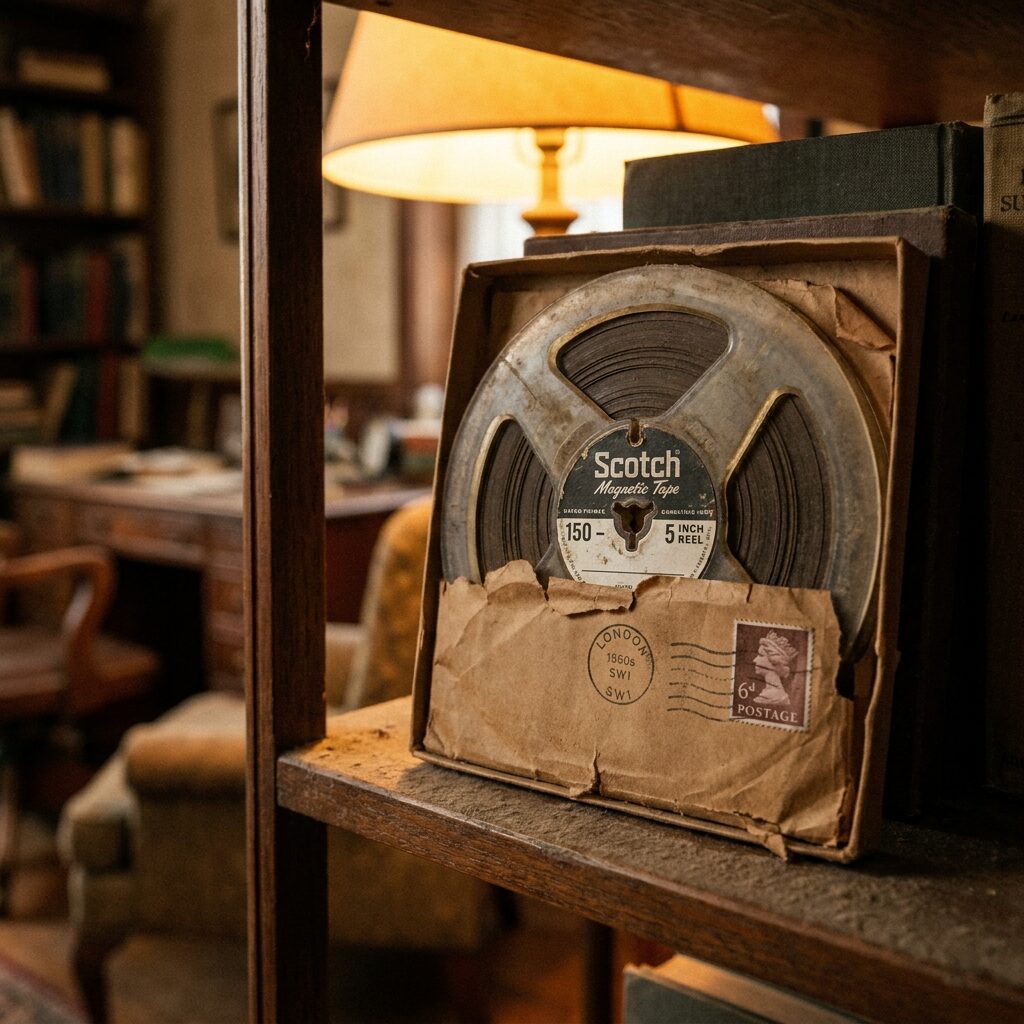
Here’s an image for you: a five-inch reel-to-reel tape, Scotch 111 stock, wrapped in brown paper and postmarked from the Baldwin, New York post office in May 1965. Registration number 3827, notarized by a man named Harry Lichtiger. A poor man’s copyright, mail yourself the tape, leave it sealed, and the postmark proves when you wrote it. Lou Reed stuck this package on a shelf behind his desk at Sister Ray Enterprises and didn’t touch it for over fifty years.
Fifty years. The Beatles hadn’t released Rubber Soul yet. Reed hadn’t even properly formed the Velvet Underground. And sitting in that sealed envelope was a song that would eventually wreck people, quietly, politely, without raising its voice.
In 2017, archivists Don Fleming and Jason Stern were cataloging Reed’s papers for the New York Public Library for the Performing Arts when they found the package and cracked the seal. Inside were recordings of “Heroin,” “I’m Waiting for the Man,” “Wrap Your Troubles in Dreams,” six other mostly unheard originals, and the earliest known recording of “Pale Blue Eyes,” four full years before the version that appeared on the Velvet Underground’s third album.
The 1965 demo is spare and ghostly, Reed on finger-picked acoustic guitar and harmonica, John Cale adding vocal harmonies, no drums, no bass, no organ. Reed spoke “Words and music by Lou Reed” at the start, like he was filing a deposition. It runs about five minutes. And of all those words and all that music, only the first verse and chorus survived into the 1969 album version. Reed rewrote everything else over those four years, living with this song longer than most bands exist.
Which brings us to the thing about “Pale Blue Eyes” that I keep turning over in my head. This is a song about someone specific, written with enormous tenderness, in which almost every biographical detail is a fabrication. The eyes in question weren’t blue. The woman may not have been married. The feelings were real. Everything else was invented, and that’s not a flaw. That’s what makes it art.
Reed himself put it plainly in his 1991 book Between Thought and Expression: “I wrote this for someone I missed very much. Her eyes were hazel.”
Hazel. Not pale blue. The title of the song is a lie. And it’s a better song for it.
The Quietest Loud Band
After firing John Cale and making the loudest album of their era, the Velvet Underground went to Hollywood and recorded the quietest. They weren’t the one-trick noise band critics had written off, and they knew it.
To understand what “Pale Blue Eyes” meant in context, you need to understand what the Velvet Underground had been doing immediately before they recorded it. Their second album, White Light/White Heat, released in January 1968, was, depending on who you ask, either a visionary blast of noise or an unlistenable mess. Probably both. As critic Richie Unterberger put it, they had made “perhaps the loudest album of all time.” The seventeen-minute feedback assault of “Sister Ray” alone could strip paint off walls.
And now, less than a year later, they were about to make what Unterberger called “the world’s quietest LP.”
The pivot wasn’t accidental. It came down to a personnel change. In September 1968, Lou Reed gave Sterling Morrison and Maureen Tucker an ultimatum: him or John Cale. Reed and Cale had been grinding against each other from the start. As Doug Yule later told Uncut, “John and Lou pushed against each other a lot. It was like a constant ongoing tug of war.” Reed won. Morrison was dispatched to deliver the news. Cale’s last shows were September 27 and 28 at the Boston Tea Party.
His replacement was Doug Yule, a twenty-one-year-old from the Boston band the Grass Menagerie, discovered by Morrison through the band’s road manager Hans Onsager. Yule proved himself at La Cave in Cleveland in early October and was a full member within weeks. He was cooperative where Cale had been confrontational, melodic where Cale had been abrasive. Reed liked that just fine.
“I really didn’t think we should make another White Light/White Heat,” Reed explained. “I thought it would be a terrible mistake… I thought we had to demonstrate the other side of us. Otherwise, we would become this one-dimensional thing, and that had to be avoided at all costs.”
So they went to Hollywood. T.T.G. Studios, to be specific, with the band staying at the Chateau Marmont, writing and rehearsing in the afternoons, recording at night through November and December 1968. They self-produced, with MGM’s Director of Engineering Val Valentin running the board. The sessions were mostly live takes with minimal overdubs, a stripped-down approach that gave the album its particular feel.
All of this was happening while contract disputes with MGM Records were getting worse. MGM would eventually terminate the band’s deal after the album was finished. They provided essentially zero promotion. The album didn’t chart. It just sort of appeared and disappeared.
You’ve probably heard Brian Eno’s famous line about the first Velvet Underground album, that it only sold 30,000 copies but “everyone who bought one started a band.” What you might not know is that even that figure was wrong. Eno got the number directly from Reed, but an MGM royalty statement shows 58,476 copies sold by February 1969, 13,336 mono, 45,140 stereo, roughly double what Eno claimed. Not that it mattered much. The Velvets were never going to sell records. They were going to do something weirder: become the kind of band that barely anyone heard at the time but that half of rock music eventually traced itself back to.
Shelley, Syracuse, and Beautiful Lies
Reed wrote “Pale Blue Eyes” for Shelley Albin, his Syracuse girlfriend, then changed her eye color because it sounded better, possibly invented her marriage because the song needed it, and rewrote the lyrics over four years until only the feeling was still true.
Her name was Shelley Albin. She was Lou Reed’s first serious girlfriend, his college sweetheart at Syracuse University in the early 1960s. And she is the subject of “Pale Blue Eyes.” Reed was never coy about that. What he was coy about, what he actively lied about, was almost everything else.
Start with the title. The eyes were hazel. Reed told us so himself, in black and white, in his 1991 lyric collection Between Thought and Expression. Why change them? Because “pale blue eyes” is a better phrase than “pale hazel eyes.” Say them both out loud. The first one floats; the second one thuds. Reed was a poet before he was a documentarian, and he understood that the sound of a phrase matters more than its accuracy. “Pale blue eyes” has a coolness to it, a distance, an almost translucent quality that mirrors the emotional remove of the song. “Pale hazel eyes” sounds like a police report.
Then there’s the marriage. The final verse, the one that recontextualizes everything, hinges on the line “the fact that you are married only proves you’re my best friend.” It’s the song’s gut-punch, the moment that reveals this isn’t just wistful nostalgia but an active, ongoing, probably adulterous love. Except: according to Anthony DeCurtis’ biography Lou Reed, “Shelley wasn’t married and did not have blue eyes (details he changed to make the song work).”
Now, here’s where it gets genuinely ambiguous, and I want to be honest about that. Albin did eventually marry a man named Ronald Corwin. Some sources maintain she was already married when Reed wrote the song. DeCurtis says she wasn’t. We don’t have Shelley Albin’s own account; she’s never spoken publicly about it. So what we’re left with is a conflicting record, which feels about right for a song that’s really about the gap between what happened and what got written down.
What’s not ambiguous is how long Reed carried this song. The 1965 demo, the one sealed in that envelope, already contained the first verse and chorus in recognizable form. A setlist from Poor Richard’s in Chicago, dated June 23 through July 3, 1966, shows “Pale Blue Eyes” listed alongside “Story of My Life,” meaning the song existed in some form during the Cale era, over two years before the album sessions. Reed lived with these chords, this melody, this woman’s memory, for four years. Most of the lyrics got rewritten. The feeling didn’t.
And that’s the important thing. DeCurtis writes that Reed “tried many times to get her back, and therefore what he ‘had but couldn’t keep.'” The emotion was real. The specific details were crafted, reshaped, invented where necessary. The eye color changed because it sounded better. The marriage was added, or wasn’t, because the song needed that particular kind of forbidden weight. Reed was building a structure of feeling, not filing a memoir.
Sterling Morrison understood this tension better than anyone. “Cale’s departure allowed Lou Reed’s sensitive, meaningful side to hold sway,” he observed. “Why do you think ‘Pale Blue Eyes’ happened on the third album, with Cale out of there? That’s a song about Lou’s old girlfriend in Syracuse.” Morrison’s point was sharp: this song couldn’t have existed on the first two albums. Not because Reed hadn’t written it. He had, years earlier. But the band’s dynamic wouldn’t have allowed it to breathe. You don’t play a near-whispered love song in a group where every rehearsal is a power struggle. You play it when the struggle is over, when the room is quiet enough to hear what you actually feel.
At the Velvet Underground’s first reunion at the Fondation Cartier in Paris in 1990, Reed initially wanted to open with “Pale Blue Eyes.” Someone reminded him the song was written after Cale left. Reed’s response was instant and perfect: “Then it will have to be ‘Heroin.'” From the quietest song to the most dangerous, because those were the only two modes that felt honest to him.
One Grace Note Changes Everything
Stripped to tambourine, clean guitar, and a half-buried vocal, “Pale Blue Eyes” is radical minimalism, where one tiny vocal ornament on the word “on” is all that separates a country ballad from something that won’t leave you alone.
Pitchfork made an observation about “Pale Blue Eyes” that ruined me: “Without the grace note Reed threw on the word ‘on’ in ‘linger on,’ for instance, ‘Pale Blue Eyes’ somehow transforms into a straight country ballad.”
Try it yourself. Sing the chorus flat, lin-ger on your pale blue eyes, and you’ve written a perfectly decent country weeper. Now add that little vocal curl on the word “on,” that tiny melodic hiccup, and you’re somewhere else. One ornament separates Nashville from the Lower East Side. One ornament separates a good song from one that follows you around for weeks.
The arrangement is startlingly bare. There are no drums on this track. None. Maureen Tucker plays tambourine, single shakes on beats 2 and 4, patient as a pulse. Sterling Morrison plays clean, undistorted electric guitar, slipping fills between Reed’s strummed acoustic. Doug Yule’s Hammond organ shows up only on the choruses, adding a faint warmth that disappears when the verses come back. Morrison and Yule sing backing harmonies in those chorus sections too, but they’re buried in the mix, more texture than melody.
The song sits in F Major at 83 beats per minute, andante, literally walking pace. The chord progression couldn’t be simpler: F to B-flat to F to C to F for the verses, shifting to D minor and C for the choruses. Beginner chords. You could teach them to someone in ten minutes. But listen to what happens when the chorus arrives at D minor. That move from the brightness of F Major to the ache of its relative minor does harmonically what the lyrics do emotionally: something warm and open suddenly has a darker undertone running through it.
Reed’s vocal is mixed low, almost submerged, like he’s singing to himself rather than performing. This was deliberate, and it caused a fight. Reed made his own mix of the album, pushing his voice and guitar forward while pulling everything else back. He wanted to “get directly to somebody, unfiltered… So, if you listen to the record, it’s like sitting across from you.” Morrison hated it. He called it “The Closet Mix” because “I thought it sounded like it was recorded in a closet.” He called the whole approach “anti-production.” Val Valentin made a more conventional mix with louder guitars and more definition. Which version you prefer says something about what you think the song is for. The Closet Mix feels like someone telling you a secret. The Valentin Mix sounds like a band in a room. I go back and forth.
One thing that’s easy to miss: the guitars are tuned down a whole tone from standard. It’s subtle, but it gives the recording a particular warmth and weight, a slight heaviness that keeps it from tipping into prettiness. Everything in the arrangement points the same direction, clear the path for the voice and the words. Someone described it as “a duet for warm guitar and almost religious tambourine,” which is about right. The tambourine isn’t really keeping time. It’s doing something closer to ceremony.
The song runs five minutes and thirty-nine seconds in the Valentin Mix. Nearly two minutes of that is an instrumental outro that fades slowly, the sound pulling away from you by degrees. Lingering, in other words. Which, yes, is the whole point of the thing.
The Punchline in Verse Five
The lyrics of “Pale Blue Eyes” open with nursery-rhyme simplicity, then build across five verses toward a single word, “married”, that reframes every tender line before it into something far more complicated.
Sometimes I feel so happy
Sometimes I feel so sad
Sometimes I feel so happy
But mostly, you just make me mad
Baby, you just make me mad
[Chorus]
Linger on your pale blue eyes
Linger on your pale blue eyes
[Verse 2]
Thought of you as my mountaintop
Thought of you as my peak
Thought of you as everything
I’ve had but couldn’t keep
I’ve had but couldn’t keep
[Chorus]
Linger on your pale blue eyes
Linger on your pale blue eyes
[Verse 3]
If I could make the world as pure
And strange as what I see
I’d put you in the mirror
I put in front of me
I put in front of me
[Chorus]
Linger on your pale blue eyes
Linger on your pale blue eyes
[Verse 4]
Skip a life completely
Stuff it in a cup
She said, “Money is like us in time
It lies but can’t stand up
Down for you is up”
[Chorus]
Linger on your pale blue eyes
Linger on your pale blue eyes
[Verse 5]
It was good what we did yesterday
And I’ll do it once again
The fact that you are married
Only proves you’re my best friend
But it’s truly, truly a sin
[Chorus]
Linger on your pale blue eyes
Linger on your pale blue eyes
The first two lines of “Pale Blue Eyes” are almost comically simple: “Sometimes I feel so happy / sometimes I feel so sad.” That’s the opening of one of rock’s great love songs. It sounds like something a child would write. And that’s the point, Reed is lulling you in, getting you comfortable with what seems like a straightforward, emotionally uncomplicated song. By the time you catch what he’s actually doing, you’re already in.
“Sometimes I feel so happy / but mostly you just make me mad.” That pivot on “but mostly” is subtle and perfect. We’ve gone from nursery-rhyme simplicity to something more complicated in four lines. Happy and sad aren’t the real poles here, happy and mad are. And the way Reed sings “mad,” flat, matter-of-fact, almost casual, tells you more about this relationship than a hundred more elaborate lyrics could.
The second verse is where the song starts to gut you. “Thought of you as my mountaintop / thought of you as my peak / thought of you as everything / I’ve had but couldn’t keep.” That last line is where the past tense does its damage. This is a living person Reed is singing about, someone who exists in the present, but he’s already grammatically consigned her to loss. “Everything I’ve had but couldn’t keep”, the ache of something being over while you’re still in the middle of it. DeCurtis wrote that Reed “tried many times to get her back,” and you can hear every one of those attempts in that verse.
The third verse shifts to a kind of magical thinking: “If I could make the world as pure and strange as what I see / I’d put you in the mirror I put in front of me.” It’s a strange image, narcissistic and devoted at the same time. He wants to see her everywhere, but specifically by reflecting himself. Love as a hall of mirrors. Very Lou Reed.
Then the fourth verse, and here’s where I have to be honest: nobody completely knows what this one means. “Skip a life completely / stuff it in a cup / she said, money is like us in time / it lies, but can’t stand up / down for you is up.” There’s even a textual discrepancy, some transcriptions have “she said,” others have “they said.” The verse has generated decades of interpretation, from metaphors about the futility of conventional living to commentary on the transactional nature of relationships. I’ve seen smart people argue convincingly for readings that completely contradict each other. What matters more than solving it is what it does structurally: it introduces ambiguity and disorientation right before the final verse. It destabilizes you so that what comes next hits harder.
And what comes next is the punchline. Steve Pafford used that word, and it’s exactly right, this verse lands like the final line of a joke, recontextualizing everything you’ve heard before it.
“It was good what we did yesterday / and I’d do it once again.” Okay, fine, a tender reflection on shared experience, until: “The fact that you are married / only proves you’re my best friend / but it’s truly, truly a sin.”
There it is. Four verses of tenderness, longing, and philosophical musing, and then Reed drops the word “married” and suddenly you realize this isn’t wistful memory. This is happening right now. Yesterday. And he’d do it again. The word “sin,” repeated, emphasized, “truly, truly,” carries double weight. Sin in the literal religious sense, adultery. And sin in the emotional sense, the knowledge that this beautiful thing is wrong and you don’t care. He delivers the most damaging line in the softest possible voice.
And then the chorus returns one final time. “Linger on your pale blue eyes.” The same words as every other chorus, but now they mean something different. Earlier, “linger” felt romantic, staying a little longer, savoring. Now it feels compulsive. He can’t stop looking. He can’t leave. Lingering isn’t tenderness anymore. It’s inability to let go. The refrain picks up weight with each repetition as the verses get darker around it. By the end, lingering is both the most loving and the most destructive thing the song describes.
Remember: the eyes are hazel. The marriage might be invented. And the emotion is the truest thing in the room.
The Album Nobody Heard
The Velvet Underground’s self-titled third album proved the band could be gentle without losing their edge, and was promptly ignored by almost everyone, failing to chart while their label dropped them.

The Velvet Underground’s self-titled third album is the sound of a band making a deliberate left turn. After the avant-garde provocation of the debut and the scorched-earth noise of White Light/White Heat, this record said: we can do this too. We can be quiet. We can be tender. And we can still make you uneasy.
Colin Larkin, writing in The Encyclopedia of Popular Music, nailed the album’s strange duality: it “unveiled a pastoral approach, gentler and more subdued, retaining the chilling, disquieting aura of previous releases.” That’s exactly right. The quietness isn’t comforting. It’s the other kind of quiet, the kind before something happens.
“Pale Blue Eyes” sits at track four on Side A, paired on the album with “Jesus”, a placement that David Fricke singled out in his 1985 Rolling Stone review as the emotional center of the record: “The ironic pairing of ‘Pale Blue Eyes’ and ‘Jesus,’ both soft and fragile, both confessing different kinds of love, best summarizes the hopeful warmth at the center of the Velvets’ rage.” Think about that pairing for a second. A song about adulterous love and a song that’s basically a hymn, sitting side by side. Secular longing and spiritual yearning, each delivered with the same gentleness, the same sincerity. That one sequencing choice tells you more about Reed’s intentions on this album than any interview he ever gave.
The two-mix saga complicated the album’s reception from day one. Reed had gone behind the band’s back to create his Closet Mix, boosting his vocals and softening everything else. The Valentin Mix, more conventional, with louder guitars, was prepared separately. The original US vinyl got the Closet Mix. The UK release got the Valentin Mix. A 1985 West German CD somehow ended up with the Closet Mix for tracks one through five and the Valentin Mix for six through ten, apparently by accident. Morrison and Tucker were frustrated by the whole mess. Which version you grew up with shaped how you heard not just “Pale Blue Eyes” but the entire record.
The commercial reality is hard to overstate. The album didn’t chart on the Billboard 200. At all. MGM provided no promotion. The only single was “What Goes On” backed with “Jesus,” released in March 1969, which also went nowhere. The label terminated the band’s contract after the album was completed. For context, the debut had peaked at a distant 171 on Billboard, White Light/White Heat at 199. The third album couldn’t even manage that.
Lester Bangs, reviewing the album in Rolling Stone in 1969, wrote that its “combination of powerfully expressive music and profoundly sentimental lyrics will persuade the band’s detractors into believing they can ‘write and play any kind of music they want to with equal brilliance.'” He was right about the brilliance. He was wrong about the persuading. Nobody heard the record. Not then, anyway.
The album wouldn’t chart until its 1985 Verve reissue. By then, a generation of musicians who’d found copies in dollar bins had already internalized it and built whole genres out of what they heard.
Every Quiet Band Started Here
From dream pop and shoegaze to Korean cinema and a demon’s secret playlist, “Pale Blue Eyes” has spent decades quietly infiltrating the culture, without ever being released as a single.
Here’s the thing about “Pale Blue Eyes”: it was never released as a single. It appeared on an album that didn’t chart. It was recorded by a band that most people in 1969 had either never heard of or actively disliked. And somehow it burrowed into the culture and never left.
You can draw a direct line from “Pale Blue Eyes” to dream pop and shoegaze. Someone described Galaxie 500, one of the defining bands of that late-’80s/early-’90s moment, as “Pale Blue Eyes washed with distorted guitar feedback,” and honestly, that nails it. Dean Wareham’s whispery vocals over slow, reverb-drenched guitars owe an obvious and acknowledged debt to what Reed and Morrison did on this track. Take the bones of this song, run the guitar through a wall of effects pedals, and you’ve basically got an entire genre.
The influence gets literal sometimes. An English trio called Pale Blue Eyes formed in Totnes, Devon in 2019, Matt and Lucy Board on guitar and keyboards, Aubrey Simpson on bass, making dream pop and shoegaze directly descended from the song they named themselves after. They’ve toured with Sea Power and Slowdive, which means they’ve shared stages with bands who were themselves shaped by the Velvet Underground. The lineage folds back on itself.
In film, “Pale Blue Eyes” keeps showing up as emotional shorthand, a way to telegraph a very specific kind of melancholy. The most extraordinary example is the 1997 South Korean film The Contact, in which the entire plot revolves around a radio DJ who receives an anonymous package containing the VU album and plays “Pale Blue Eyes” on air, hoping to reconnect with a former lover. The whole movie hinges on this song’s ability to reach someone across distance and silence. Wim Wenders used it in Perfect Days in 2023. Julian Schnabel used an instrumental version in The Diving Bell and the Butterfly. It appeared in Adventureland, in Regular Show: The Movie, in a 2009 episode of Cold Case, though that last one committed the anachronism of placing the song in a 1967 storyline, two years before it was recorded.
On October 27, 2013, Lou Reed died. That evening, the Killers were performing at the inaugural Life Is Beautiful Music & Art Festival in Las Vegas. They played “Pale Blue Eyes” as tribute. It’s the right song for a eulogy, not one of Reed’s confrontational anthems, not “Walk on the Wild Side” or “Heroin,” but the quiet one, the vulnerable one, the one that sounds like missing someone while they’re still in the room. Or just after they’ve left it.
And then there’s the fictional endorsement that might be my favorite piece of “Pale Blue Eyes” trivia. Neil Gaiman, when asked on Tumblr in 2019 what the demon Crowley from Good Omens listens to, said: “I suspect that he drives out with ‘The Black Angel’s Death Song’ playing, but when he’s at home and relaxing and nobody knows it’s ‘I’ll Be Your Mirror’ or ‘Pale Blue Eyes.'” A demon’s secret vulnerability. A song so tender that even a fictional being of pure malice listens to it only when no one’s watching. Gaiman understood something about the song that’s hard to articulate otherwise: it’s private music. It’s the thing you put on when you’re alone and willing to feel something you’d never admit to in public.
None of this was supposed to happen. A song that was never a single, from an album that sold nothing, by a band that most of the world ignored. And yet here we are, fifty-seven years after Reed sealed that tape, and “Pale Blue Eyes” keeps finding new ears, new contexts, new reasons to matter. That’s not commercial success. It’s something weirder and more durable than that, a song that worked its way into how people process longing, without anyone in the music industry ever deciding it should.
Everyone Heard It Differently
From R.E.M.’s jangle-pop thank-you note to Courtney Love’s punk land-grab to reunion-era performances with the very man whose firing made the song possible, “Pale Blue Eyes” has been covered by artists who each seemed to hear a completely different song in it.
A good cover reveals the singer as much as the songwriter. “Pale Blue Eyes” has drawn an unusually wide range of interpreters, and no two of them seem to have heard the same song.
R.E.M. recorded their version in 1984, releasing it as the B-side to “So. Central Rain (I’m Sorry)” and later collecting it on Dead Letter Office. This was early R.E.M., Murmur-era chime and mumble, all jangle, and their cover plays like a thank-you note to an older generation. Peter Buck’s guitar owed so much to Sterling Morrison that covering a VU song was practically a self-portrait. Reverent without being stiff, a young band saying out loud what their records had been saying quietly.
Courtney Love went somewhere else entirely. When Hole played “Pale Blue Eyes” at the Whisky a Go Go in February 1992, Love introduced it by calling Reed “the original new waver”, not a tribute so much as a territorial claim. Punk reclaiming the Velvets as proto-punk, the start of a lineage running through the Ramones and the Sex Pistols into the early-’90s underground. She rewrote the verses but kept the chorus intact, which says something on its own: the feeling stays, but I’m telling the story differently. The performance came out on the 1995 EP Ask for It.
The most commercially successful version might not be the one you’d guess: Paul Quinn and Edwyn Collins released their cover as a single in August 1984, and it reached number 72 on the UK chart, the only version of “Pale Blue Eyes” to ever chart anywhere as a standalone release. Quinn sang for Bourgie Bourgie, Collins fronted Orange Juice; they’d been Glasgow classmates from ages eleven to fifteen. Their take is post-punk pop, bright and angular where the original is warm and half-buried, recorded at AM-PRO Studios in London with Collins producing. It was the first release on Alan Horne’s Swamplands label, Horne had founded Postcard Records, the label that helped shape Scottish indie pop.
Patti Smith performed it live in the mid-to-late 1970s, one New York poet honoring another. Marisa Monte recorded a version for her 1994 album Verde, Anil, Amarelo, Cor de Rosa e Carvão. Counting Crows played it live regularly starting in 2003. The Kills recorded a version in 2010. Soap&Skin put out a spare, piano-led reading on her 2024 album Torso. Ryan Adams cut a solo acoustic version during his 2023 European tour.
Two covers stand out for what they accidentally say about the song’s backstory. During the Velvet Underground’s 1990s reunion tour, John Cale, the man whose firing made the song possible, got back onstage with the band and played “Pale Blue Eyes” on viola. There’s something genuinely weird about that. Audiences were hearing an arrangement that couldn’t have existed in the original timeline, viola layered onto a song that Morrison said could only have happened “with Cale out of there.” Cale’s playing added a mournful weight the studio version never had, and the whole thing felt like a quiet contradiction nobody wanted to point out.
Then there’s Maureen Tucker covering it solo. She played tambourine on beats 2 and 4 on the original, background, keeping time, and here she was stepping up to sing Reed’s most exposed lyric as her own. If Morrison felt like a voyeur playing it (“If I wrote a song like that, I wouldn’t make you play it”), what did it feel like for Tucker to inhabit those words after all those years? Most covers of “Pale Blue Eyes” are interpretations. Tucker’s feels more like she’s exercising a right, earned by being in the room when it first happened.
Linger On
A song that existed before its band, survived four years of rewriting, outlived its creator, and keeps working because Reed knew that emotional truth and biographical truth are different things.
The song existed before the band properly formed. It was on that sealed tape in 1965, when the Velvet Underground was still figuring out what it was, when Cale and Reed were still just two guys making demos in somebody’s apartment. It survived four years of rewriting, a lineup change that changed the band’s whole personality, and recording sessions at a Hollywood studio during a contract dispute. It appeared on an album that no one bought, on a label that dropped the band, in a year when the culture was looking elsewhere. It outlived the band. It outlived Reed himself.
And it keeps working because of something Reed would have appreciated: his most honest emotional statement is built almost entirely on invented details. The eyes were hazel. The marriage may have been fictional. The biographical specifics were shaped, altered, fabricated to serve the song. That’s not a contradiction. That’s just what songwriting is, the difference between a diary entry and art. A diary says what happened. A song says what it felt like. Reed chose feeling every time.
Sterling Morrison, the man who played guitar on the track, the man who showed up and acquiesced, said something that I think about a lot: “If I wrote a song like that, I wouldn’t make you play it.” He was uncomfortable. The song was too personal, too exposed, too much like reading someone’s mail. And that discomfort is the highest compliment a song like this can receive. It made the people performing it feel like voyeurs. It made the people in the studio feel like they’d walked in on something private. It still does that, fifty-seven years later, through headphones, to strangers.
“Linger on your pale blue eyes.” The song asks you to do exactly what it does: stay too long with something beautiful that isn’t quite yours. Every time the chorus comes back, you’re lingering. Every time you press play again, you’re lingering. It tells you to linger, and then it makes it impossible not to.
Somewhere in the archives of the New York Public Library, there’s an opened envelope with a 1965 postmark. The tape has been played now. The secret is out. But “Pale Blue Eyes” still sounds like a secret, still sounds like something you’re overhearing, something meant for someone else, something you shouldn’t be this moved by but are. Every time. Still. Linger on.
🎵 Did you know? Lou Reed’s “Pale Blue Eyes” was written for a woman whose eyes were actually hazel. He changed the color because “pale hazel eyes” didn’t sound as good. Art > accuracy. 👀 #LouReed #VelvetUnderground #1960s https://bit.ly/4sByDMS

Click to Tweet