The Song That Won’t Leave
“The Door” sounds like a celebration and reads like a survivor’s testimony, and that tension is exactly the point.
There’s a specific kind of song that sneaks up on you. You’re in a grocery store, or a bar, or someone’s car, and something starts playing and you think: wait, what is this? You reach for your phone. You Shazam it. And then for the next three weeks you can’t get it out of your head. Rolling Stone critic Alex Tear described it perfectly, “The Door” is “a casual haunt that comes up behind you and it stays.”
Here’s the thing though. When you actually listen to what Teddy Swims is singing about on “The Door,” the earworm quality becomes genuinely strange. This is a song about surviving abuse. About a relationship that had slowly pushed out everyone who cared about him. About discovering that walking out, literally showing someone the door, was the moment he saved his own life. That’s the lyrical content. Now set it against the production: 128 BPM, gospel-inflected pop-soul, a chorus so irresistible it practically bounces out of the speaker and follows you around the room. The tension between those two things is not a bug. It might be the whole point.
By the time “The Door” dropped as a single on April 17, 2024, Swims already had “Lose Control” at #1 on the Billboard Hot 100, a slow-burn climb that had built over months, not overnight. And here he came with the follow-up, and the follow-up was rawer. Less obviously radio-friendly. Built on a chord progression that occupies the least popular key in the Hooktheory database. A song about abuse, written by a man who figured out what he was feeling by writing it down.
Why does the catchiest song about escaping an abusive relationship feel so good to listen to? I don’t think that’s a contradiction. I think it’s the most honest thing about the song. But to understand why, you need to know a little about who Jaten Dimsdale is, how the song got written, and why a D♯7 chord does something to your nervous system you probably can’t quite explain.
Conyers, Georgia to Everywhere
Teddy Swims spent years building a following before “Lose Control” broke through, and “The Door” is what it looks like when a slow-burn artist puts his most personal material on tape.
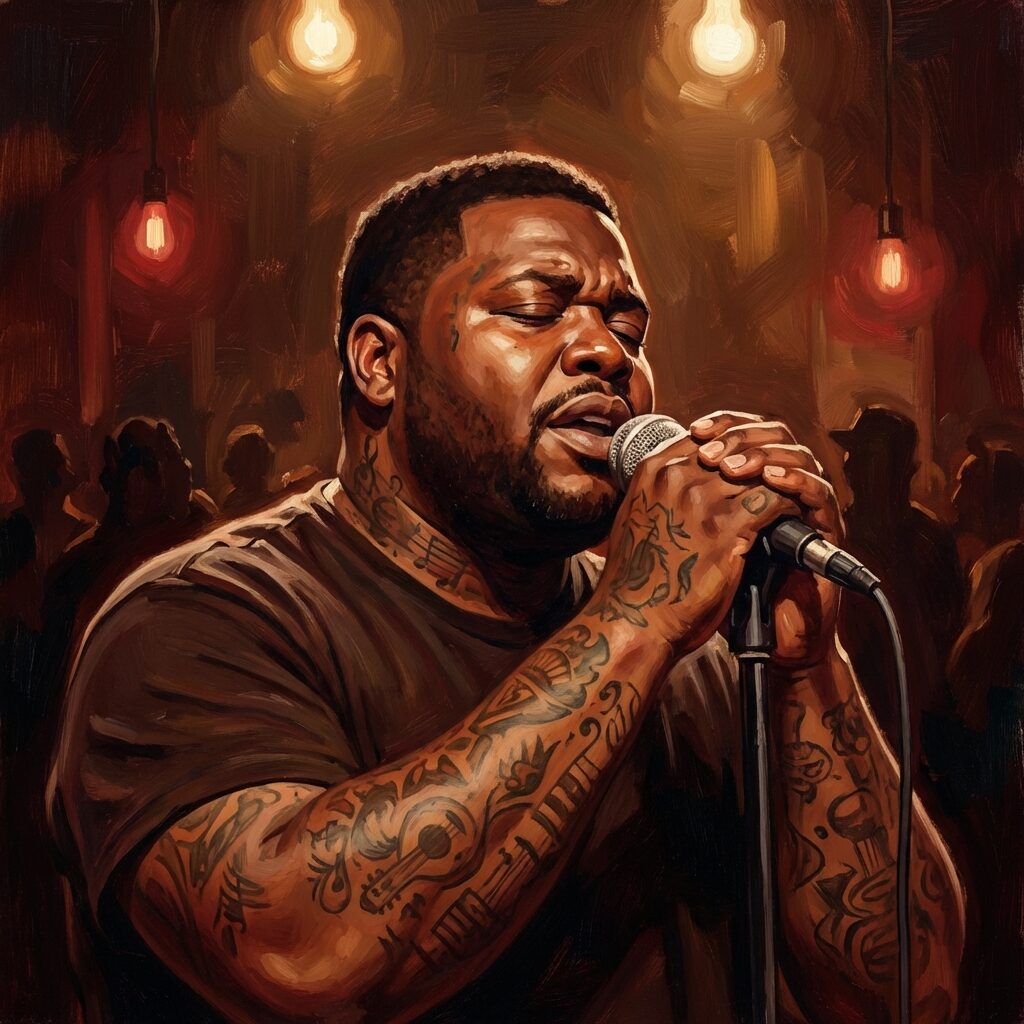
Jaten Collin Dimsdale was born September 25, 1992, in Conyers, Georgia, a small city about 25 miles southeast of Atlanta. No viral moment, no label machine. He built it the old way: years of YouTube covers, relentless touring, grinding the circuit until people knew who he was. By the time “Lose Control” became inescapable in 2023 and 2024, Swims was not a new artist. He was an overnight success eight years in the making.
What makes him unusual in the current pop-soul landscape is hard to put into a sentence. On the surface: heavily tattooed, big-voiced, bear-built, a physical presence you wouldn’t necessarily associate with gospel-inflected vulnerability. But that’s exactly what he does. He sings like someone who has sat in a pew and felt it, not someone imitating the aesthetic. No retro cosplay, no deliberate throwback positioning. He’s emotionally unguarded in a way that pop music, especially pop music made by men, almost never is. When he opens his mouth, you believe him. That’s rarer than it sounds.
The album that houses “The Door”, I’ve Tried Everything But Therapy (Part 1), released September 15, 2023, on Warner Records, announces its intentions in the title. This is not a polished, carefully managed debut. It’s a confession with a tracklist. “The Door” sits at track four, which means by the time you get there, the album has already made clear we’re in uncomfortable emotional territory. The title isn’t a joke or a marketing hook. It describes exactly what you’re hearing: a man working through things he probably should have been working through with a licensed professional, using songwriting instead.
One of the six co-writers on “The Door” is Sherwyn Nicholls, full name Sherwyn Hewett Nicholls, who supported Swims on his 2022 tour. That matters more than it might seem. This wasn’t a commercial writing room full of strangers optimizing for radio. Nicholls was there. He watched Swims live through whatever he lived through. When the song got written, at least one person in the room knew the backstory from the inside.
By spring of 2024, Swims was navigating something genuinely strange: the wound that produced these songs was still fresh. The songs about the wound were now playing everywhere. Every interview asked him about it. That takes a particular kind of steadiness, being willing to keep excavating something painful in public, over and over, while simultaneously being celebrated for it. He handled it with more grace than most people would.
What He Found Writing It
Swims didn’t go into the writing sessions knowing what he felt, he found out while writing it down. The people he brought into the room had been sitting with him long enough to help him get there.
Let’s be clear about what this song is about, because Swims has been clear about it. “The Door” is about an abusive relationship with an ex-girlfriend, one that didn’t just hurt him but drove away the people around him. Friends. Family. The support system that’s supposed to catch you. In a TooFab interview, Swims addressed male victimhood in abusive relationships without hedging: “It goes both ways.” Simple statement. Necessary one. It doesn’t take long to say. It takes something else to say it on the record, in public, in the entertainment industry, in 2024.
What’s striking about the creative process behind this song isn’t just the subject matter, it’s what Swims discovered by writing it. Not what he already knew and put into words. What he didn’t know until the words came out. He told Songfacts: “I think that those are the things your heart needs to say, or your subconscious is trying to tell you that you’re not fully tapped into. There’s been a lot of therapy through that. There were times that I found out that I didn’t even know I was feeling this way.”
That’s not a talking point about the creative process. That’s a real thing, writing as diagnostic tool, showing the writer what they haven’t been able to see yet. Songwriting as self-discovery isn’t a new idea, but it’s rarely described this specifically. He didn’t go into the session knowing what he felt. He found out while writing it down. The album title, I’ve Tried Everything But Therapy, reads, in that light, like a clinical description of what actually happened in those rooms.
The writing room for “The Door” wasn’t a random collection of industry hires brought in to optimize a commercial product. Julian Bunetta had been working with Swims since January 2020, more than three years before the album dropped. Bunetta is behind One Direction’s “Story of My Life” and, more recently, Sabrina Carpenter’s “Espresso.” He knows how to build a song people carry around. Ammo, Joshua Emanuel Coleman, has credits alongside Beyoncé and Kesha, and was also part of “Lose Control.” These aren’t interchangeable producers. They’re people who had been in the room with Swims long enough to understand what he was actually trying to say.
Then there’s the wild card: Mikky Ekko, whose legal name is John Stephen Sudduth, who co-wrote and performed on Rihanna’s “Stay” in 2012. That song, bare, devastating, about the irrational pull of a relationship you know is destroying you, is in some sense the spiritual predecessor to “The Door.” The same songwriter who helped articulate why we stay also helped articulate what it feels like to finally leave. I can’t let that pass without noting it.
Swims wasn’t cavalier about the rollout. When asked about the strategy for the single in Variety in 2024, he said: “We’re going to let that grow organically.” No race to capitalize on “Lose Control.” The song was given room to find its audience instead of being pushed to radio and hoped for the best. Given what happened on the UK charts, debuting at #91 in May, climbing to #5 by November, 83 total weeks in the Top 100 across two separate runs, that patience looks like wisdom now.
The postscript came on November 20, 2024, at the 58th Annual CMA Awards in Nashville. On the red carpet, Swims publicly addressed his unnamed ex, maybe for the first time in an interview: “I have nothing but thanks to give to that person, because I was able to take some of that trauma and put it in a way that I can celebrate it now amongst other people with the same kind of issues, so thanks to her honestly.” Read that again. A man who was abused, wrote a song about it, watched it reach millions of people, and his public statement is gratitude. Not bitterness. Not performance. Someone who has actually processed something, and come out the other side.
Why It Feels Like That
G♯ minor is the least popular key in the Hooktheory database, and that off-center quality is doing more emotional work in this song than any lyric.
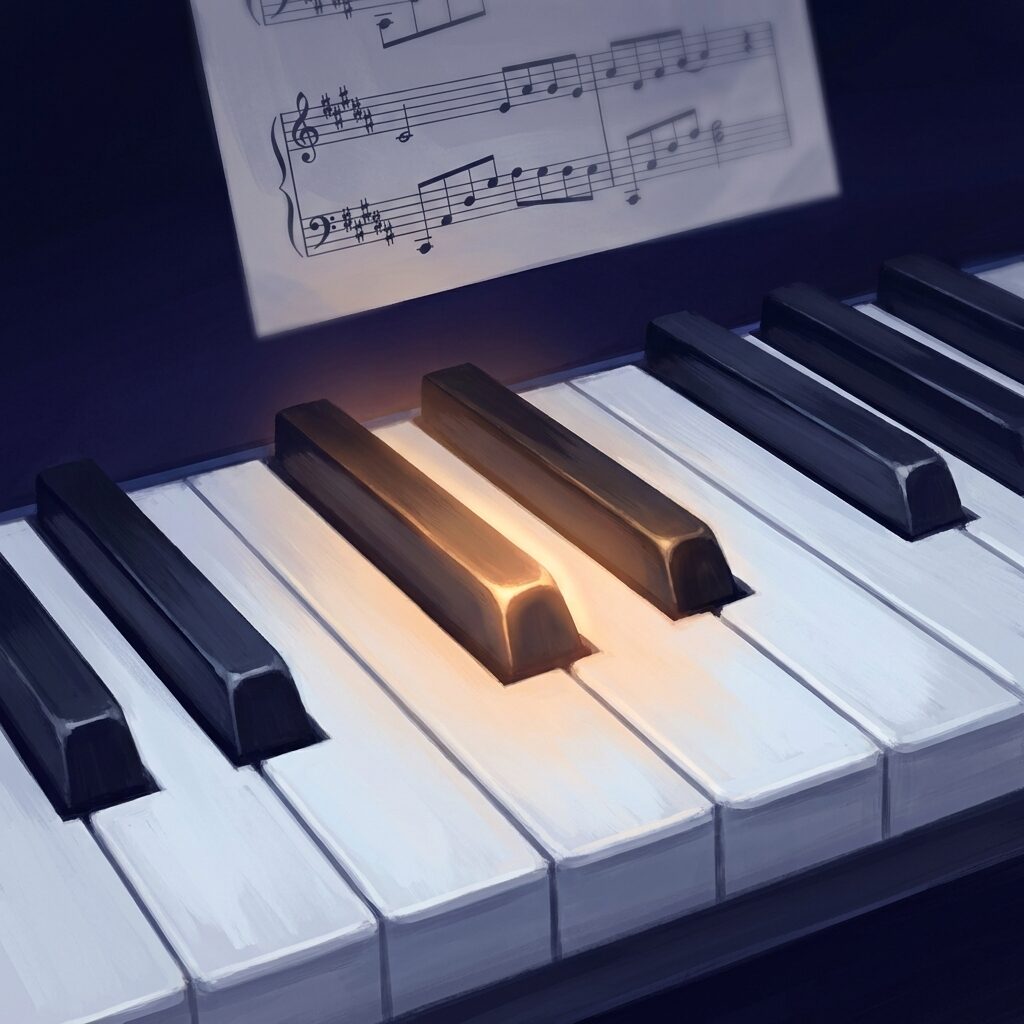
128 BPM. 4/4 time. Pop-soul with gospel color. On paper, that’s a workout track, something you’d hear at the end of a spin class. So why does “The Door” feel like it’s pressing on something specific, something slightly off-center? Why that particular quality Rolling Stone’s Alex Tear called a “casual haunt”?
Part of it is the key. “The Door” is in G♯ minor, enharmonically A♭ minor, which is the least popular minor key in the Hooktheory Theorytab database. 24th among all keys in usage. There’s something about that choice that works on you subliminally. You’re not quite in a key your ear has been trained on. The whole thing sits slightly sideways in a way you can feel but not name. And that feeling, familiar but displaced, maps onto what the song is actually about: a life that looked right from the outside but was wrong on the inside.
The chord progression is where it gets interesting. The main cycle is G♯m – E – F♯ – D♯7, or i – ♭VI – ♭VII – V in Roman numerals. That last chord, the D♯7, is the harmonic minor V. In natural minor, you’d get D♯ minor. Harmonic minor raises the seventh scale degree by a half step, producing a major chord with a dominant seventh. The result is a sharper, more urgent tension before the progression resolves back to G♯ minor. A pull. A lean. Your body actually does this slightly forward thing when it hits.
A user on Reddit’s r/musictheory called a specific passage in the song’s first six bars “haunting” without being able to say why. Another user did the work: the melody in those bars is G♯–B–G♯–C♯–B–A♯–B, and as it repeats across the cycling progression, it lands on different chord tones and extensions each time. The same notes mean slightly different things against each successive chord. Something familiar keeps arriving somewhere unexpected. That’s the technical explanation for why the song sounds like it’s circling something it can’t resolve, which, obviously, is exactly what the lyrics are doing too.
The production is lean in a way that reads as deliberate. Julian Bunetta on keyboards, drums, and bass. Ammo on keyboards, drums, and vocal production, plus background vocals, which he sings alongside Swims. That’s the whole thing. No accidental textures. The gospel influence isn’t coming from instrumentation, no organ, no choir, it lives in the melodic phrasing and in those background vocals. It’s in how Swims approaches a melody, the way he’ll push a note or let a phrase decay. You feel it without being told it’s there.
Here’s the detail I find most interesting: in live performances, Swims swaps the D♯7 for a D♯sus4. The suspended fourth delays the resolution, instead of snapping home with the urgency of a dominant seventh, the chord floats, unresolved, before finally landing. Same emotional territory, different release. The D♯7 says: we’re going home now, and here’s the push to get us there. The D♯sus4 says: we’re going home, but we’re going to hang here for a moment first. A performer who would think to make that change knows exactly what his song is doing.
PopFiltr called it “a surprising juxtaposition of upbeat melodies and a powerful message” wrapped in “an up-beat, almost paradoxical musical arrangement.” But I’m not sure it’s paradoxical at all. The music is telling the truth about what it feels like after you leave. Not during the crisis, not in the worst moment, after. When you’re out and you realize you’re going to be okay. That’s what 128 BPM feels like. That’s what a chorus you can’t stop singing feels like. The song isn’t in denial about the darkness. It’s narrating from the other side of it.
I Said I Would Die for You
Three movements, submission, agency, pivot, compressed into three and a half minutes, with a title phrase grounded in one very specific physical image.
I took a page out of your favorite book
You sold me lies just by the way you look
Taught me a language that I’d never speak
Baby, that ain’t for me, that, that ain’t for me
I dug my grave watchin’ the way you move
You took me higher than I ever flew, ooh
Too many times, gave you a second chance
Baby, I’m just a man, I’m, I’m just a man
[Pre-Chorus]
No more thinkin’ about you late night
No more runnin’ around with your friends and I’m
Done pickin’ the pieces of my
Soul up off the floor, oh, oh
[Chorus]
I said I would die for you, baby
But I can’t take this pain no more
I thought I was willin’
But tonight, I saved my life when I showed you the door
I don’t wanna lose you, baby
But I can’t play this gamе no more
I thought it would kill me
But tonight, I saved my lifе when I showed you the door
[Verse 2]
You never thought this day would ever come
But I looked you in the eyes and pulled the rug
You tried to take away my sanity
Baby, that ain’t for me, that, that ain’t for me
[Pre-Chorus]
Oh, no more thinkin’ about you late night
No more runnin’ around with your friends and I’m
Done pickin’ the pieces of my
Soul from out the floor, oh, oh
[Chorus]
I said I would die for you, baby
But I can’t take this pain no more
I thought I was willin’
But tonight I saved my life when I showed you the door
I don’t wanna lose you, baby
But I can’t play this game no more
I thought it would kill me
But tonight I saved my life when I showed you the door
[Post-Chorus]
When I showed you the door
When I showed you the door
But tonight, I saved my life
[Chorus]
I said I would die for you, baby
But I can’t take this pain no more
I thought I was willin’
But tonight, I saved my life when I showed you the door
I don’t wanna lose you, baby (I don’t wanna lose you, baby)
But I can’t play this game no more (No more)
I thought it would kill me (I thought it would kill me)
But tonight, I saved my life when I showed you the door
[Outro]
Mm-mm-mm
Woah, oh, oh

“The Door” moves in three parts, all of them compressed into three and a half minutes. Verse one is submission. Verse two is agency. The chorus is the pivot, and it’s doing that work every time it comes around.
Verse one: “I dug my grave watchin’ the way you move / You took me higher than I ever flew.” Both images put the culpability on the narrator. He dug the grave. He went higher than he ever had. That combination, exhilaration and destruction, feeding each other, gets captured in two lines without any comment on top of it. Swims doesn’t need to tell you this was bad for him. The grave does that.
By verse two, something has flipped: “I looked you in the eyes and pulled the rug.” The narrator isn’t being acted on anymore. He’s acting. He’s the one pulling. That shift from passive to active is the whole arc of the song, and it happens in about ninety seconds. The verses don’t describe the journey, they enact it.
The pre-chorus names three specific things being rejected: late-night rumination (“no more thinkin’ about you late night”), social enmeshment (“no more runnin’ around with your friends”), and the ongoing labor of putting yourself back together (“done pickin’ the pieces of my soul up off the floor”). That last image lands hard. Anyone who’s been in a relationship that required constant damage control knows exactly what it feels like. And “done” before it doesn’t just mean finished, it means depleted. Used up. Not doing this anymore.
The chorus puts past devotion up against a present decision: “I said I would die for you, baby / But I can’t take this pain no more / I thought I was willin’ / But tonight, I saved my life when I showed you the door.” The past tense, “I said,” “I thought”, is quiet but deliberate. He’s not canceling the love. He’s placing it in the past, where it belongs, while the present action, tonight, I saved my life, sits firmly in the now. Songwriting Hub noted that these lines fall after the strong beat rather than on it, which “supports the emotions of past-tense storytelling.” The rhythm earns that: the beat lands, then the word arrives, like memory catching up to feeling.
The title phrase is worth slowing down on. “Showed you the door” is idiomatic, a polite way of saying you threw someone out. But idioms carry weight from what they’re built on, and this one is built on something physical. You walk to the door. You open it. You stand there. Not “showed you out.” Not “walked away.” Not some more abstract version of the same gesture. A door, with a hinge and a handle and two sides, grounds the whole act of self-preservation in a single object you can put your hand on. That’s why the resolution lands instead of floating.
Then there’s Mikky Ekko. His most famous credit is Rihanna’s “Stay”, a song about being unable to leave even when you know you should. “All along it was a fever / A cold sweat hot-headed believer / I threw my hands in the air, said show me something / He said, if you dare come a little closer.” That’s Ekko writing the gravity that keeps you orbiting something burning you alive. “The Door” is the other side of that. Same songwriter, same threshold, just finally walking through it. The person who helped write why we stay also helped write what leaving sounds like.
The Long Burn
The US numbers don’t tell the real story, 83 weeks in the UK Top 100 across two chart runs is what a song looks like when it finds its audience the slow way.
In the United States, “The Door” entered the Billboard Hot 100 at #67 the week of August 3, 2024, and peaked at #24. It hit the Top 10 on both Adult Pop Airplay and Pop Airplay. Next to “Lose Control” reaching #1 on March 30, 2024, those numbers can look like a lesser result. That reading is wrong. These are two different kinds of success doing two different things in the market.
The UK story is where you see what this song actually is. It debuted on the Official Singles Chart at #91 on May 2, 2024. It climbed. Slowly, steadily, on recommendation and word of mouth and Shazams in pubs. By the last two weeks of November 2024, six months after it charted, it was sitting at #5 for two consecutive weeks. Across its full chart run, the song spent 10 weeks in the Top 10, 19 weeks in the Top 20, and 83 total weeks in the Top 100 across two separate chart runs. That second run started in January 2025 and was still going well into the year: #6 on January 9, #7 on January 16, #7 on January 23, #8 on January 30. That’s not a song that spiked and collapsed. That’s a song that went to work every day for a year and a half.
The Shazam data adds a detail I keep coming back to. Of 6.3 million total Shazams, the peak discovery point was approximately 55 seconds into the song. That’s mid-verse-one. That’s before the pre-chorus, before the chorus, before Swims has even gotten to the hook. People were hearing the song cold, in a bar, a shop, someone else’s car, and reaching for their phones based on the verse alone. That tells you something about what Swims is doing with his voice, and about how the production draws you in before it pays off.
RIAA Platinum certification arrived on March 10, 2025. International certifications in 13 countries. At one point Swims held the top two spots simultaneously on the UK Official Trending Chart, “The Door” and “Bad Dreams” sitting side by side. The song appeared on 16 charts worldwide for a combined 429 weeks.
Alex Tear’s line, “The Door just won’t stop”, is not hyperbole if you look at the actual chart weeks. It’s a factual description.
What He Does With It Live
From a side stage at the VMAs to a burning bed at the BRITs, Swims has performed this song in wildly different conditions, and it holds up in all of them.
The 2024 MTV VMAs, September 11 at UBS Arena in Long Island, offer a useful case study in the indignity of being Teddy Swims at this particular moment. While DJ Khaled held the main stage, Swims performed on the Doritos Extended Play Stage, a side stage, the secondary room, the one for artists who haven’t earned full-show status yet. His screen time for both “Lose Control” and “The Door” was, by some accounts, about a minute combined. Fans noticed: “I can’t believe Teddy Swims’ performance is on a side small Doritos whatever stage and DJ Khaled is jumping on the main stage where he doesn’t even have to be.” Another: “They are doing everyone a favor by making Teddy Swims sing a quarter of each song because he is easily outshining them.”
One detail from that medley sticks with me: it included a cover of Rihanna’s “Stay”, co-written by Mikky Ekko, who also co-wrote “The Door.” That’s not a random setlist call. That’s an artist who knows exactly what conversation his work is part of and choosing to say so out loud, on a side stage, with a fraction of the exposure he’d earned, covering the song that his own song grew out of. The conditions didn’t reward that kind of gesture. He made it anyway.
The Tonight Show on October 1, 2024, was Swims’ debut on that stage, performing “The Door” with backing vocalists Freak Freely. For the chunk of US television viewers who hadn’t yet heard the song live, that was the introduction, wide stage, proper lighting, the full vocal arrangement. Worth tracking down.
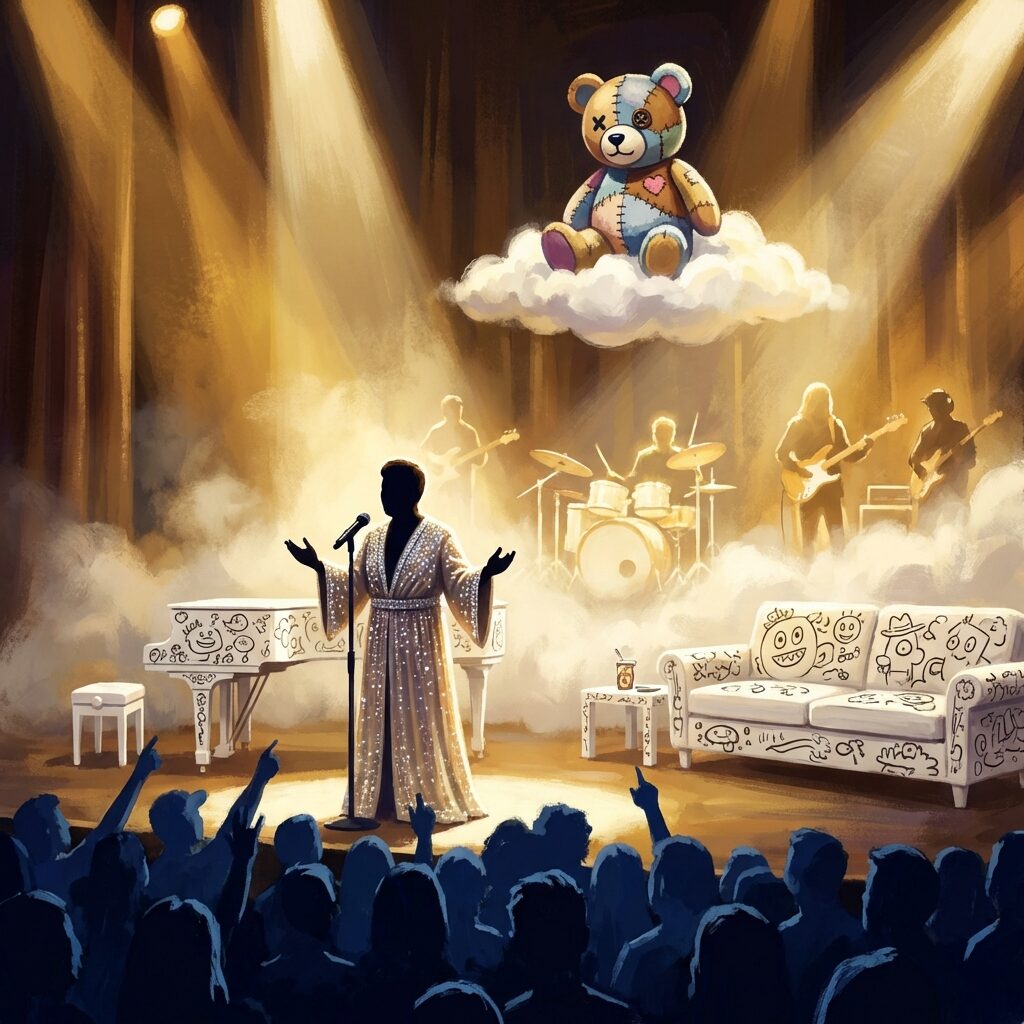
Then there’s the BRIT Awards, March 1, 2025, at The O2 in London. Let me just describe what was on that stage: white furniture covered in cartoon doodles. A leather-clad dancer with a lamb on her head. A life-size stuffed bear on a cloud above the band. Swims opened in a cloak and collar designed to look like a comforter and pillows for “Bad Dreams,” then emerged in a rhinestoned terrycloth robe for “The Door.” Then he sat at the piano and the stage caught fire during “Lose Control.” Pitchfork called it “surreal.” Swims posted afterward: “Literally set the bed on fire at the brits.”
It’s easy to call it absurdist and move on, but the aesthetic actually makes sense if you know his work. He writes songs about extreme emotional situations, abuse, grief, love, survival, and wraps them in arrangements that feel good to be inside. Emotional extremity dressed up in music you can move to. The BRIT Awards stage just made that visible. The bear on the cloud, the burning bed, the rhinestoned robe, that’s the internal logic of his songs turned into set design.
At Lollapalooza Argentina in 2025, Swims performed “The Door (Tiago PZK Version)” live with Tiago PZK, a Georgia soul singer and an Argentine urban artist sharing a stage the song had somehow earned in both languages.
And then there’s the outlier: a TikTok Swims posted of himself covering “The Door” in New Zealand with SessioNZ, informal, acoustic, no arena in sight. It got 212,900 likes. Sometimes the most telling performance is the one nobody planned. No stage fire, no stuffed bear. Just the song doing what it does in a room where the only production value is the voice.
What the Door Opened
A man talked openly about being abused by a woman, wrote a pop song about leaving, and 277 million YouTube views later, the conversation he started still isn’t finished.
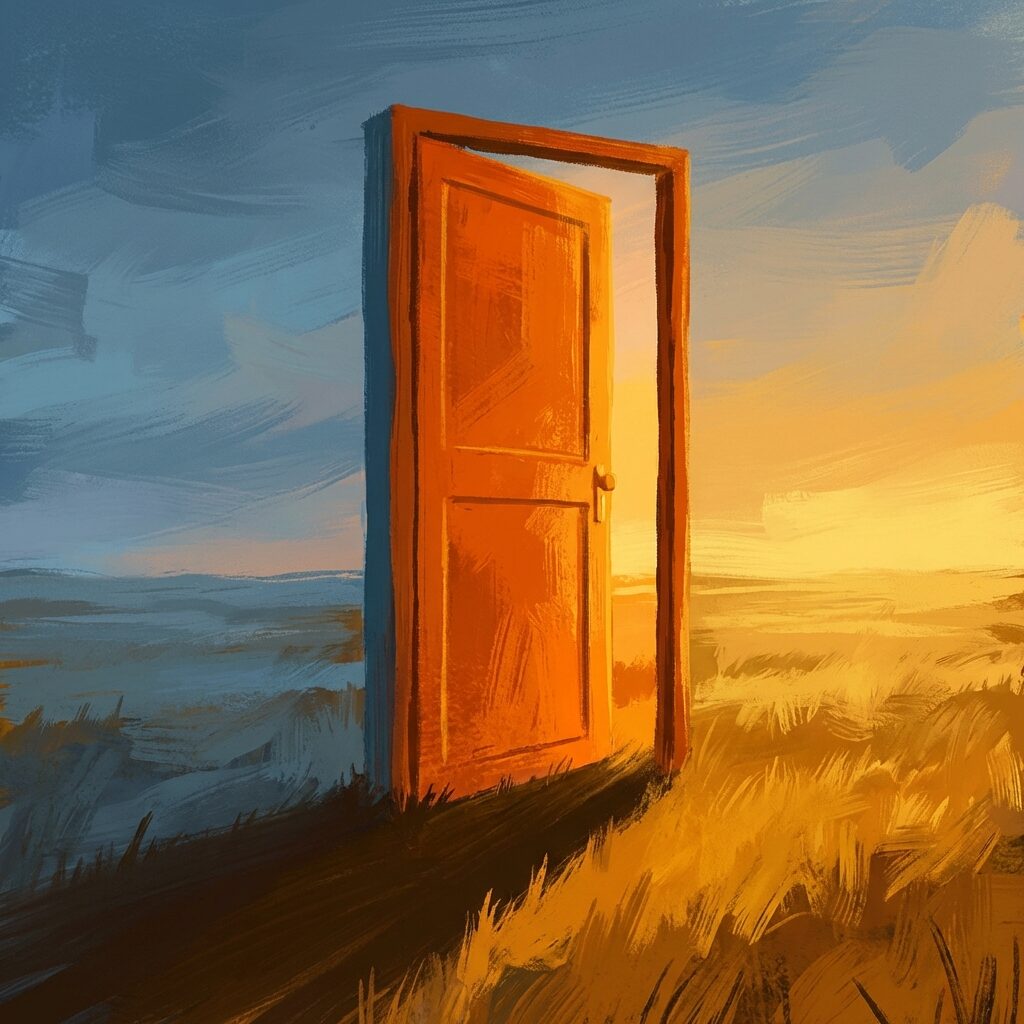
Let’s sit with the specific thing Teddy Swims did when he talked publicly about “The Door.” A man said, in interviews, on red carpets, in entertainment media contexts, that he had been abused by a woman. He said, directly, without hedging, “it goes both ways.” Then he wrote a pop song about it that 277 million people watched on YouTube.
Pop music has rarely known what to do with this narrative. The options have usually been: play it for laughs (the henpecked husband as comic trope), redirect it into aggression (the retaliatory anger anthem), or just not tell it at all. “The Door” doesn’t do any of those things. It positions the narrator not as someone still suffering, but as someone who got himself out. That’s the crucial thing. The song isn’t about being abused. It’s about the moment of deciding the abuse is over. And it sounds like what that decision should feel like, not defeated, not bitter, but genuinely free.
The Tiago PZK Version, released June 14, 2024, is its own chapter. Tiago PZK is an Argentine artist who works in trap, R&B, bachata, and cumbia, a long way, culturally and musically, from Conyers, Georgia gospel-inflected pop-soul. He added a Spanish-language verse. Broadway World called the collaboration one that “not only breaks down genre boundaries, but also unites cultures,” which is the kind of thing you say about a collab. What actually matters is that it works, the emotional core survives the genre shift and the language change. A song about a man from Georgia finding the nerve to leave an abusive relationship translates into Spanish-language urban pop without losing what made it specific. That’s not nothing. It says something about how common the underlying experience actually is.
Grammy nominations were announced in November 2024. Swims was in Spain for the Los40 Music Awards when it happened. He rented a hotel conference room to watch live. His last name starts with “S,” so he was announced last in the Best New Artist category, and for a moment, watching from that conference room, last name at the back of an alphabetical list, he thought he hadn’t made it. He had. He called his father first. His father’s reaction: “Look what you’ve done, baby. It’s amazing.” The song about saving his own life turned into a moment his father got to watch happen. I don’t have a music theory explanation for why that matters. It just does.
The album title always promised this: I’ve Tried Everything But Therapy. What “The Door” shows is that writing the song was the therapeutic act, that he found out what he felt by putting it into words. The Grammy nomination for Best Pop Vocal Album for Part 2 at the 2026 ceremony is evidence that whatever conversation he started with this album, nobody’s done with it yet.
One more data point on cultural reach: KIDZ BOP covered “The Door.” There’s also an 8-bit electronic version, and a jazz/blues version by Alexandra Ilieva. When KIDZ BOP covers your song about surviving an abusive relationship, you’ve achieved a kind of saturation that deserves a straight-faced acknowledgment even though the irony is thick enough to cut. The song is everywhere. The song won’t stop. Alex Tear called it.
The Door Was Already Open
The song works because it tells the truth about what surviving feels like from the other side, not tragedy, but relief, eventually, the kind that moves at 128 BPM.
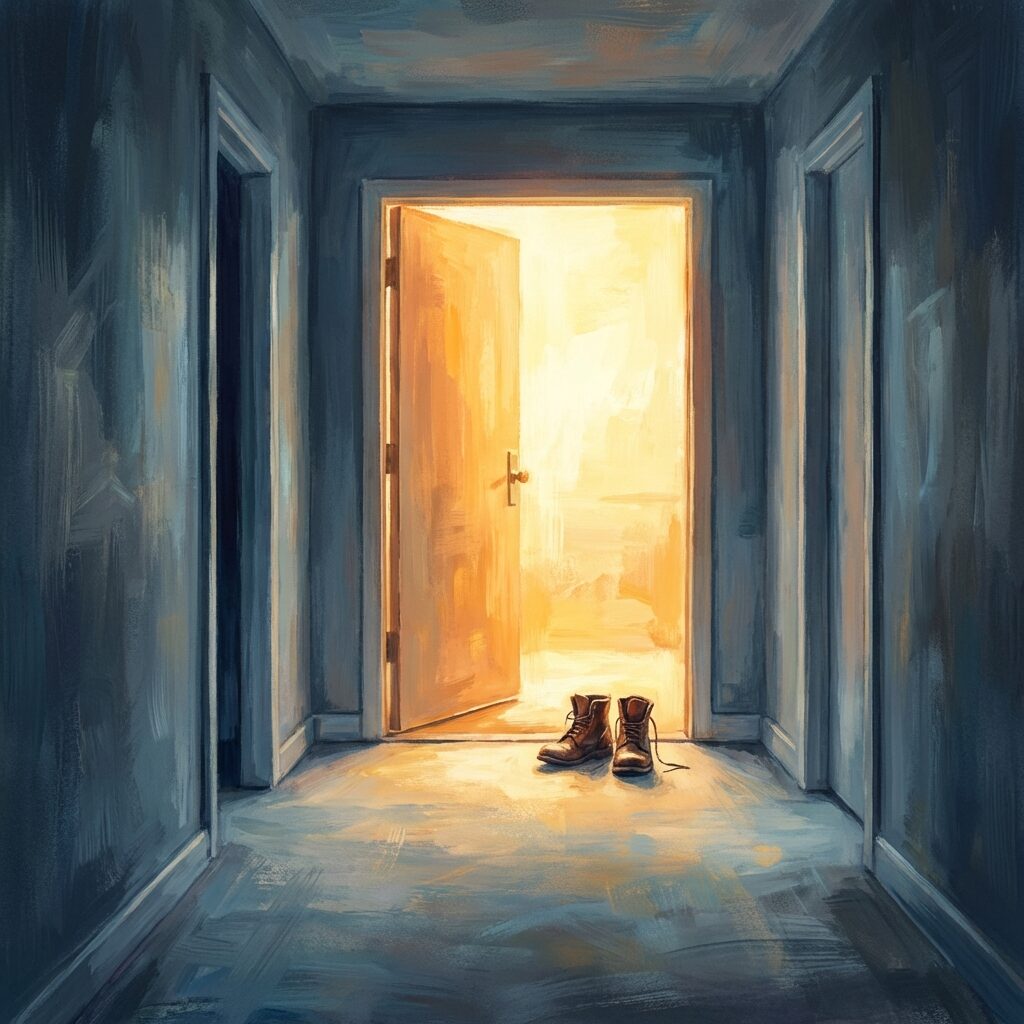
Here’s the answer to the question the song poses by existing: it doesn’t feel like a contradiction that a song about escaping abuse sounds like freedom. It feels like freedom because it is. “The Door” isn’t about the worst moment of the relationship. It’s not narrating the crisis from inside it. It’s narrating from after. From the moment you’re out. And from after, from the other side of a door you finally walked through, it really does feel like a chorus you can’t stop singing. The music isn’t in denial about the darkness. The 128 BPM and the gospel uplift are what the truth sounds like when you get to the other side of it.
By July 2024, Swims was publicly with singer Raiche Wright. He got her name tattooed on his index finger. She tattooed his real name, Jaten, on her wrist. “Bad Dreams” came from her ability to calm him down at night. The man who wrote I showed you the door found out what was on the other side of it, and what was on the other side was someone who tattooed his real name on her body because she wanted to carry it around with her. That’s not a tidy narrative arc I’m projecting onto the story. That’s just what happened.
The best line in “The Door”, the line that holds the whole song up, isn’t dressed as poetry. It doesn’t reach for a metaphor or an oblique image. It just says the thing: tonight, I saved my life when I showed you the door. That’s it. The whole song in one clause. A man who figured out he was in danger by writing it down, and then wrote the most direct version of what he needed to say.
Alex Tear was right that it haunts you. But it doesn’t haunt you because it’s sad. It haunts you because it’s true in a way pop music doesn’t usually bother to be, that self-preservation isn’t betrayal, that leaving isn’t failure, that the bravest thing you can do is show someone the door. And it says this at 128 BPM, over a G♯ minor chord progression, with gospel in the background vocals, with a chorus you’ll be singing in the shower for the next three weeks. The door the song is named for is also the door the listener walks through. That’s why it stays.
Did you know? Teddy Swims’ ‘The Door’ gets Shazammed most at 55 seconds — before the chorus even drops 🚪🎵 #TeddySwims #TheDoor #PopSoul https://bit.ly/4b5pcQC

Click to Tweet