Foster the People | Pumped Up Kicks
The Slap in the Face
“Pumped Up Kicks” is a first-person monologue from a kid plotting murder. It went Diamond, hit a billion streams, and most people were dancing to it before they caught a single word.
“It took people a while to let the lyrics get into their bones,” Mark Foster told Billboard in 2019, “and I think that once the lyrics got under their skin it was a bit of a slap in the face. And I think some people were embarrassed that they didn’t realize it in the beginning, that they had been dancing to it.”
Think about that. A song that hit Diamond certification, cracked a billion Spotify streams, and soundtracked everything from Entourage to Gossip Girl is a first-person monologue from a kid plotting murder. And most of the people who made it a hit had no idea what they were singing along to.
You know the song even if you think you don’t. That loping bass line, warm and round, pulling you forward. The whistled melody that burrows in and never leaves. The sun-drenched chorus where the vocals open up and everything feels easy. You’re bobbing your head, maybe humming along, and then the words actually register: All the other kids with the pumped-up kicks, you better run, better run, outrun my gun.
Wait. What?
“Pumped Up Kicks” has always lived in the space between what it sounds like and what it says. Mark Foster wrote it during a freestyle session in a jingle studio a block from the beach, and even he was surprised by what came out. Millions of people fell in love with the melody before they’d processed a single lyric. Then real-world violence started making the fiction feel less like fiction. A song about a would-be shooter became a song that would-be shooters actually claimed.
What follows is how that happened, and why nobody’s been able to put the thing to rest since.
Eight Years of Sleeping in His Car
Before Foster the People existed, Mark Foster spent nearly a decade delivering pizzas and sleeping in his car in LA. A jingle-writing gig finally gave him a real studio and the production skills to build a hit by himself.
Mark Foster’s path to “Pumped Up Kicks” doesn’t read like the origin story of a Diamond-certified single. Born in Milpitas, California in 1984, raised outside Cleveland, Ohio, he sang in the Cleveland Orchestra Children’s Chorus as a kid, which tells you the ear was always there, and picked up drums, guitar, and piano along the way. After graduating from Nordonia High School in Macedonia, Ohio in 2002, he did what a lot of young musicians do with more ambition than a plan: he moved to Los Angeles.
Specifically, he moved to Sylmar, a neighborhood in the San Fernando Valley that is not exactly the glamorous LA of the postcards. And then he went nowhere for a very long time.
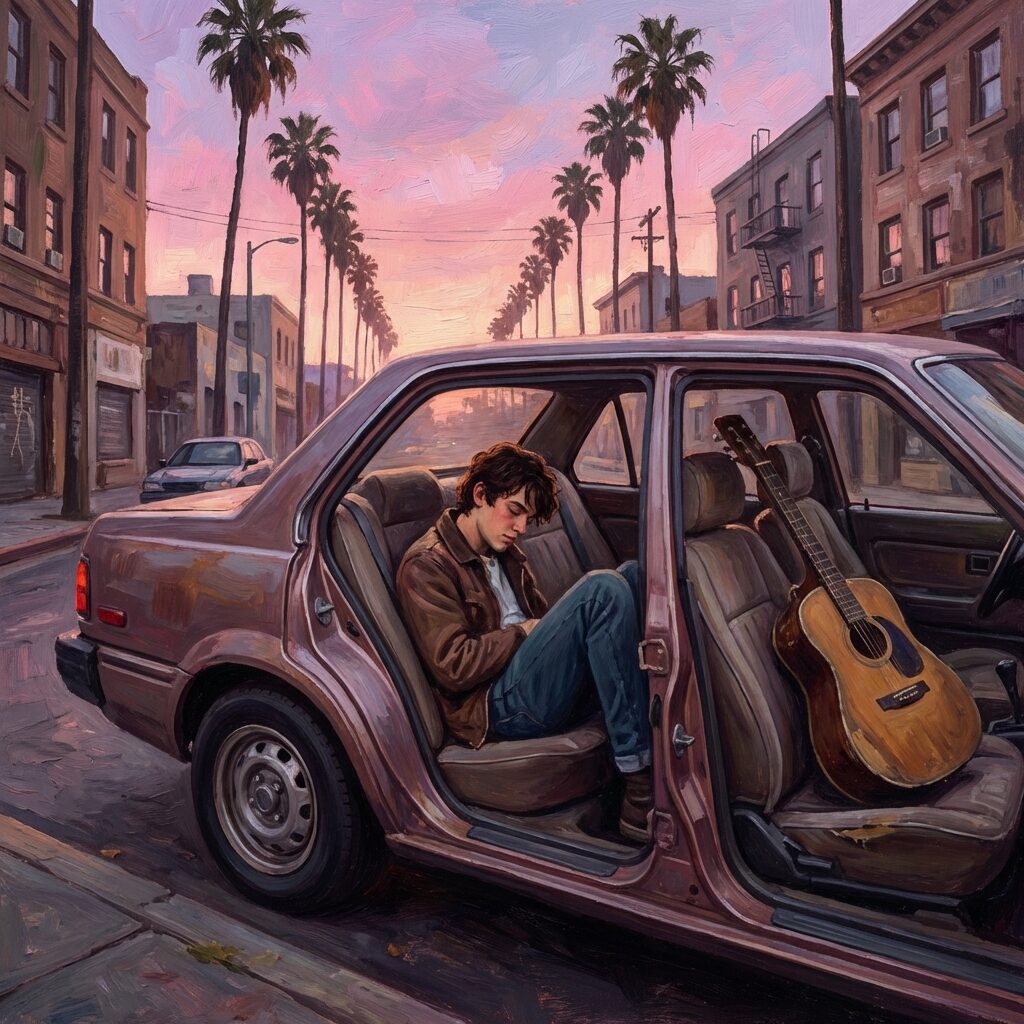
“For eight years, I just scraped by as a starving artist delivering pizzas, sleeping on couches, sleeping in my car.” Eight years. That’s not a brief rough patch before the big break. That’s a chunk of your twenties spent wondering if the whole thing was a mistake.
The break, when it finally came, wasn’t a record deal or a viral moment. It was a day job. In 2008, Foster landed a gig writing commercial jingles at Mophonics, a boutique music production house in LA. And before you picture him cranking out fifteen-second cat litter spots, Foster was quick to clarify the distinction: “a boutique agency that did pretty artistic scores for things. It wasn’t cat litter commercial jingles.” The clients were brands like Honey Bunches of Oats and Verizon. Not glamorous, but not hack work either. More to the point, it gave him studio access and forced him to develop the production chops he’d been missing.
In 2009, Foster pulled together a proper band. Mark Pontius came on as drummer, Cubbie Fink on bass, and they called themselves Foster the People. But here’s what makes the timeline a little ridiculous: the band barely existed as a functioning unit when their biggest song was already done. Foster had written and recorded “Pumped Up Kicks” at the Mophonics studio, playing every instrument himself. Pontius and Fink weren’t on the track. The band was a name on paper and a couple of rehearsals when the song that would define their career was already in the can.
So the picture at this point is a guy in his mid-twenties who’s spent the better part of a decade failing in LA, who finally has access to a real studio and has quietly gotten very good at building songs alone in Logic Pro, who has a brand-new band with no audience and no reputation, and who, on one particular day, forced himself to stay inside and work instead of going to the beach.
A Block from the Beach
On a day when he wasn’t feeling it, Foster forced himself to stay in the studio, chased the drum feel from Fleetwood Mac’s “Dreams,” freestyled a verse that took the song somewhere he hadn’t planned, and accidentally cut the final version of a Diamond-certified single.
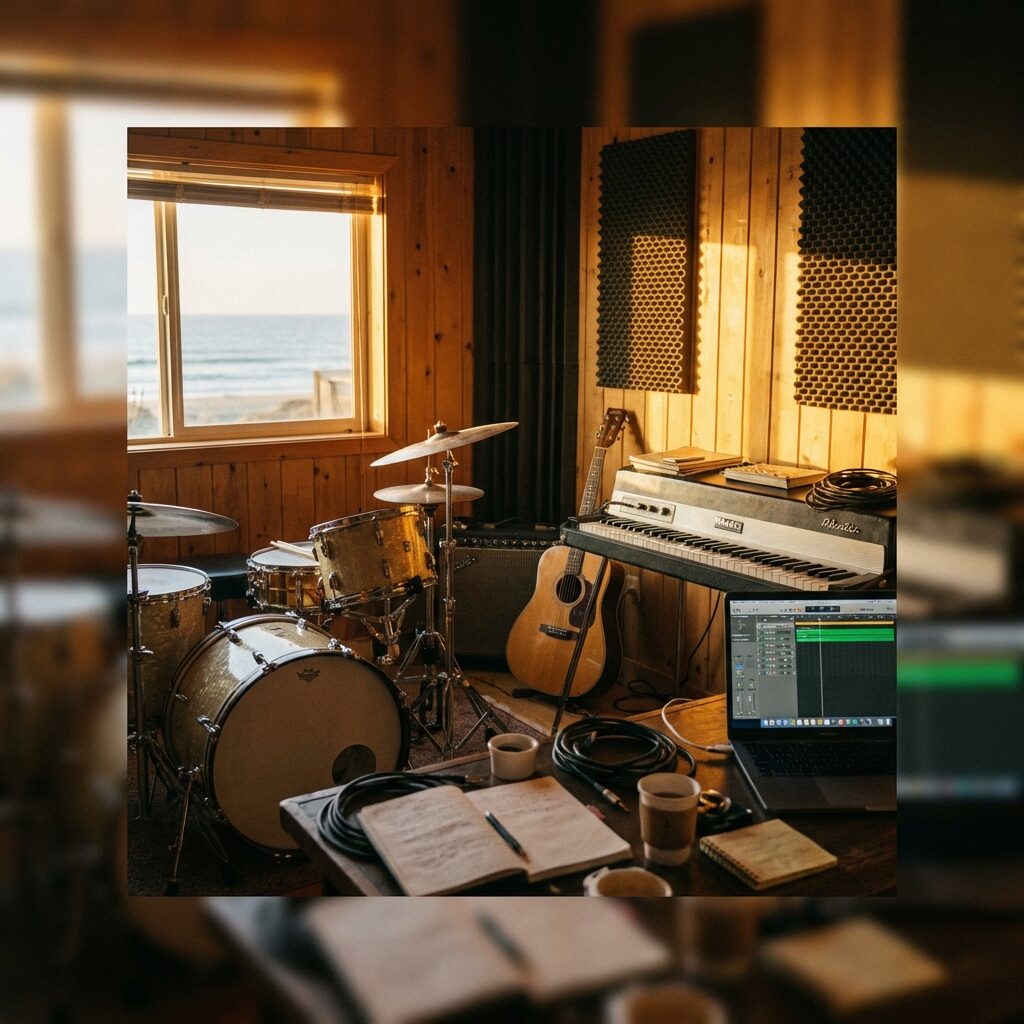
The Mophonics studio was a block from the beach. It was a beautiful LA day. Foster was not feeling it.
This matters because songwriting mythology tends to favor lightning bolts, the melody that arrives fully formed in a dream, the lyric that just pours out. And sometimes that really does happen. But “Pumped Up Kicks” didn’t come from a flash of anything. Foster later told The Columbian: “I wasn’t inspired when I wrote ‘Pumped Up Kicks,’ and that’s what came out. So it just solidified the notion that persistence is more powerful than inspiration.”
He made himself stay in the studio and start building.
The drums came first. Foster was chasing the beat from Fleetwood Mac’s “Dreams”, that particular groove where the kick and snare create a loping, almost lazy momentum that still pushes you forward. Go back and listen to both songs side by side. You can hear the family resemblance. It’s not a copy. It’s more like a shared opinion about how a song should breathe.
Then came the harmonies. Foster had late-’60s and early-’70s vocal sounds in his head, the Mamas and the Papas, Phil Spector’s Wall of Sound productions. Those layered, slightly washed-out group vocals that make everything sound like it’s drifting in from another room. He stacked his own voice into those arrangements, building the chorus with its wide-open, welcoming feel.
Guitar came last. For the bridge, he was reaching toward Jimi Hendrix territory, “casual riffing with hammer-ons and blues influence, Americana style,” as he described it. Not Hendrix-level pyrotechnics, but that same looseness, a guitarist who sounds like he’s just hanging out inside the pocket of the groove.
Foster wrote the chorus first, and at that stage, it was basically a confidence anthem. “Outrun my gun” was metaphorical, swagger, a boast. The gun wasn’t a gun yet.
Then he started freestyling the verse.
What came out was a narrative about a kid named Robert, finding a six-shooter in his dad’s closet, with a box of fun things and a long plan forming in his head. The metaphorical gun from the chorus suddenly became very literal. The song had surprised its own writer. “Everything happened really quickly, I didn’t overthink anything,” he told Billboard. That first verse essentially wrote itself, dragging the song from cocky indie-pop into something much darker without Foster consciously deciding to go there.
When he stepped back and looked at what he had, he made a deliberate choice. He could have softened it, dialed back the violence, kept the gun as metaphor. Instead he leaned in. He compared his approach to Truman Capote’s In Cold Blood, getting inside the mind of the killer rather than writing from the victim’s perspective. That second option, he felt, would have been “a cop out.” He’d been reading about a surge in teenage mental illness and youth violence at the time, and a shooting that week had disturbed him. He wanted to understand the psychology, not just mourn the aftermath.
“I was trying to get inside the head of an isolated, psychotic kid,” he told Rolling Stone. “It’s a f–k you song to hipsters, in a way, but it’s a song the hipsters are going to want to dance to.”
Two sentences, and that’s the whole song explained.
Now, the recording timeline. It varies depending on which interview you read. Wikipedia and Reddit say five hours. Neon Music says about eight. Foster’s own most detailed account, in American Songwriter in 2021, describes two sessions: “On the first day, I started it and put in around six hours, then I came back, wrote the second verse, polished it up and it was done.” An Apple profile says a day and a half. The discrepancies probably just reflect different ways of counting. The point everyone agrees on: it was fast.
And the demo became the final. Foster played every instrument, vocals, guitar, bass, keyboards, synthesizers, drums, percussion, programming. He did the mixing. He used Logic Pro to arrange and edit. He thought nobody would ever hear it. The recording that went Diamond, that cracked a billion streams, was a one-man demo made by a jingle writer who’d decided not to go to the beach.
Why You Can’t Stop Humming It
Four chords that never change, production that buries the lyrics under filters and reverb, and a structure twice the length of standard pop, here’s how the music pulls off the misdirection.

Here’s the thing about “Pumped Up Kicks” as a piece of music: the production isn’t just catchy. It’s actively working against the lyrics. Everything the arrangement does, the warmth, the groove, the vocal treatment, functions as camouflage for what’s being said. And it works almost too well.
Four chords, no escape
The chord progression is Fm – A♭ – E♭ – B♭. That’s the whole song. Verse, chorus, bridge, same four chords, same order, looping from the first bar to the last. No key change, no bridge detour, no dramatic shift to a relative minor. Four chords, over and over, for four minutes.
This kind of harmonic stasis is a deliberate choice. When the chords never change, your ear stops tracking them and starts floating. The progression becomes a groove instead of a journey. Your brain doesn’t need to follow where the harmony is going, so it locks into the rhythm, the melody, the production textures, everything except, apparently, the lyrics.
There’s an ongoing theoretical argument about what key this song is actually in. Analyze it in E♭ major and you get ii – IV – I – V, which is unusual but plants E♭ as home. But the song starts on Fm and the verse melody centers on B♭, which pulls your ear toward F as the tonal center. Hooktheory’s analysis hedges, tagging some sections as F Dorian and others as E♭ major. The giveaway: every D in the song is D-natural, never D-flat. That D-natural is what makes it F Dorian rather than F Aeolian (natural minor), and it adds a brightness to what could have been a straightforwardly minor-key song. One more way the music stays warmer than the words have any right to be.
The vocal filter trick
This is where the real sleight of hand happens. In the verses, where all the narrative content lives, where Robert finds the gun, where the plan takes shape, Foster’s vocals are run through a bandpass filter that makes them sound like they’re coming through a telephone or an old radio. There’s distortion, a short-repeat delay around 100 milliseconds, and the frequency range is squeezed so you lose the highs and lows. The effect is dreamy, distant, slightly underwater. You hear the melody fine. You feel the rhythm of the words. But the actual content? It’s obscured just enough that your brain registers “pleasant singing” without necessarily processing “he found a six-shooter gun in his dad’s closet.”
Then the chorus hits, and the production opens up completely. The vocal filter drops away. The reverb expands into a big, hall-like space. The vocals are likely doubled, sung twice and layered, giving them that wide, enveloping quality. Everything gets brighter, cleaner, more present. It’s a rush of openness after the compressed verse, and it feels euphoric. By this point, the fact that you’re clearly hearing “you better run, better run, outrun my gun” almost doesn’t register as a threat, because the musical payoff is so strong that the words just become part of the hook.
The verses hide the story. The chorus makes the payoff feel like a party. I keep coming back to how well this works, most listeners go years without catching what the verses actually say, and that’s not an accident. It’s the production doing exactly what it was designed to do.
The bass nobody can agree on
That bass line, the loping, round, slightly rubbery low end that basically is the song’s identity, has sparked its own small debate. Most sources call it synth bass. The Los Angeles Times described it as a “loping synth bass” in their review. But forum threads on TalkBass have floated the idea that it might be a Guitarrón sample, a Mexican acoustic bass guitar with a very particular woody attack. Producer and engineer Bobby Owsinski singled out the bass-guitar doubling as “one of the cooler aspects of the song,” noting how the electric guitar doubles the bass line to add definition and cut. Both could be true: a synth bass or Guitarrón sample providing the low-end warmth, with a guitar doubling for articulation. It’s the kind of bass line that non-musicians notice and musicians can’t stop arguing about.
Too much of a good thing
The song’s structure is weird for pop. The intro runs a full 38 seconds before any vocals appear, an eternity in a format where most tracks are trying to hook you within fifteen. Each section runs roughly twice the length of standard pop sections. And the chorus shows up eight times total, including four consecutive choruses at the end. The form reads: Intro – Verse – Chorus – Verse – Chorus – Bridge – Chorus – Chorus – Chorus. That is a lot of “better run, better run.”
Foster has acknowledged this with the benefit of hindsight: “If I had known that the song was going to be played everywhere, I would have taken those damn choruses out of the song and made it move faster.” Fair enough, the last minute does drag a bit. But that 38-second intro, letting the bass line and groove settle in before anyone sings a word, was the right call. It sets the mood without asking anything of you. You’re already locked in before the story starts.
The whistle and the drop
The whistling bridge around 2:48 is the song’s other signature moment. Clean electric guitar enters with chordal playing while the melody gets whistled, a group whistle that sounds communal and carefree, like walking down a street on a warm afternoon. More sonic warmth layered onto a song about a kid planning to shoot his classmates. The contrast just keeps piling up.
What happens after the bridge is subtle but worth noticing. The chorus returns with only doubled guitar, no bass, no drums. It’s a stripped-down beat of tension before the full arrangement crashes back in for the final run. That brief absence of low end and rhythm creates a small vacuum that makes the return feel bigger than it actually is. Simple trick, well-executed.
And then there’s the Easter egg. On the instrumental version of the track, at the 1:02 mark, right before the chorus enters, you can hear a brief, distorted voice saying “This is where you die.” It’s buried so deep you’d never catch it in the vocal version, and it may not have been part of any conscious plan. But it’s there. Even the instrumental has a dark secret hiding underneath.
Robert’s Quick Hand
The lyrics build a portrait of class resentment, parental neglect, and a kid failed by every adult around him. The public filled in the blanks about a school shooting that the song never actually mentions.
Robert’s got a quick hand
He’ll look around the room, he won’t tell you his plan
He’s got a rolled cigarette
Hanging out his mouth, he’s a cowboy kid
Yeah, he found a six-shooter gun
In his dad’s closet with a box of fun things
I don’t even know what
But he’s coming for you, yeah, he’s coming for you, wait[Chorus]
All the other kids with the pumped-up kicks
You better run, better run, outrun my gun
All the other kids with the pumped-up kicks
You better run, better run faster than my bullet
All the other kids with the pumped-up kicks
You better run, better run, outrun my gun
All the other kids with the pumped-up kicks
You better run, better run faster than my bullet[Verse 2]
Daddy works a long day
He be coming home late, and he’s coming home late
And he’s bringing me a surprise
‘Cause dinner’s in the kitchen, and it’s packed in ice
I’ve waited for a long time
Yeah, the sleight of my hand is now a quick-pull trigger
I reason with my cigarette
And say, “Your hair’s on fire, you must’ve lost your wits,” yeah
[Chorus]
All the other kids with the pumped-up kicks
You better run, better run, outrun my gun
All the other kids with the pumped-up kicks
You better run, better run faster than my bullet
All the other kids with the pumped-up kicks
You better run, better run, outrun my gun
All the other kids with the pumped-up kicks
You better run, better run faster than my bullet
[Bridge]
Run, run, run, run
Ru-ru-ru-run, run, run
Ru-ru-ru-ru-run, run, run, run
Ru-ru-ru-run
Run, run, ru-run, run
[Chorus]
All the other kids with the pumped-up kicks
You better run, better run, outrun my gun
All the other kids with the pumped-up kicks
You better run, better run faster than my bullet
All the other kids with the pumped-up kicks
You better run, better run, outrun my gun
All the other kids with the pumped-up kicks
You better run, better run faster than my bullet
All the other kids with the pumped-up kicks
You better run, better run, outrun my gun
All the other kids with the pumped-up kicks
You better run, better run faster than my bullet
The lyrics are doing more work than the filtered vocals let on. Worth slowing down on them.
“Robert’s got a quick hand / He’ll look around the room, he won’t tell you his plan.” We’re immediately watching someone calculate. Not rage, not break down, calculate. The opening line puts Robert past the emotional crisis. He’s already planning. That’s colder than anger.
The “pumped up kicks” are Reebok Pumps, basketball shoes from the late ’80s and early ’90s with an inflatable air bladder on the tongue. If you’re under thirty, you probably don’t know the reference, but in 1991, Boston Celtics rookie Dee Brown won the Slam Dunk contest wearing Reebok Pumps and literally inflated them on court before his winning dunk. Reebok turned it into a massive ad campaign. The shoes were expensive, flashy, aspirational. If you had Pumped Up Kicks and you didn’t pick Air Jordans, you came from money. Robert’s targeting the kids who can afford the shoes he can’t. Class resentment, aimed at the visible markers of privilege.
The second verse is where the domestic picture comes into focus. “Daddy works a long day / He be coming home late.” And then: “Dinner’s in the kitchen, and it’s packed in ice.” That line says so much with so little. An absent father. A kid eating alone. The “packed in ice” detail, whether it’s a frozen dinner or something grimmer, describes a household where nobody’s paying attention. Robert isn’t just isolated at school. He’s invisible at home. Every adult who should be noticing the warning signs has checked out.
About the name Robert. A lot of listeners connected it to Robert Hawkins, who carried out the 2007 Westroads Mall shooting in Omaha, Nebraska. The band’s publicist denied it outright: “This is completely false. The character name in the song is just a coincidence.” There’s also a factual problem with the theory, the song describes a “six-shooter gun,” a revolver, while Hawkins used a semi-automatic AKM rifle with 30-round magazines. If Foster were referencing a specific shooter, he’d probably get the weapon right. The six-shooter and “cowboy kid” imagery feel more like Western mythology, frontier violence as American archetype, than a nod to any particular incident.
Foster made this distinction himself in a 2019 Billboard interview: “I think people kind of filled in the blanks that it was about a school shooting, but I never say anything about a school in the song. It’s really more about this person’s psyche.” He’s right. There’s no school in the lyrics. No classroom, no hallway, no campus. The public projected their own fears onto the song’s blank spaces, and the song was built in a way that made those projections easy, maybe inevitable.
And then there’s the thing your brain does with the mismatch. Research on music perception shows that when upbeat, pleasant music sits underneath dark or disturbing lyrics, songs get “stickier.” They grab more attention and lodge more firmly in memory. Your brain registers the contradiction before your conscious mind catches up. “Pumped Up Kicks” might be the clearest example of this I can think of. The music says everything is fine. The words say someone is going to die. That tension, even when you haven’t consciously processed the lyrics, is a big part of why the song gets stuck in your head and won’t leave.
From Free Download to Columbia
A free download on the band’s website caught fire across music blogs and Hype Machine, sparked a label bidding war, and landed them on Columbia, at which point their manager told them to stop everything and make an album good enough to prove they weren’t a fluke.
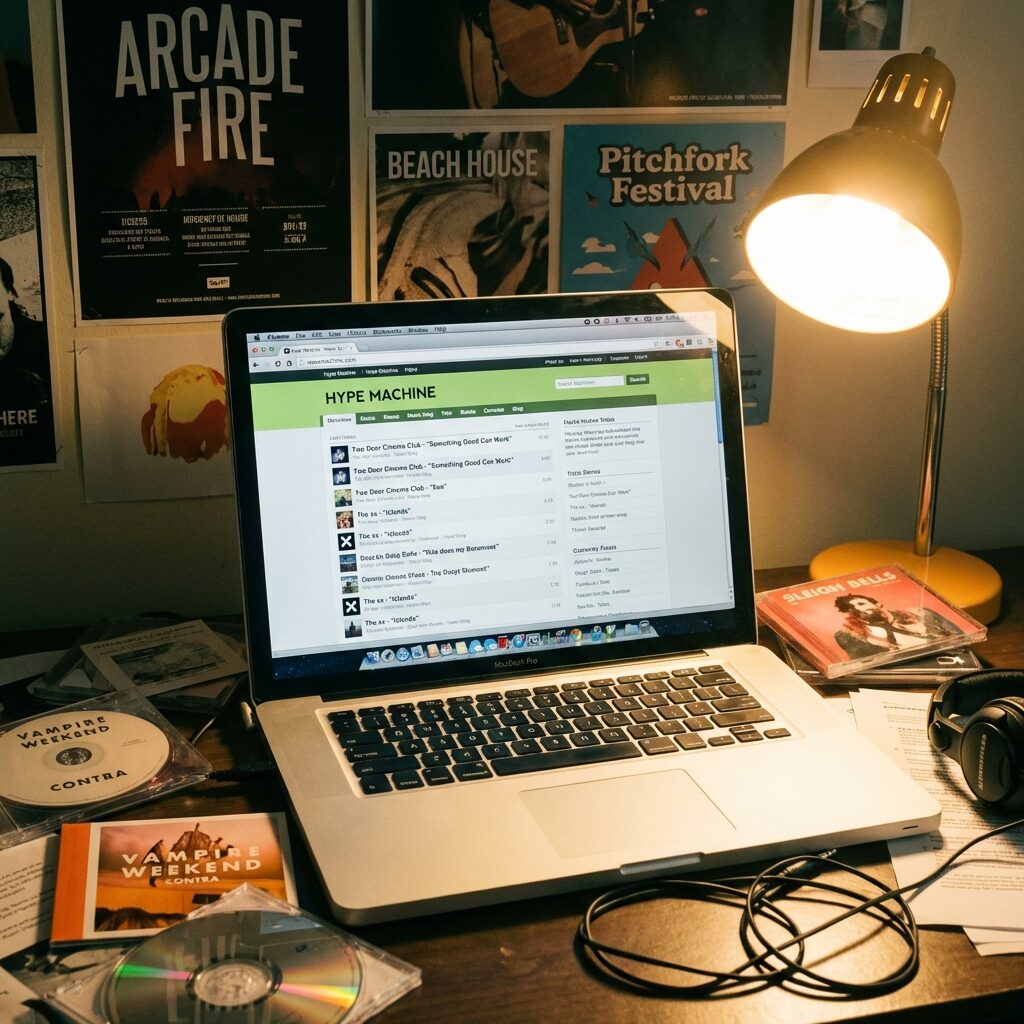
The band barely existed, and they had one completed song. So they did the most 2010 thing possible: they posted it on their website as a free download.
This was early 2010, when the music blog ecosystem was still how most people found indie music. Nylon magazine used the track in an online advertising campaign, which gave it an initial push. From there, it spread through the blog circuit and climbed Hype Machine, the aggregator that tracked which songs indie blogs were posting about most frequently. In the blog era, a good Hype Machine chart position could matter more than actual radio play.
The song’s first live performance was at a Stand Up Charity Benefit in Venice in February 2010. By March, the viral success had gotten them booked at SXSW. Foster, remember, this was a guy who’d been delivering pizzas and sleeping in his car for eight years, was not remotely prepared for any of it.
He called artist manager Brent Kredel at Monotone, Inc. in March 2010: “Everyone is calling me and emailing me, what do I do? Who are the good guys, who are the bad guys?” Kredel later described the whiplash: “He went from the guy who couldn’t get a hold of anyone to being the guy who had hundreds of emails in his inbox.”
Kredel and co-manager Brett Williams arranged meetings with Warner Bros., Atlantic, Columbia, and Universal Republic. By May 2010, Foster the People had signed a multi-album deal with Startime International, a Columbia Records imprint. Foster also struck a separate publishing deal with Sony/ATV for territories outside North America while keeping control of his North American publishing, a sharp bit of business for a guy who’d spent eight years broke.
Then came the counterintuitive part. With a viral hit and a major-label deal, you’d expect them to rush a release, book a tour, keep the thing rolling. Kredel went the other direction: “The focus was to stop everything and not work on any marketing or touring, but to make an album that backed up ‘Pumped Up Kicks.'” They needed an album that could prove the band wasn’t a one-song accident. So they slowed down.
Meanwhile, the song kept building on its own. In July 2010, it was licensed for an episode of Entourage, the first media placement. That same month, Sirius XM’s Alt Nation channel started spinning it, three full months before it began climbing rock radio charts. Foster credited them specifically: “Alt Nation played our music before any other radio outlet in the country.” By January 2011, alternative radio stations KROQ-FM and KYSR had picked it up.
The band, still green as a live act, started playing club shows in October 2010. Booking agent Tom Windish secured dates specifically “to help them get their sea legs.” By January 2011, they’d booked a month-long residency at The Echo nightclub in Los Angeles, promoted by emailing everyone who’d downloaded the song. By the third show, Windish recalled, “there were hundreds of people trying to get outside.” The song was eight months old, hadn’t been officially released as a traditional single, and was already too big for the room.
Stuck Behind Adele and Maroon 5
“Pumped Up Kicks” spent eight straight weeks parked at #3 on the Hot 100, boxed out almost every week by Maroon 5’s “Moves Like Jagger” and Adele’s “Someone Like You,” before going on to Diamond certification and a billion Spotify streams.
Here’s where the numbers start getting ridiculous.
“Pumped Up Kicks” debuted on the Billboard Hot 100 at #96 in May 2011 and climbed steadily to #3 by September. Then it got stuck. For eight consecutive weeks, September 10 through October 29, 2011, the song sat at #3 on the biggest chart in American music, unable to break through.
What was blocking it? For seven of those eight weeks, the two songs ahead were Maroon 5’s “Moves Like Jagger” and Adele’s “Someone Like You.” That’s a brutal pair to draw. “Moves Like Jagger” had Christina Aguilera on the hook and a chorus that burrowed into your skull whether you wanted it there or not. “Someone Like You” was Adele being Adele, the kind of vocal that made grown adults cry in traffic on the way to work. Meanwhile, “Pumped Up Kicks” was an indie-pop song about a troubled kid with a gun. It was never going to out-sad Adele or out-party Maroon 5. But it held that #3 spot for two full months, which says something about how big the song had gotten.
The chart stats back that up. It was the first Alternative Songs #1 to crack the US top 5 since Kings of Leon’s “Use Somebody” in 2009. It became the first song ever to top both the Alternative Songs chart and the Dance Airplay chart at the same time, an alt-rock track that DJs were spinning in clubs. In 2011 alone, it moved 3.84 million digital copies, making it the sixth best-selling digital song of the year in the US.
It hit #1 in Australia, charted in 39 countries, and spent 40 total weeks on the Hot 100. Torches, the debut album that Kredel’s strategy had been designed to make worthy of the single, debuted at #8 on the Billboard 200 on the strength of, let’s be honest, one song, selling 33,000 copies in its first week.
And it kept going. By August 2013, US sales had passed 5.17 million copies. In October 2020, the RIAA certified it Diamond at 14× Platinum. It crossed a billion streams on Spotify, making it the platform’s most-streamed song from 2011. The music video eventually joined YouTube’s Billion Views Club. For a demo written by a jingle composer who figured nobody would hear it, those are hard numbers to wrap your head around.
When the Song Became the Thing It Described
From MTV censoring the chorus to Sandy Hook radio pulls to real shooters referencing the track in their journals, “Pumped Up Kicks” kept colliding with the violence it described. Foster nearly retired it for good, but the song had stopped belonging to him.
The first sign that the song’s content would become a problem came from MTV, which censored the words “gun” and “bullet” from the chorus, dropping the audio every time Foster sang them. For a song that works because of the tension between sunny music and dark lyrics, having a network selectively mute the dark parts was almost too on the nose.
Foster was furious. He told Rolling Stone: “I think MTV is scared of an alternative band that has a sound like this. I think the sound is deceiving. You’ve got reality shows which are all about teenagers getting pregnant and you’ve got Jersey Shore, where a girl gets punched in the face and they show the clip over and over… domestic violence is fine but talking about family values and teen isolation and bullying is not.” He had a point. The network wasn’t really worried about violence, their programming was full of it. What bothered them was the specific kind of violence the song described, and what it would look like to keep airing it.
Then came Sandy Hook.
On December 14, 2012, twenty children and six staff members were killed at Sandy Hook Elementary School in Newtown, Connecticut. In the aftermath, radio stations pulled “Pumped Up Kicks” from rotation. KIIS-FM in Los Angeles dropped it explicitly. Columbia Records received complaints claiming the song glorified school shootings. Ke$ha’s “Die Young” was pulled at the same time.
Foster supported the decision. “I respect people’s decision to press pause,” he said. “And if that becomes a catalyst for a bigger conversation that could lead to positive change moving forward, then I absolutely support it.” A careful, decent thing to say from someone watching his biggest song get tangled up with the worst news in the country.
But the song’s connection to real violence was just getting started.
Nikolas Cruz, who carried out the shooting at Marjory Stoneman Douglas High School in Parkland, Florida in 2018, referenced the song in his journals and told a journalist: “Listen to Pumped Up Kicks.” A shooting in Brazil involved a perpetrator who made the song their anthem. Adam Lanza, the Sandy Hook shooter, reportedly had an obsession with Robert Hawkins, the same Robert Hawkins that fans had speculated was the inspiration for the song’s character, a connection the band had explicitly denied.
The song Foster wrote about a fictional troubled kid was being cited by real troubled kids as a reference point, a soundtrack, something they saw themselves in. What he’d imagined and what was actually happening were bleeding into each other, and he was watching it in real time.
Live shows got complicated fast. After the 2017 Route 91 Harvest festival shooting in Las Vegas, where 60 people were killed at a country music concert, the song fell off the tour setlist. At the Life Is Beautiful festival in Las Vegas, near the anniversary of the shooting, the band decided not to play it for a crowd of 50,000 to 60,000 people. They closed with “Hey Jude” instead, featuring Cirque du Soleil performers. It was the right call, and they handled it well.
Then the band walked offstage, and a large section of the crowd started chanting “Pumped Up Kicks.”
Sit with that for a second. The band chose, out of real sensitivity, not to play a song about gun violence near the site of a mass shooting, and the audience demanded it anyway. The song had stopped belonging to them. Foster could decide what he wanted to do with it, but he couldn’t decide what it meant to everyone else.
At ACL Festival in 2017, the band skipped it during Weekend 1 but gave in for Weekend 2, with Foster delivering a speech about unity and covering John Lennon’s “Love” as a kind of buffer.
By December 2019, Foster was considering walking away from it entirely. “I’ve been very seriously thinking of retiring the song forever,” he told Billboard. “Shootings have continued to happen, and I feel like there are so many people that have been touched, either personally or by proxy, by a mass shooting in this country, and that song has become almost a trigger of something painful they might have experienced. And that’s not why I make music.”
He added: “I can’t ask other people not to play it live, but the public made the song what it is, and if the song has become another symbol for something, I can’t control that. But I can control my involvement in it.”
There’s one more detail that rarely comes up. Cubbie Fink, the band’s bassist, had a cousin who survived the Columbine shooting. The cousin was in the library when it happened. For at least one member of the band, the weight of playing a song about a school shooter, even if the song technically never mentions a school, was never hypothetical.
As of the mid-2020s, the song hasn’t been permanently retired. It still shows up in the live set, usually late in the show or as an encore. Foster found a way to keep playing it. But the question of what the song is, and what it does, never really went away.
The Meme, the Covers, the Legacy
From 4chan dark humor to Kendrick Lamar remixes to HBO soundtracks, the song became the sonic marker for an entire era. Its contradictions, the gap between the sunny hook and the violence underneath, turned out to be the reason it stuck around.
By the mid-2010s, “Pumped Up Kicks” had entered the strange second life that only truly ubiquitous songs achieve: it became a meme.
The specific format started on 4chan’s /wsg/ board in June 2016, when users began pairing the song with a clip from Everybody Hates Chris (Season 4, Episode 2, if you’re keeping track). YouTuber Melody Nabro compiled the clips, and by early 2018 the format had peaked. The memes went straight for the darkest possible reading of the song, which is 4chan’s whole thing, but they were also doing something real: when a song about gun violence has been played at your prom, your graduation, and your office holiday party, sometimes the only honest response is to make it into a joke. You laugh because the alternative is sitting with how weird it is that nobody stopped pressing play.
The covers and remixes are where you really see how far the song traveled. Kendrick Lamar did a remix with DJ Reflex that pulled the song into hip-hop circles. Weezer covered it during their 2011 live shows. Steel Panther’s Michael Starr (Ralph Saenz) recorded a cover for HBO Max’s Peacemaker soundtrack, a show built entirely on the tension between violence and pop music, so the song fit without anyone having to force it. Gus Dapperton contributed a cover for the Torches X deluxe edition in 2021. Even Tongo, the Peruvian musician, did a parody titled “Pan con ají” in 2018. When a song gets big enough, it stops belonging to its original context and just becomes material.
The licensing list reads like a survey of early-2010s American media: Entourage, Gossip Girl, Homeland, Pretty Little Liars, The Vampire Diaries, Suits, American Horror Story, CSI: NY, and films like Friends with Benefits and Fright Night. Half of Torches‘ songs got licensed for media use, but “Pumped Up Kicks” was the one music supervisors kept reaching for. It became the sonic marker for a specific moment, that narrow window when indie-leaning pop actually crossed over into genuine mainstream territory.
That crossover is worth pausing on. “Pumped Up Kicks” didn’t happen in isolation. It arrived alongside fun.’s “We Are Young” and Gotye’s “Somebody That I Used To Know,” and those three songs, all made by artists with indie credentials who’d been grinding for years, proved something the industry hadn’t believed: indie-leaning pop could compete commercially with straight-ahead pop and hip-hop. They opened a door that acts like Imagine Dragons, twenty one pilots, and WALK THE MOON would walk through over the next several years. Whether that was good for music depends entirely on what you like listening to. But the commercial impact was real. “Pumped Up Kicks” was one of the songs that convinced record labels indie-flavored production could sell at scale.
The uncomfortable part of the legacy is that you can’t separate the contradictions from the staying power. If it were just a catchy pop song, it would have faded. If it were just a protest song about gun violence, it would have been respected and forgotten. It’s both, and that’s the thing. It makes you feel good while describing something horrifying. It got co-opted by the very violence it depicted. Its creator nearly killed it and couldn’t. The cognitive dissonance isn’t a bug. It’s the entire engine.
Three Minutes That Stopped the Room
An uninspired day in a jingle studio produced a Diamond-certified song that half the world danced to and the other half wanted banned, and its creator is still sitting with both of those truths at once.
Here’s what stays with me about “Pumped Up Kicks.”
A guy who’d spent eight years delivering pizzas and sleeping in his car forced himself to stay in a jingle studio on a day when he wasn’t feeling it. He wasn’t chasing a hit. He wasn’t trying to say something important. He was just being stubborn about showing up. And what came out, in somewhere between five hours and two sessions, depending on which interview you trust, was a song that went Diamond, crossed a billion streams, charted in 39 countries, got censored by MTV, got pulled from radio after Sandy Hook, got cited in a killer’s journal, got chanted by 60,000 people who were told they couldn’t hear it, and nearly got retired by its own creator.
Foster put it better than I can: “I’m proud that a three-minute song created so much conversation about something that’s worth talking about, and I think that every artist dreams of making something that holds its value, and that I really feel like I made the earth pause for a second and bend down to hear what I was saying.”
But he also said this: “A three-minute song can make somebody more uncomfortable than a two-hour movie.”
He means both of those. They sit side by side and neither one wins. Foster is proud of the conversation and haunted by what followed. He wrote a song about the distance between surface and substance, and then the song itself lived out that same tension, how it sounds versus what it means, what he intended versus what people heard, fiction versus the reality that kept showing up uninvited.
An uninspired Tuesday produced a Diamond-certified song that half the country wanted banned and the other half couldn’t stop dancing to. The warm music hiding cold words, the moving before the listening, that contradiction is what made it land so hard, and it’s the same reason people are still arguing about it fifteen years later.
You’re probably humming it right now. And if you are, ask yourself: do you know what you’re singing?
🎵 Did you know? Foster the People’s “Pumped Up Kicks” spent 8 weeks at #3 on the Hot 100 blocked by Adele and Maroon 5 every single week. The demo IS the final version. 💎 #FosterThePeople #IndieRock #2010sMusic https://bit.ly/4dXHtkn

Click to Tweet