The Hit He Never Wanted
Kanye admitted he never liked Gold Digger, yet it became his biggest hit through a two-year pileup of accidents, rejections, and revisions that nobody could have planned.
In 2013, Kanye West sat down with Zane Lowe on BBC Radio 1 and said something that should’ve made no sense to anyone who’d spent the previous eight years hearing “Gold Digger” leak out of every car window, house party, and department store speaker system on the planet. He admitted he “never really” liked the song, but he knew it would make him money.
Think about that. The biggest hit of his career, and the man treats it like a rental property. Good investment, wouldn’t want to live there.
Rewind to the summer of 2005. Kanye is already a star. The College Dropout proved that a producer who rapped about backpacks and Jesus Walks could move units. But he hasn’t crossed over yet, not the way he’s about to. Late Registration is weeks from dropping, and its second single is about to do something nobody, possibly including Kanye himself, saw coming. It’s going to sit at number one for ten consecutive weeks, dethrone Mariah Carey, sell 80,000 digital downloads in a single tracking period (a record at the time), and slip one of hip-hop’s most pointed commentaries on race and money underneath the catchiest hook of the year.
But the weird part of the “Gold Digger” story isn’t any of that. It’s that none of it was supposed to happen this way. The song started life as a dark spoken-word poem about a man who murders a gold digger and gets 25 years in prison. The beat was made at Ludacris’s house in Atlanta for a female rapper who didn’t want it. The Jamie Foxx hook only exists because Kanye watched a movie with John Mayer one night and got an idea. The final verse, the one that gives the whole song its sting, was written at the last possible moment before the single shipped.
“Gold Digger” might be the best illustration of how pop music actually gets made. Not some single moment of brilliance, but a two-year pileup of revisions, rejections, and accidents that nobody could have planned. A song that was sculpted more than it was written. And the guy who sculpted it says he never even liked how it turned out.
From ’18 Years’ to Gold
Gold Digger started life as a murder-punchline poem on Def Poetry Jam, got built into a beat for Shawnna (who passed on it), and only became the song we know after Kanye watched a Ray Charles biopic, recruited Jamie Foxx for a vocal trick most listeners still haven’t caught, and rewrote his third verse at the last minute.
The earliest version of what became “Gold Digger” barely sounds like a pop song. In 2003, at the 2nd Annual Dynamic Producer Conference in New York, Kanye performed a piece called “18 Years” with John Legend on piano. Slower, rawer, no Jamie Foxx, no Ray Charles sample, just lyrics that were more or less the skeleton of what we’d eventually hear. He also delivered it as spoken-word poetry on HBO’s Def Poetry Jam, hosted by Mos Def. It was his second appearance on the show, following earlier performances including a piece called “Bittersweet.”
But the punchline was completely different. Instead of the paternity-test twist we all know, the original ending went: “25 years, 25 years, he killed that bitch, they gave him 25 years!” Dark. Violent. And as Stereogum later put it with characteristic bluntness: “If Kanye West had left in the ‘killed that bitch’ punchline, his whole fashion and media empire wouldn’t be crumbling today because he wouldn’t have had that empire in the first place. ‘Gold Digger’ would’ve never gone to #1.” One lyric change. That’s the margin between a novelty album cut and a career-defining hit.
The beat came together in 2004 at Ludacris’s home studio in Atlanta. And it wasn’t even for Kanye. He built it for Shawnna, a Chicago rapper signed to Ludacris’s label, intended for her debut album Worth tha Weight. The original hook was written from a female first-person perspective: “I’m not sayin’ I’m a gold digger, but I ain’t messin’ with no broke n****s.” For whatever reason, Shawnna passed.
So Kanye took the beat back, flipped the hook to a male perspective, and started building verses around it, though not in the order you’d expect. The second verse, the famous “18 years” narrative, was actually the first one written. He rapped it during early 2004 while on tour promoting The College Dropout. The first verse came later that year while he was out on Usher’s Evolution Tour. And the original third verse? He lifted it from an unreleased track called “Drop Dead Gorgeous” that he’d produced and rapped on for Murphy Lee of the St. Lunatics.
Then the song changed shape entirely. Kanye watched the 2004 biopic Ray with his friend John Mayer, not John Legend, who’d played piano on the early “18 Years” version, though the two Johns get confused constantly in the retelling. Jamie Foxx’s Oscar-winning turn as Ray Charles gave Kanye an idea: what if Foxx sang an interpolation of Charles’s “I Got a Woman” as the hook?
The timeline here matters. The beat already existed. The Ray Charles sample was already chopped into it. Plain Pat, Kanye’s A&R executive, confirmed this to MTV in 2006: “He did that beat a while before the movie was even thought of. He did the beat at Ludacris’ house in Atlanta and he did it for Shawnna. She passed on it, actually.” The film didn’t give him the idea to use Ray Charles, it gave him the idea to use Jamie Foxx as Ray Charles. And what Foxx brought wasn’t just a vocal performance. It was a perceptual trick.
Getting Foxx’s vocals right took work. He recorded over many takes. One version had him singing from start to finish, but it was scrapped because his performance didn’t sit right against the instrumentation. He re-recorded again after deciding another version had too many explicit lyrics. The final version puts Foxx’s interpolation only in the intro, and here’s what makes the arrangement so clever. His impression is convincing enough that it primes your ear. For the rest of the song, the background vocals are Ray Charles’s actual 1954 recording singing “She gives me money when I’m in need.” But because Foxx already planted the gold-digger framing, your brain keeps hearing “She takes my money.” Most people have no idea they’re hearing the real Ray Charles for most of the track. It might be the sneakiest bit of production on a number-one hit in the 2000s.
And then, about a year after writing those original verses, right before “Gold Digger” was set to drop as a single, Kanye scrapped his third verse entirely and wrote a new one. The version that would change what the whole song meant. The final recording was cut and mastered at Sony Music Studios in New York in roughly a week, with additional sessions at The Record Plant, Chalice Recording Studios, and Grandmaster Recording Studios in Hollywood.
John Mayer, by the way, was one of the first people to hear the finished product. According to Mayer, Kanye was so excited after writing the final lyrics that he rapped the entire song to him on the spot. For a track Kanye would later claim he never really liked, that’s a lot of enthusiasm.
Gospel, Soul, and a Phaser Pedal
“Gold Digger” traces a line from 1950s gospel through Ray Charles’s invention of soul, stitched together by an odd crew: a new-wave musician, a championship DJ, and a college-dropout producer.

To understand what “Gold Digger” is doing musically, you have to go back about fifty years. Start in Houston, Texas, 1954, with a jubilee vocal quartet called the Southern Tones recording a gospel number called “It Must Be Jesus” for Duke Records. That song drifted out of a car radio while Ray Charles was touring the South with Ruth Brown that same summer. Charles heard something in it, not the sacred lyrics, but the feeling, the rhythm, the way it moved. His trumpeter Renald Richard wrote secular words, Charles built a 16-bar gospel chord progression and added a Latin riff for the brass, and they cut “I Got a Woman” on November 18, 1954, in a makeshift studio at Georgia Tech’s radio station WGST in Atlanta.
“I Got a Woman” hit #1 R&B in January 1955. It’s frequently cited as the first soul record ever made. Gospel preachers were furious. Big Bill Broonzy accused Charles of “mixing the sacred with the profane.” Music historian Peter Guralnick later argued the song “exerted as profound an influence on the course of American popular music as any single record before or since.” Elvis covered it. The Beatles covered it. And fifty years later, Kanye West chopped Charles’s voice into a beat about gold diggers, church hymn to club anthem, with every stop along the way involving someone being told they’d gone too far.
The production sits in A-flat Mixolydian at 92 BPM. Hooktheory’s database ranks A-flat as the 40th most popular key overall, which partly explains why the song feels brighter and less predictable than a standard major or minor key. The Mixolydian mode drops the seventh note a half step, creating that slightly bluesy, not-quite-resolved quality you hear in the chord movements. It’s the same modal territory that runs through classic rock and R&B, fitting, because “Gold Digger” is basically a soul record wearing a hip-hop outfit.
Most listeners never catch this: the Ray Charles sample and Jamie Foxx’s interpolation are both in the song, doing completely different jobs. Foxx’s interpolation opens the track, flipping Charles’s original “She gives me money when I’m in need” to “She takes my money when I’m in need” and changing “a kind of friend indeed” to “a trifling friend indeed.” But the background vocals throughout the rest of the song? That’s Charles’s actual 1954 recording. Two versions of the same melodic idea, one re-performed and one sampled, layered on top of Kanye’s chopped arrangement with bouncy handclaps and drum patterns recycled from “Get Em High” off The College Dropout.
Then there’s A-Trak, who was touring with Kanye from 2004 to 2008 and first heard a rough version of “Gold Digger” around May 2004. Kanye had a problem: the track felt too poppy. He needed hip-hop credibility. A-Trak had the answer. “He had this rough version, but it felt too pop to him,” A-Trak told Complex. “He wanted to give it some hip-hop cred. I had an idea for a scratch, for the part where he raps ‘Get down girl, go ‘head, get down.’ I knew which sample to use.”
What A-Trak did next was small but it mattered: he put a phaser effect on his turntable scratch so it blended with the synths instead of sitting on top of them. This came out of his broader thinking that scratch DJs needed to move past the 1980s and ’90s vocabulary of James Brown breaks and obvious cut-and-paste routines. The scratches were recorded late in the process after Kanye flew A-Trak to L.A., and they solve a specific problem, grounding a song that could’ve floated away into pure pop.
And then there’s Jon Brion, possibly the strangest name to appear on a major hip-hop record in the 2000s. Brion grew up in Connecticut, started his career as a touring member of Aimee Mann’s new wave band ‘Til Tuesday (whose biggest hit, “Voices Carry,” peaked at #8 in 1985), and was known primarily as a producer for Fiona Apple and a film scorer. His work on Eternal Sunshine of the Spotless Mind is what caught Kanye’s attention. Zero rap background. Rick Rubin made the introduction.
Kanye had completed about 75% of Late Registration by November 2004 but felt unsatisfied with where things were headed. Brion came aboard in March 2005 and changed the album’s direction. Their chemistry was immediate: by the end of their very first session together, they’d finished the basic tracks for the final version of “Gold Digger.” Brion composed additional sonic elements for the track, later recalling that Kanye knew exactly what he wanted, “Great, we’ll focus on those things”, even if he couldn’t always say it in traditional music terminology.
Listen to the ending of the track and you’ll catch a synth coda with vintage 1970s synthesizers honking in cadence with Kanye’s voice. As Highsnobiety’s Bianca pointed out, it nods pretty clearly to Stevie Wonder’s “Superstition.” And buried underneath everything is that “Bumpin’ Bus Stop” vocal sample, David Pryor exclaiming “Get down” three times across 13 seconds, a layer most people never consciously register but would miss if it disappeared. That’s the kind of thing that separates a good beat from one you’re still noticing something new in on the hundredth play.
The Twist in the Third Verse
What sounds like a party anthem about gold-digging women is actually a three-act story where the villain shifts with each verse, and a last-minute final verse flips the entire song’s moral on its head.
Kanye West
]
She take my money when I’m in need
Yeah, she’s a triflin’ friend indeed
Oh, she’s a gold digger
Way over town that digs on me
Uh
[Pre-Chorus: Kanye West]
Now, I ain’t sayin’ she a gold digger
But she ain’t messin’ with no broke niggas
Now, I ain’t sayin’ she a gold digger
But she ain’t messin’ with no broke niggas
[Chorus: Kanye West]
Get down, girl, go ‘head, get down
Get down, girl, go ‘head, get down
Get down, girl, go ‘head, get down
Get down, girl, go ‘head
[Verse 1: Kanye West]
Cutie the bomb, met her at a beauty salon
With a baby Louis Vuitton under her underarm
She said, “I can tell you rock, I can tell by your charm
Far as girls, you got a flock
I can tell by your charm and your arm”
But I’m lookin’ for the one, have you seen her?
My psychic told me she’ll have a ass like Serena
Trina, Jennifer Lopez, four kids
And I gotta take all they bad asses to ShowBiz?
Okay, get your kids, but then they got their friends
I pulled up in the Benz, they all got up in
We all went to din’ and then I had to pay
If you fuckin’ with this girl, then you better be paid
You know why? It take too much to touch her
From what I heard, she got a baby by Busta
My best friend said she used to fuck with Usher
I don’t care what none of y’all say, I still love her
[Pre-Chorus: Kanye West]
Now, I ain’t sayin’ she a gold digger, uh
But she ain’t messin’ with no broke niggas, uh
Now, I ain’t sayin’ she a gold digger, uh
But she ain’t messin’ with no broke niggas, uh
[Chorus: Kanye West]
Get down, girl, go ‘head, get down
Get down, girl, go ‘head, get down
Get down, girl, go ‘head, get down
Get down, girl, go ‘head
[Verse 2: Kanye West]
Eighteen years, eighteen years
She got one of your kids, got you for eighteen years
I know somebody payin’ child support for one of his kids
His baby mama car and crib is bigger than his
You will see him on TV any given Sunday
Win the Super Bowl and drive off in a Hyundai
She was supposed to buy your shorty Tyco with your money
She went to the doctor, got lipo with your money
She walkin’ ’round lookin’ like Michael with your money
Shoulda got that insured, Geico for your money (Money)
If you ain’t no punk
Holler, “We want prenup, we want prenup, yeah”
It’s somethin’ that you need to have
‘Cause when she leave yo’ ass, she gon’ leave with half
Eighteen years, eighteen years
And on the eighteenth birthday, he found out it wasn’t his
[Pre-Chorus: Kanye West]
Now, I ain’t sayin’ she a gold digger, uh
But she ain’t messin’ with no broke niggas, uh
Now, I ain’t sayin’ she a gold digger, uh
But she ain’t messin’ with no broke niggas, uh
[Chorus: Kanye West]
Get down, girl, go ‘head, get down, uh
Get down, girl, go ‘head, get down
Get down, girl, go ‘head, get down, uh
Get down, girl, go ‘head
[Verse 3: Kanye West]
Now, I ain’t sayin’ you a gold digger, you got needs
You don’t want a dude to smoke, but he can’t buy weed
You go out to eat, he can’t pay, y’all can’t leave
There’s dishes in the back, he gotta roll up his sleeves
But while y’all washin’, watch him
He gon’ make it to a Benz out of that Datsun
He got that ambition, baby, look at his eyes
This week, he moppin’ floors, next week, it’s the fries
So stick by his side
I know there’s dudes ballin’, and yeah, that’s nice
And they gon’ keep callin’ and tryin’, but you stay right, girl
And when he get on, he’ll leave yo’ ass for a white girl
[Chorus: Kanye West &
Jamie Foxx
]
Get down, girl, go ‘head, get down
Get down, girl, go ‘head, get down
Get down, girl, go ‘head, get down
Get down, girl, go ‘head
[Outro: Kanye West]
Let me hear that back
If you only ever heard “Gold Digger” at a party, which, let’s be honest, is where most people first encountered it, you’d be forgiven for thinking it’s a straightforward anthem about women who chase money. The hook is unambiguous. The bounce is irresistible. And the “We want prenup!” call-and-response is basically designed for crowd participation.
But the song is sneakier than that, and it’s all in the structure. Each verse tells a different story, and the villain changes every time.
The first verse, written while Kanye was on Usher’s Evolution Tour in 2004, is the setup. It paints the portrait of a woman who’s clearly in it for the money, the club girl, the one who’s got her eye on the prize. It’s playful, almost sympathetic. Kanye isn’t condemning her; he’s narrating her game with a wink.
The second verse, which was actually the first one Kanye wrote, back during the College Dropout tour, is where the comedy and the anxiety start working together. The “18 years” narrative gives you a guy who’s paying child support for nearly two decades, only to discover on the kid’s 18th birthday that the child isn’t his. It’s a sucker punch delivered as a punchline. And that “We want prenup! We want prenup!” moment is one of the great audience-participation hooks of the 2000s, a room full of people screaming about prenuptial agreements over a Ray Charles sample. It works as comedy. It also works as genuine male anxiety about being taken advantage of.
But the third verse is where Kanye pulls the rug out. This is the verse he wrote at the last minute, right before the single was set to release, replacing an older verse he’d borrowed from a Murphy Lee track. And what he wrote changed the whole point of the song.
In the final verse, we meet a black woman who stands by her man when he’s broke. She’s loyal, she’s unselfish, she holds him down through the struggle. And then he makes it big, and leaves her for a white girl. Suddenly the gold-digger accusation flips. The man is the villain now. He’s the one who commodified the relationship, who treated loyalty as a temporary arrangement. As Rolling Stone put it: “But just when you think ‘Gold Digger’ is nothing more than a danceable screed against money-grubbing women, Kanye throws in a story about a poor black woman who stands by her man only to see him get rich and dump her.”
Shea Serrano, in The Rap Year Book, called it out plainly: “‘Gold Digger’ is secretly a clever examination of the effects money has on relationships.” That word secretly is doing a lot of work. Most people never notice the switch. The hook is so catchy, the beat so bouncy, that the third verse’s commentary slides past without friction. You can dance to it for years before the actual argument registers.
And then life caught up with the lyric. When Kanye married Kim Kardashian, the third verse started reading like autobiography. Nicki Minaj addressed it directly in her November 2016 Marie Claire cover story: “It wasn’t funny when Kanye said, ‘When he get on, he’ll leave your ass for a white girl’, and Kanye happens to be with a white girl now… It wasn’t funny when it said it; it was the fucking truth.” A lyric Kanye wrote at the last minute, in a verse that almost didn’t exist, about a scenario he hadn’t lived yet, and then he lived it.
One more thing worth mentioning: the clean version. Radio edits are usually an afterthought, a necessary compromise that makes a song worse. But “Gold Digger”‘s radio version replaces the n-word with a repeated “broke broke” echo effect that arguably creates its own sonic experience. It’s not just a bleep or a silence, it’s an inventive production choice that gives the clean version a rhythmic texture the explicit version doesn’t have. A small detail, but it tells you the people making this record cared about every version reaching every listener.
80,000 Downloads and a Dethroned Queen
“Gold Digger” jumped from #19 to #1 on the strength of 80,000 digital downloads, a record at the time, sat atop the Hot 100 for ten weeks after dethroning Mariah Carey, and finished as the 9th biggest hit of the 2000s, all while iTunes was still rewriting how the industry worked.
Here’s where the numbers start getting absurd.
“Gold Digger” debuted at #92 on the Billboard Hot 100 on the chart dated August 6, 2005. Within weeks, it jumped from #19 to #1, the fifth highest leap to the top spot in chart history at that time, powered by over 80,500 digital downloads in a single tracking period. That was a record. The fastest-selling digital download of all time, back when buying a song on iTunes still felt like a novelty and the industry was trying to figure out what any of it meant for their business.
Think about the timing. This was 2005. The iPod was three years old. The iTunes Music Store was two. Digital sales were just starting to factor into Billboard’s chart methodology, and the old rules about radio spins and physical singles were getting rewritten week by week. “Gold Digger” was one of the songs that proved digital could shove a record to the top of the chart almost overnight, skipping the slow build that radio-driven hits had always needed.
It reached #1 on the chart dated September 17, 2005, and stayed there for ten consecutive weeks, the second-longest reign of the year, behind only Mariah Carey’s “We Belong Together” at fourteen weeks. And it got there at Carey’s expense: “Gold Digger” ended her historic run at #1 and simultaneously blocked her follow-up single “Shake It Off” from claiming the top spot. Mariah had been running the Hot 100 all summer. Kanye walked in and took it.
The album side of this fed into it too. Late Registration debuted at #1 on the Billboard 200, selling 860,000 copies in its first week. The single brought casual fans to the album, and the album’s critical acclaim gave the single staying power beyond its initial splash. Each one kept the other in the air.
Outside the US, “Gold Digger” was Kanye’s first #1 in both Australia (ARIA Singles Chart) and New Zealand (where it spent two weeks at the top). It cracked the top 5 in the UK, his most successful song on the UK Singles Chart up to that point. It charted across Europe, Norway, Netherlands, Sweden, Germany, Austria.
The certifications show where the song kept living long after it left the charts. In the US, it’s certified 8× Platinum by the RIAA as of September 2020, eight million units. With estimated total sales around nine million (per ChartMasters), it’s potentially Diamond-eligible, though RIAA certifications have to be manually submitted, and nobody’s filed the paperwork. In the UK, it reached 4× Platinum (2.4 million units, certified May 2024). Australia gave it 4× Platinum. New Zealand, 6× Platinum. Denmark, 2× Platinum.
When Billboard compiled its list of the biggest Hot 100 hits of the 2000s decade, “Gold Digger” landed at #9. The ninth biggest song of ten years. A song its creator told Zane Lowe he never really liked.
Marching Bands and Spike Lee
Gold Digger escaped the radio. Kanye turned it into a marching-band Grammy spectacle, debuted it on the SNL season premiere, and watched Spike Lee drop it into a hostage scene in Inside Man. Then Hurricane Katrina happened, someone mashed the beat with Kanye’s “George Bush doesn’t care about Black people” moment, and the song became something political that nobody had planned for. Over 30 tracks have sampled it since. It went from pop hit to proof of concept for everything Kanye built after.
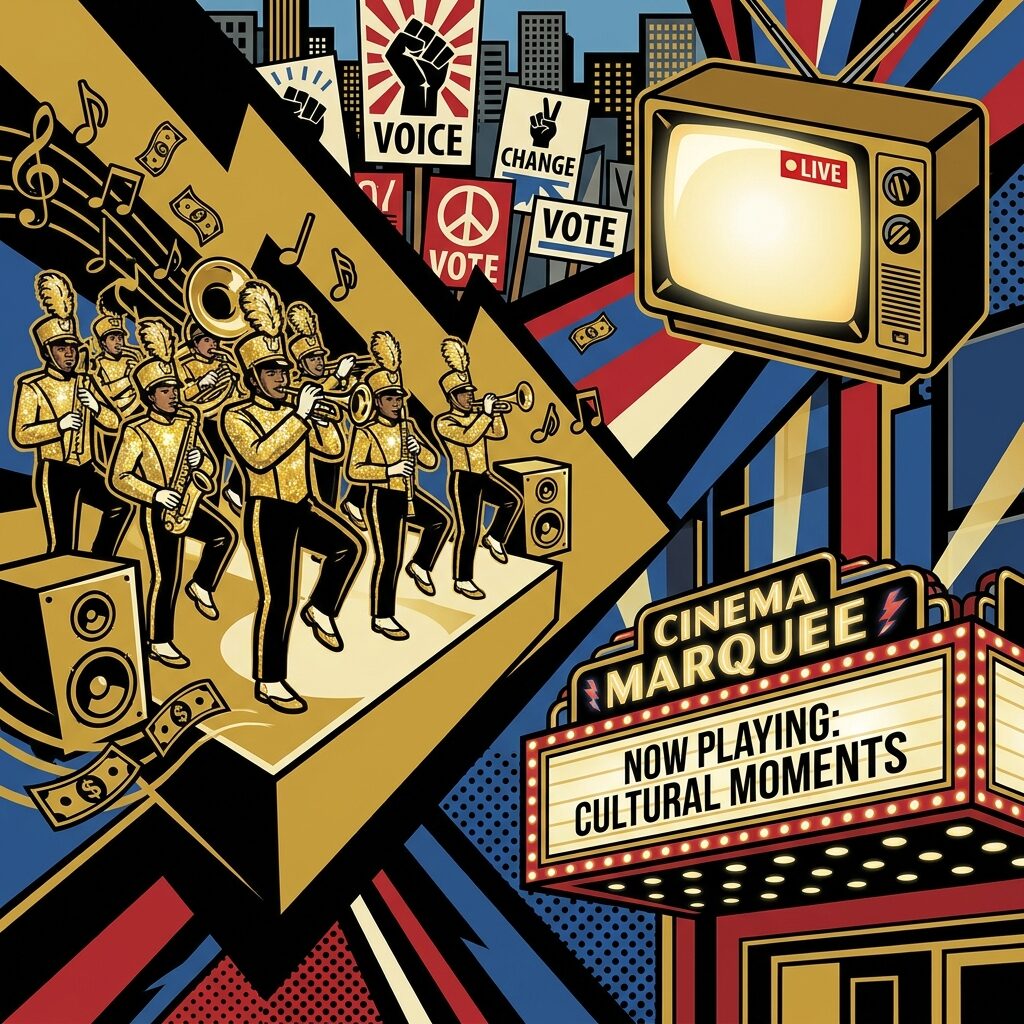
A song becomes a hit. A song becomes something else entirely when it starts showing up in places its creators never planned for it.
The Grammy performance in February 2006 was peak mid-2000s Kanye spectacle, the kind of thing that only makes sense if you remember this was a man who genuinely believed every stage was too small for what he had to say. At the 48th Grammy Awards, Kanye and Jamie Foxx led opposing marching bands in a mock football halftime show. Dancers in gold bikinis played the “gold diggers.” Others marched as “Broke Phi Brokes”, Kanye turning his own song into a full theatrical production number that played like homecoming at a college that only existed in his head. It was ridiculous and completely committed, which is basically the whole Kanye thing in two words.
A few months earlier, in October 2005, he’d performed “Gold Digger” on the Season 31 premiere of Saturday Night Live with A-Trak and a mini-orchestra, transitioning into “Touch the Sky.” This was the moment Kanye went from being a rapper who performed on TV to being an event, where the performance itself became the story people talked about the next day. He’d go on to perform at the Brit Awards and the MTV Video Music Awards in 2006, escalating the production each time.
Then Spike Lee got hold of the song. In Inside Man (2006), the uncensored version plays as a bank clerk’s ringtone during a hostage scene. The phone goes off at the worst possible moment, Dalton Russell, Clive Owen’s character, hears it after the hostages were supposed to have surrendered their devices. On one level it’s a plot beat. On another, it’s Spike Lee doing what Spike Lee does: letting a song about money and manipulation play inside a movie about a bank heist, trusting the audience to catch the irony without spelling it out. A gold digger’s anthem scoring a film about people literally digging for gold.
But the most loaded cultural moment tied to “Gold Digger” wasn’t planned by anyone. After Hurricane Katrina, a mash-up circulated online titled “George Bush Doesn’t Care About Black People,” combining audio from Kanye’s infamous live television outburst with the “Gold Digger” beat underneath. The song became a delivery mechanism for political anger, its rhythm carrying a message that had nothing to do with prenups or 18 years, and everything to do with systemic neglect. The beat was familiar enough that it lowered the barrier to engagement. People who might never have watched the raw NBC clip heard the mash-up and absorbed the message through a hook they already knew.
The sampling afterlife is massive. Over 30 subsequent tracks have sampled “Gold Digger,” including Jimmy Fallon and Justin Timberlake’s “History of Rap” medley, Girl Talk’s “Summer Smoke,” and High Contrast’s drum-and-bass remix. Lil Wayne freestyled over the beat for his mixtape The Suffix. The Automatic covered it at the Reading and Leeds Festivals. There’s even a lullaby rendition for infants, which is how you know a song has been fully absorbed into the culture, when it goes from spoken-word poem to nursery music.
Shea Serrano put the legacy in perspective: the song “helped revitalize sampling soul music, it stitched together pop music themes generally attributable to the easily ignorable ‘conscious rap’ quadrant… and it created a precedent for the larger-scale gazing he’d go on to do.” The Kanye experiment, Serrano concluded, “was no longer an experiment, it was a business model.” “Gold Digger” was the proof of concept. Everything after, Graduation, 808s, My Beautiful Dark Twisted Fantasy, the fashion empire, the stadium tours, ran on the commercial credibility this song built.
The Voice from a Hospital Bed
The “Bumpin’ Bus Stop” sampling lawsuit put a face on what uncleared samples actually cost. David Pryor, suffering from dementia in a hospital bed, never knew his voice appeared on “Gold Digger.” His children spent years navigating probate before they could even file suit.

Every sampling story has a human being on the other end of it. “Gold Digger” has one that’s genuinely grim.
Buried in the production is a 13-second vocal sample from “Bumpin’ Bus Stop,” a 1974 track by Thunder and Lightning. The sampled portion features David Pryor’s voice exclaiming “Get down” three times, a small, almost subliminal element in the mix. But the sample wasn’t cleared.
When “Gold Digger” released in 2005 and started climbing every chart in sight, David Pryor was in a convalescent hospital. He was suffering from senile dementia, cerebrovascular disease, prostate cancer, epilepsy, and diabetes. He never learned his voice had been sampled. He died in 2006.
It took six years for Pryor’s estate to be probated, reaching completion in 2011. His children, Trena Steward and Lorenzo Pryor, obtained the necessary information to pursue a case in 2012 and filed a copyright infringement lawsuit in Los Angeles County Superior Court in April 2013, naming Kanye West, Roc-A-Fella Records, The Island, and Def Jam Music Group as defendants. They sought $150,000 per infringement plus attorney’s fees, and asked the court to halt sales of “Gold Digger.”
West’s legal team attempted to dismiss the suit, arguing the sample was too small to constitute infringement, a common defense in sampling cases that turns on whether the borrowed material is recognizable enough to merit protection. According to RadarOnline, the case reached a conditional settlement in October 2014, with undisclosed terms that had not been “fully performed” at the time of reporting.
Compare that to how the other samples on this same track were handled. The Ray Charles “I Got a Woman” sample was properly licensed through Atlantic Recording Corp. Jamie Foxx’s interpolation, re-performing Charles’s melody rather than using the recording directly, functioned partly as a hedge in case the original sample clearance fell through. So on one song, you have a sample that navigated the system cleanly and another that involved a man who died without knowing his voice was on the biggest hit in the country. That gap tells you most of what you need to know about how uneven the sampling process can be.
Best Rap Solo, Not Record of the Year
“Gold Digger” won the Grammy for Best Rap Solo Performance but lost Record of the Year to Green Day, continuing the Grammys’ long habit of overlooking hip-hop. It swept the BET Awards and landed on nearly every best-of list of the 2000s.
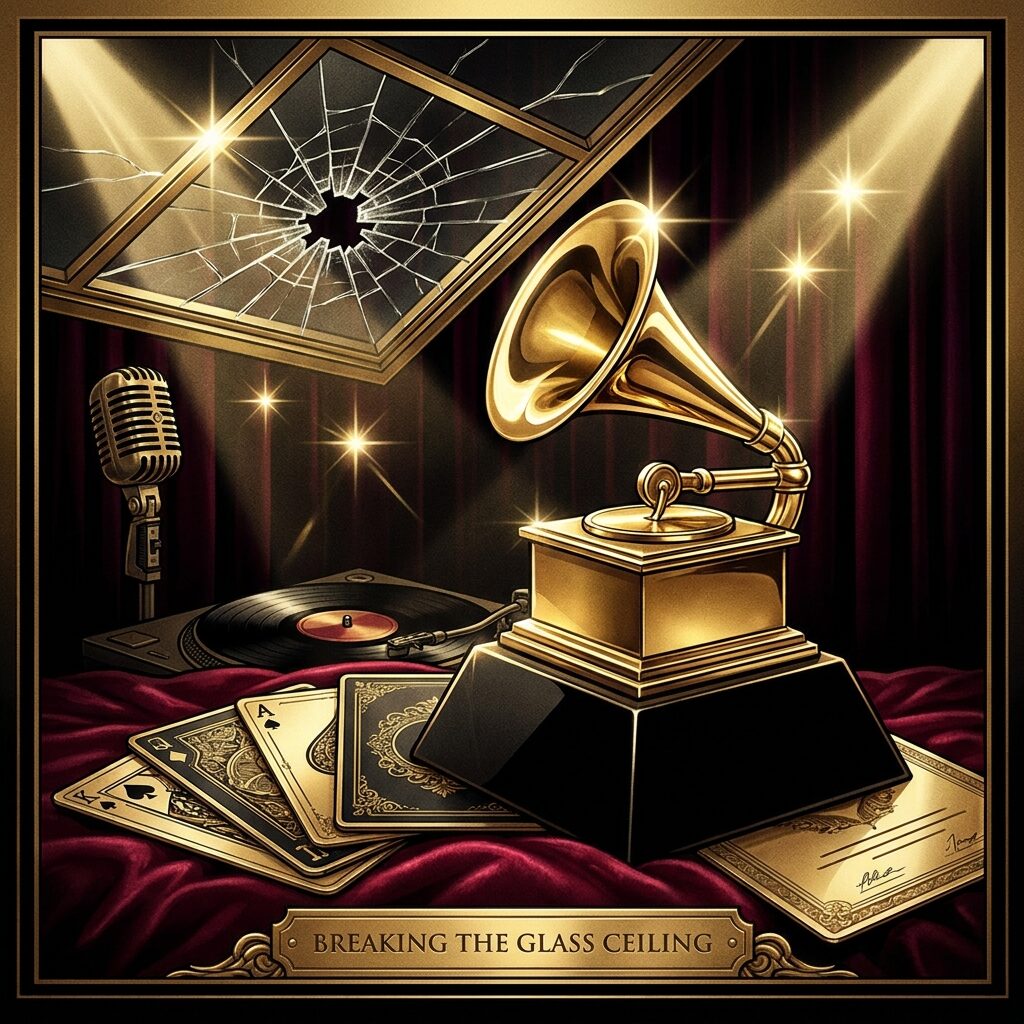
At the 48th Grammy Awards in February 2006, “Gold Digger” won Best Rap Solo Performance. It was also nominated for Record of the Year and lost to Green Day’s “Boulevard of Broken Dreams.” Think about that for a second: a ten-week #1 pop-rap crossover that sold millions of copies and changed how people bought music lost the top Grammy to a rock ballad. The Grammys had been snubbing hip-hop for years, and 2006 was no exception. They’d get better at this eventually, but not yet.
The BET Awards were a different story. “Gold Digger” swept: Video of the Year, Best Collaboration (with Jamie Foxx), and Best Director for Hype Williams, whose video featured pin-up girls and moving magazine covers alongside West and Foxx. It also took Hot Rap Track at the Billboard R&B/Hip-Hop Awards, awards from BMI in both the R&B/Hip-Hop and Pop categories, Best Rap/Hip Hop Dance Track at the International Dance Music Awards, and Best Single at the MP3.com Awards.
The song kept showing up on lists for years afterward. Shea Serrano named it the most important rap song of 2005 in The Rap Year Book. Time magazine placed it on its Greatest Songs of All Time list. Rolling Stone ranked it #36 on their Greatest Songs of the 21st Century. NME put it at #93 on their Greatest Song of All Time list and #40 on their Best Songs of the 2000s. Slant Magazine had it at #34 for the decade. Robert Dimery included it in 1001 Songs You Must Hear Before You Die. Entertainment Weekly called it the best single of 2005 in their 1990–2014 retrospective.
By any measure, it’s one of the biggest songs of the 2000s. And through all of it, Kanye’s own feelings about the track apparently never caught up. He made a song he didn’t like, revised it obsessively for two years, and watched it become one of the most awarded and critically acclaimed hip-hop tracks ever recorded. The world loved it more than he did. That’s a very Kanye problem to have.
The Accidental Masterpiece
Gold Digger tells you something real about Kanye’s process: not lone genius, but relentless revision, knowing what to keep, what to kill, who to call, and rewriting everything at the last minute because it still wasn’t right.
So let’s trace the whole improbable path one more time.
A spoken-word poem with a murder punchline, performed on Def Poetry Jam in 2003. A beat built at Ludacris’s house in Atlanta for a female rapper named Shawnna who said no thanks. A hook rewritten from first-person female to first-person male. A second verse written on one tour, a first verse on another, a third verse borrowed from a Murphy Lee cut. A screening of a Ray Charles biopic with John Mayer that sparked the Jamie Foxx idea. Multiple recording sessions where Foxx’s vocals kept getting scrapped. A new-wave touring musician from Connecticut who’d never touched a rap record, connected through Rick Rubin, finishing basic tracks in a single session. A championship DJ putting a phaser pedal on his turntable scratches to solve a problem the producer couldn’t solve alone. A mixing engineer named Mike Dean. A mastering engineer named Vlado Meller. And a final verse, the one that makes the whole song mean something, written right before the single shipped.
All of that became the biggest pop-rap hit of 2005. Ten weeks at #1. Nine million copies. 8× Platinum. Grammy winner. Top 40 song of the 21st century according to Rolling Stone. Sampled over 30 times since, performed with marching bands at the Grammys, dropped into a Spike Lee heist film, mashed up with political protest.
What “Gold Digger” actually tells you about Kanye’s creative process isn’t the lone-genius story he sometimes prefers. It’s more interesting than that. He’s a relentless reviser, someone who kept the Ray Charles sample and the “18 years” punchline, killed the murder ending and the Murphy Lee verse, and called Brion when he needed orchestration, A-Trak when he needed credibility, Foxx when he needed the perceptual trick that holds the whole production together. He didn’t write “Gold Digger” in a flash. He worked it over two years, and every revision made it sharper.
And then there’s the gospel-to-pop pipeline, which runs through this song like a nerve. Ray Charles took a church hymn and turned it into secular soul in 1954, and preachers called it blasphemy. Fifty years later, his voice, the actual recording from that WGST radio station in Atlanta, sells the hook on a song about gold diggers, primed by Jamie Foxx’s impersonation of the man Foxx won an Oscar for portraying. Gospel to soul to chipmunk-soul, the sacred repurposed three times over, each generation scandalizing the last.
The final irony is the one that follows Kanye everywhere. He resents his biggest hit. This is also the song where his taste was sharpest, where his collaborative instincts fired on every cylinder, where he kept revising past the point most producers would’ve called it done. He dropped the murder punchline because it didn’t work. He moved on from Shawnna’s version because the frame was wrong. He threw out his own third verse because it wasn’t good enough. He brought in scratches, Brion’s synths, Foxx’s voice up front. Every call was right. And then he told Zane Lowe he never really liked the result.
Maybe that’s the most honest thing he’s ever said about his own work. The best pop songs aren’t always the ones their creators love. Sometimes they’re the ones where every accident, every rejection, every last-minute rewrite just happens to land, and the person responsible is sharp enough to recognize it, even if he doesn’t want to live there. “Gold Digger” isn’t a song that was written so much as assembled, piece by piece, over years. And the guy who assembled it still won’t claim it.
🎵 Did you know? Kanye’s “Gold Digger” was originally written for rapper Shawnna with the hook “I’m not sayin’ I’m a gold digger” — she passed on it. It became a 10-week #1 hit. 🎤 #KanyeWest #GoldDigger #HipHop https://bit.ly/4cT48w2

Click to Tweet